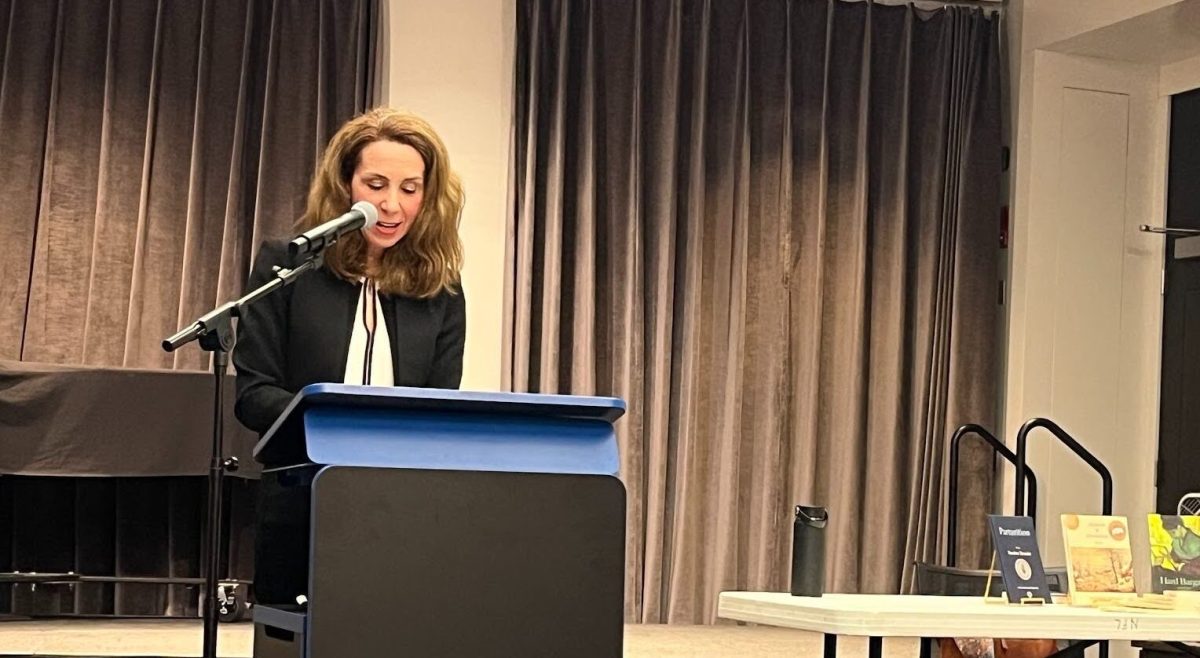
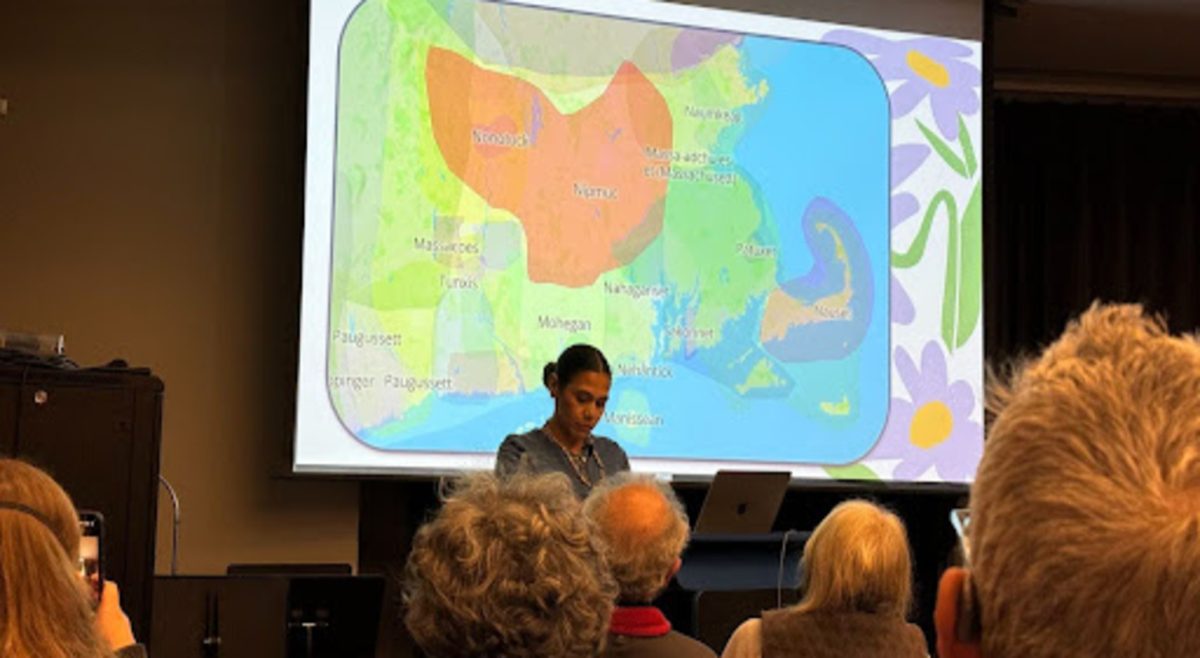
The Newton Free Library hosted Kimberly Toney, an enrolled member of the Hassanamisco Band of Nipmuc, in a Newton History Series event on Thursday.
In the talk, which was co-sponsored by Historic Newton and Newton Free Library, Toney explored the impositions, impacts, and legacies of early 17th-century documents signed by Native Americans.
“The heart of this talk is land as an archive,” Toney said. “When we think of archives, we often imagine buildings, libraries, rooms full of boxes and folders—but for Indigenous peoples, land itself has always been an archive.”
Having worked in special collections libraries for more than 15 years, Toney is the appointed inaugural coordinating curator of Native American and Indigenous collections at various libraries at Brown University and co-chair of the newly formed Nipmuc Community Land Project.
“I think about how special collections and libraries help us understand Indigenous histories, especially in the Northeast, and how these materials are cared for, stewarded, described, and accessed,” Toney said.
Talking from both lived and professional experiences, Toney discussed the history of the traditional homelands of the Nipmuc people across present-day central and western Massachusetts, northeastern Connecticut, and northwestern Rhode Island.
“Much of what I’ll talk about today connects especially to the systematic dispossession of Native lands before, during, and after a conflict commonly referred to as King Philip’s War, which took place from 1675 to 1676,” Toney said. “Its violence and consequences continued for decades after it ended, and its legacies are still very much present across the landscapes and the community still today.”
Indigenous histories are not only written on paper, but also embedded in place, Toney revealed. For many, Indigenous homelands are still alive with knowledge, where meaning is carried through movement, naming, and relationship.
“Landscapes hold memory—rivers, planting fields, village sites, trails, and burial grounds encode knowledge about governance, about kinship, spirituality, and reciprocal care,” Toney said. “When land is taken, fenced off, sold or polluted, that archive is not just disrupted, it’s attacked.”
Toney connected the loss of land to the deeds and documents that English settlers often used to negotiate for land. Toney urged the audience to consider how information is uncovered and evaluated.
“When I speak tonight about documents, deeds, petitions, and treaties, I want to hold them in tension with another archive, which is the land itself,” Toney said. “Colonial paperwork did not simply record dispossession—it attempted to overwrite Indigenous memory systems and assert that only one kind of archive, one kind of evidence, mattered.”
Toney described that Native leaders may have understood deeds as agreements to share access or allow limited use of their land, but the documents were treated by colonists as an absolute cessation of rights. Deeds, such as the Deed for Boston, were able to legitimize settler claims and erase Indigenous presence. They were drafted entirely in English legal language, which many Indigenous people did not fully understand.
“The written archive in New England overwhelmingly reflects colonial viewpoints,” Toney said. “Native voices appear, but usually in fragmented, mediated or distorted form, filtered through a particularly non-Indigenous lens.”
Toney also warned of the dangers of archival silencing, which are the ways archives fail to represent and preserve the perspectives of certain communities, most often those marginalized by systems of power.
“When I talk about archival silencing, I mean both what was left out and what was included in ways that distort Indigenous presence,” Toney said. “Acknowledging that archives are not neutral is not an indictment of history itself. It’s an invitation to read critically, to recognize deception, and to understand how power shaped what was preserved.”
Archival silencing is most often represented in phrases such as “and the rest is history,” which implies that settlers arrived and purchased land while Native people faded away, explained Toney.
“This narrative assumes Indigenous disappearance was inevitable and complete,” Toney said. “It leaves no room to interrogate the processes of warfare, confinement, coercion, and imposition of foreign legal systems that made that disappearance appear natural.”
Movements such as the Land Back movement advocate for not only the return of land, but also the return of sovereignty, the honoring of treaties, and the restoration of Indigenous stewardship practices, Toney explained.
“We have learned in school and in this society to obey the laws that have been imposed by the people who arrived here in the 1600s and came afterward,” said Vicki Danberg, an audience member. “We are ignoring the thousands of years before that, and the people who had their own structure and way of living that worked for them for all that time until the Europeans arrived.”
Toney’s project, “Their Marks,” pushes back against archival silencing by using the archive itself to tell a different story—the lives and experiences of Indigenous peoples and the marks they left behind.
“It’s not only about the return of territory—it’s about restoring relationships to these living archives, honoring Indigenous sovereignty, reasserting stewardship, and carrying memory forward into the future,” Toney said.