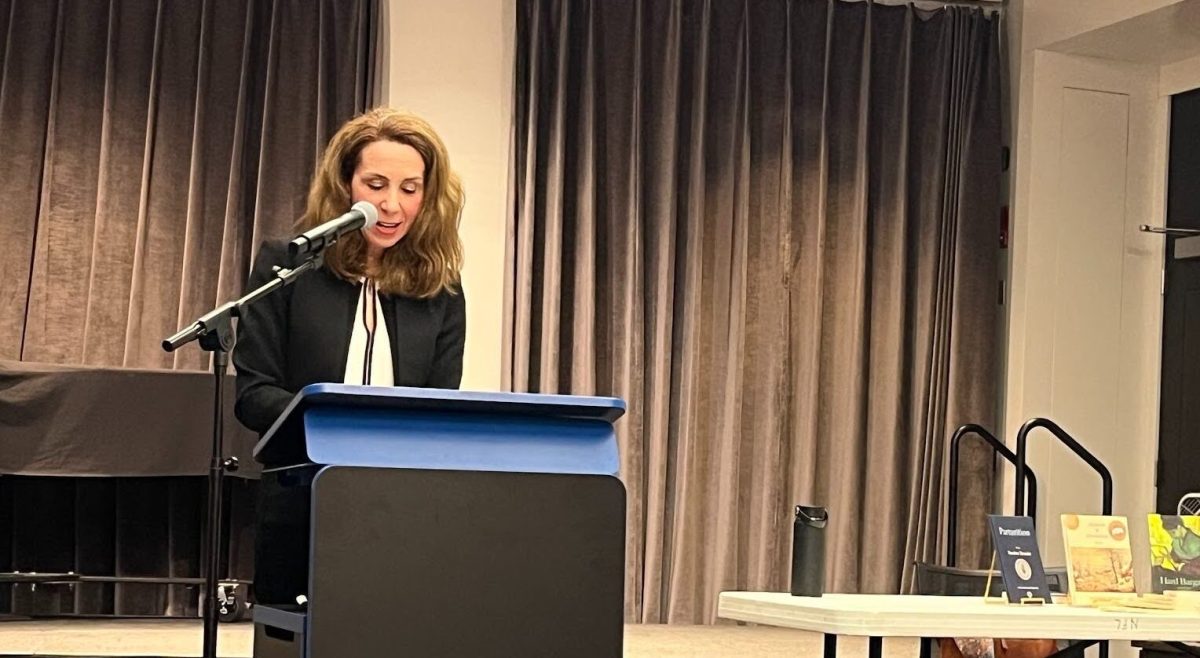
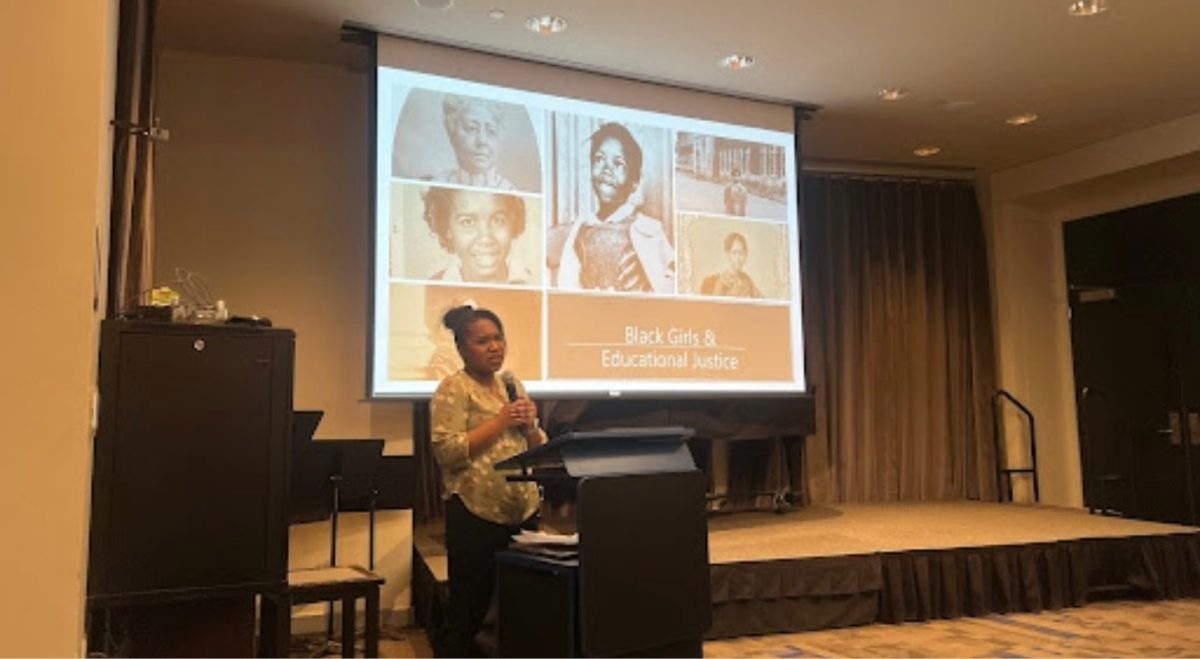
Residents gathered at the Newton Free Library on Wednesday to hear Kabria Baumgartner, an award-winning historian of early U.S. history, discuss the legacy of racism in Massachusetts public education.
As part of the Newton History Series, Baumgartner focused on the struggle of Black women activists to pursue an education.
“Going to school, which for a lot of people is a very simple act, is actually a death-defying act for someone like that,” Baumgartner said, referring to civil rights activist Ruby Bridges.
Most of Baumgartner’s lectures, however, focused on the pioneers and activists of the 19th century, with a focus on Maritcha Remond Lyons, Sarah Parker Remond, and Josephine St. Pierre Ruffin, as opposed to the more commonly known figures of the Civil Rights Movement.
“These 20th-century stories are linked to 19th-century stories,” Baumgartner said.
Baumgartner also argued that these female pioneers’ stories are worth telling so that people can fully grasp the struggles Black women endured in pursuit of an education.
“The historical record doesn’t even allow me to fully calculate that cost,” Baumgartner said of the experiences of the three activists.
A common thread within the lesson was the city of Salem, Mass., where both Ruffin and Remond attended school. Both women recounted and documented their experiences of both verbal and institutional racism within the town.
Remond attended Salem’s high school for girls that required an admissions exam. This did not stop the Salem residents from petitioning for her expulsion.
“They said that her success was an injury to their white daughters and the entire white Salem community,” Baumgartner said.
Also occurring in Salem, Baumgartner revealed to the crowd her research that the “separate but equal” doctrine had early origins in the town.
“The town of Salem could create separate schools for Black children, so long as it provided equal means of instruction,” said prominent Salem lawyer Leverett Saltonstall in a document uncovered by Baumgartner.
Baumgartner emphasized the significance of this document, as it proved that the “separate but equal” doctrine existed much earlier than previously thought. As for Salem, they adopted the doctrine and established separate schools.
“I analyze Saltonstall’s opinion as a betrayal,” said Baumgartner, who would say the policy resulted in Black people being under the whim of a white administration.
The discrimination of the mid-1800s spread beyond Salem to Boston, as Ruffin endured cruel treatment in her integrated school.
“They questioned her intelligence and hurled racial epithets at her,” Baumgartner said.
With all of the women, however, there were common threads of progress that Baumgartner and members of the audience believed should be celebrated.
“I think just the fact that there were so many—this is just a small representation of a huge number of Black women who strove to get an education and how difficult it was for all of them,” said audience member Audrey Prager.
Another audience member, Steve Jakob, added that personalizing the struggles through the three women’s stories was helpful.
“She put a personal face on good,” Jakob said.
As for Baumgartner, stories like theirs are key to continuing their legacy.
“We should celebrate the fortitude and perseverance of Black girls in the fight for equal school rights in the 19th century and in the 20th century, and sadly even in the 21st century,” Baumgartner said.
The history of racism in the Massachusetts schooling system is riddled with systematic repression of education for African Americans. Baumgartner argues that their stories are not inspiring and interesting, but key to continuing the fight they sacrificed for.