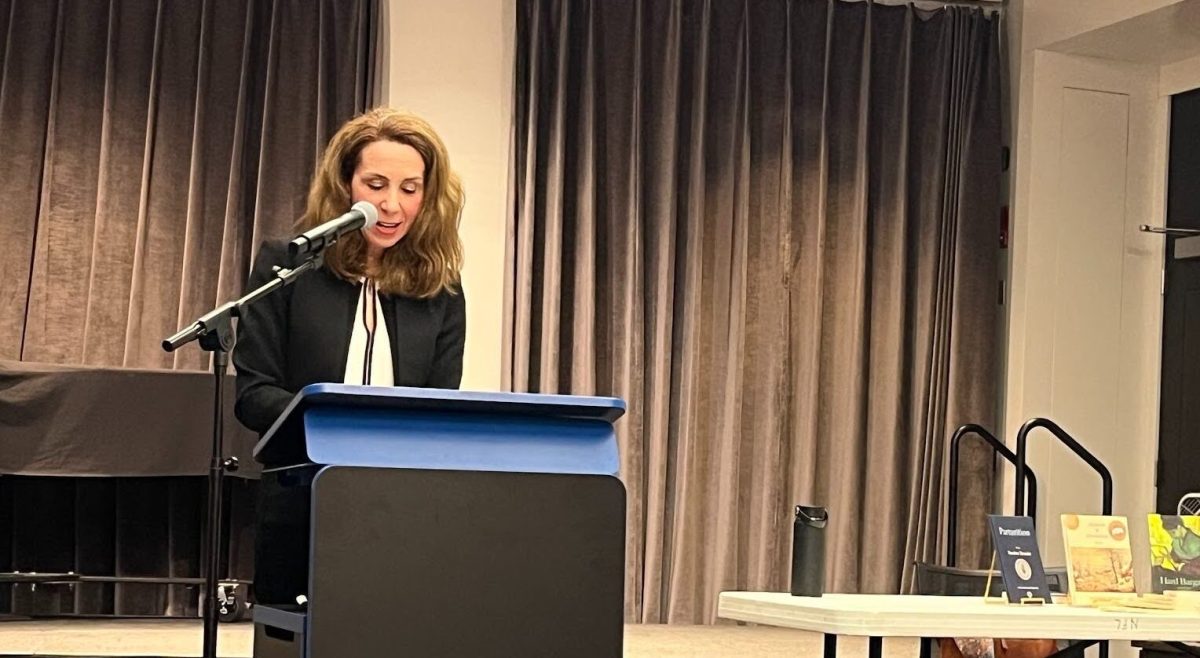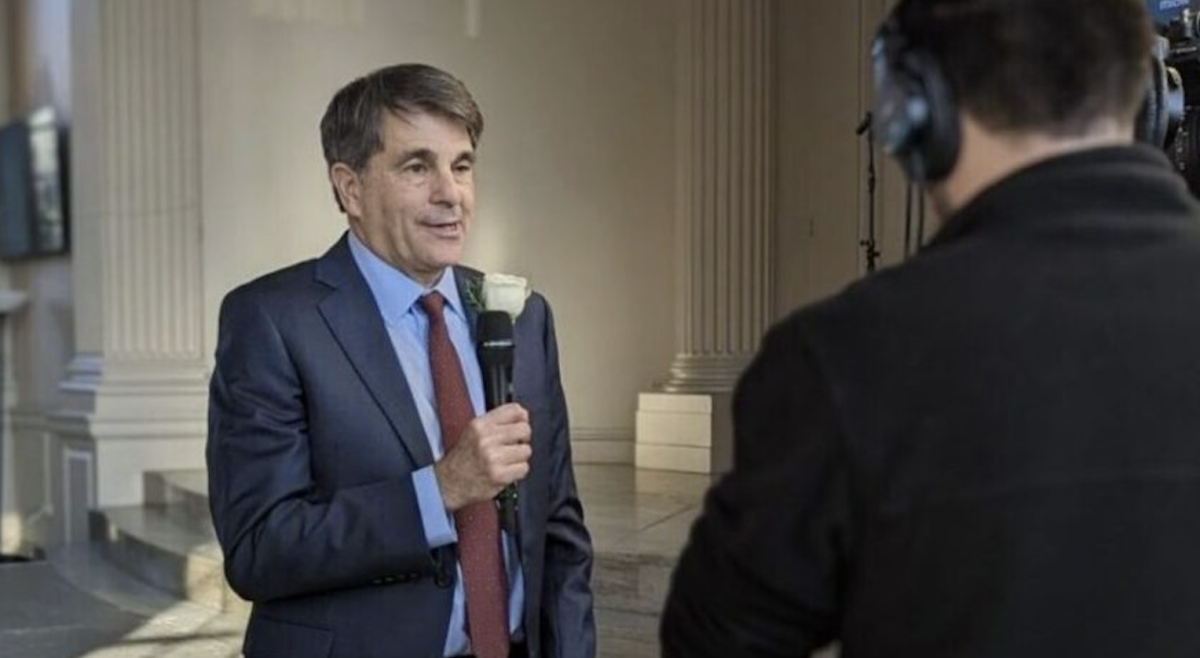
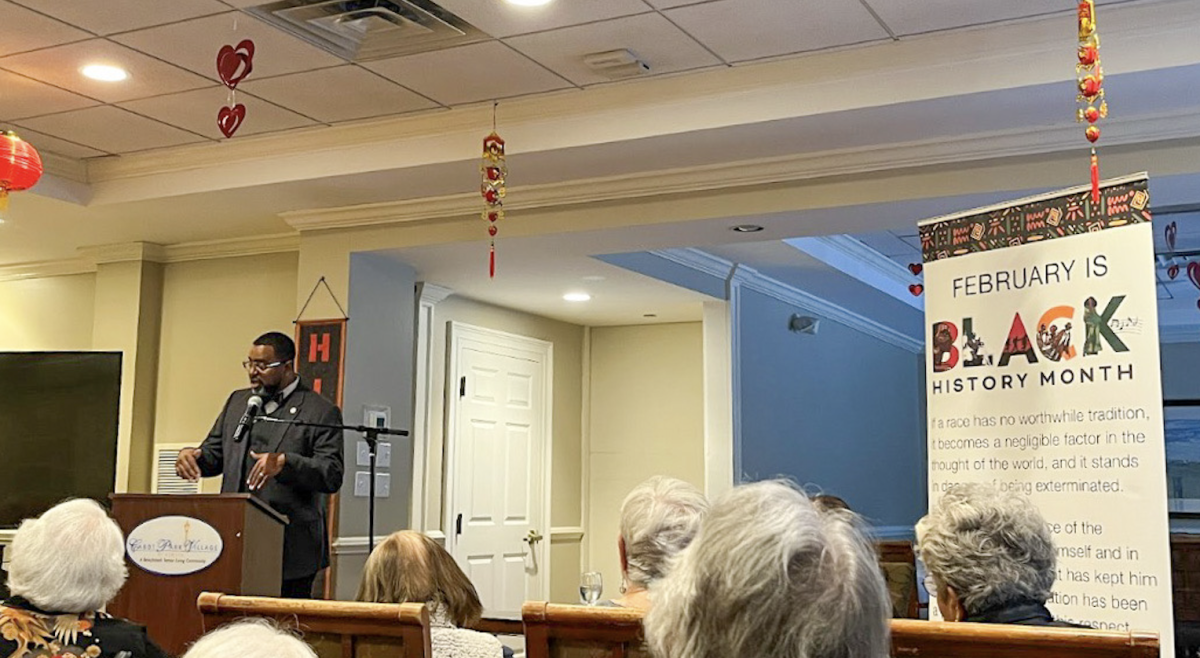
Speaking to residents of a Newton retirement community on Wednesday, civil rights advocate Rahsaan D. Hall drew a direct line from slavery to mass incarceration, warning that the nation’s failure to confront its past harms its future.
“Let us place a marker here today that we will tell our histories, that we will tell the story of our ancestors, our champions, of our heroes, and the common people who made up the malaise of their everyday lives,” Hall said. “For it is what gives us inspiration, conviction, hope, and salvation.”
Hall is the current CEO and president of the Urban League of Eastern Massachusetts, a non-profit that helps underprivileged adults access economic opportunities through free training, internships, and job placements.
As a past director of the Racial Justice Program of the Massachusetts American Civil Liberties Union, Hall made a name for himself in the contemporary civil rights movement and was a fitting speaker for the ongoing Black History Lecture Series at the retirement community, Cabot Park Village.
The focal point in Hall’s speech was a road trip he took with his father two years ago, starting in Savannah, Ga., and ending in Boston.
“It was an amazing journey, filled with rich history, memories, explorations, wanderings, and love,” Hall said. “Most of it was planned, but a lot of it was impromptu.”
Before the road trip, Hall took an interest in researching his lineage on Ancestry.com.
“I was able to trace my family on my father’s side back to the 1870 U.S. Census, which was the first U.S. census to report Black people in the state of Georgia after the end of slavery,” Hall said. “But I couldn’t get any further than the 1870 U.S. Census.”
One trip detour was visiting a professor named Douglas Blackmon, author of Slavery by Another Name. The book explores a loophole in the 13th Amendment that still allows for the unpaid forced labor of incarcerated people.
“Many Southern states began enacting Black codes, or state laws that criminalized the conduct of Black people with the aim, at worst, or the consequence, at best, of incarcerating Black people who would subsequently be leased out by correctional institutions, whether it was the local jail or the state prison to farms and plantations,” Hall said.
Blackmon was working on a project at Georgia State University to find the ancestors of those who were victims of convict leasing. Many of them died early as a result of inhumane conditions and continued forced labor, making it harder for their descendants to trace their lineages.
Hall sang a portion of a traditional hymnal that his cousin recalled their grandmother singing, called “Sweet Home.” Hall explained that these lyrics felt even more moving when he visited the graves of his grandparents, both buried in segregated cemeteries. Hall’s father later returned to place a proper headstone on his mother’s grave.
“Bigotry and racism still reach beyond the grave and have a stranglehold on this nation,” Hall said. “History, custom, and family relations all conspired to result in the de facto segregation that made my grandfather’s final resting place bear the legacy of this nation’s racist existence.”
Hall transitioned to how Black Americans have persisted in the fight against inequality for generations, noting that Black resistance has always played a role in preserving democracy. He added that it was dangerous to erase Black history, alluding to the Trump administration’s orders to remove slavery exhibits at national parks and the administration’s backlash aimed at Black history in education.
“In this present moment, disputes over voting access, executive authority, curriculum, protest rights, radicalized rhetoric, and the boundaries of federal power echo earlier periods of democratic stress,” Hall said. “The memory of these historical figures is not just nostalgia, it’s instruction.”
In a Q&A, Hall and audience members explored topics like the vilification of diversity, equity, and inclusion initiatives, current civil rights leaders, the value of young people voting in local elections, and the importance of protest as visible dissent arose.
Hall expanded the civil rights conversation to reference the heightened U.S. Immigration and Customs Enforcement violence in the country.
“What we’re experiencing is not okay, and people are standing out and coming out in droves to protest what is happening, and I think that is the point,” Hall said. “It’s not that every time we fight, we get the victory. It’s the act of fighting itself as resistance, and there’s victory in resistance.”