Ireland isn’t always considered a heavy-hitter on the global stage.
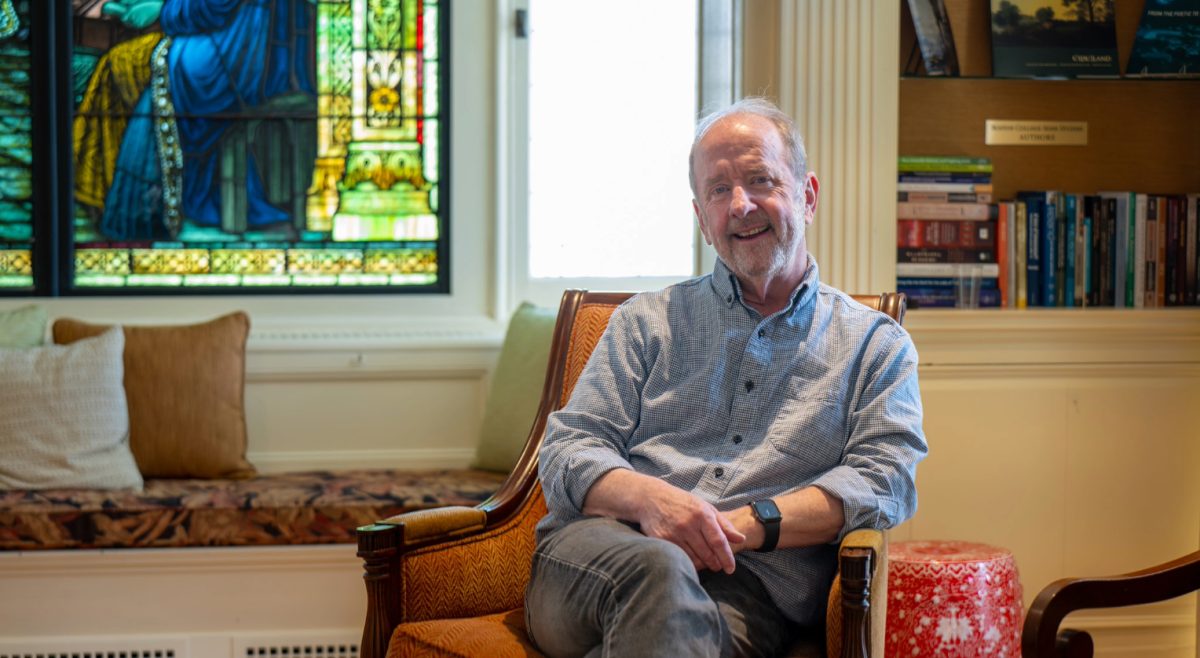
Even Boston College’s Robert Savage, a member of the history and Irish studies faculty and scholar of modern Irish, British, and Atlantic world history, acknowledges this reality.
“It’s tiny,” Savage said. “It’s a small country. It has no significant military.”
Yet Savage, who has made it his life’s work to study the complexities of 20th-century Ireland, believes that the Emerald Isle “punches above its weight” in terms of global influence and lasting legacy.
Last November, the National University of Ireland awarded Savage an honorary Doctor of Literature degree for his publications focusing on the country and its history.
Savage’s publications concentrate on the role of broadcast media during the Troubles, a period of sectarian conflict in Northern Ireland that spanned from the 1960s to the 1990s.
His interest in the field began as a high school and college student.
“There wasn’t the kind of multiple, you know, fractured media landscape that we have today,” Savage said. “The news that was broadcast every night here in the U.S., or in Australia, or France, or England, would cover events all over the place.”
Savage, watching from the United States, took a special interest in the two-to-three-minute sections that provided updates on the violence in Northern Ireland.
“I was always fascinated by how those reports were put together,” Savage said. “And what I found myself doing is going into the archive and reading how reporters, cameramen, editors, and managers all decided what could be broadcast and how it could be broadcasted.”
Savage found many troubling accounts of tension as independent media correspondents, such as the British Broadcasting Corporation (BBC), clashed with political and governmental groups while reporting on the conflict.
“The British government was always sensitive about how the BBC—whether it was television or radio—would report on the conflict in Northern Ireland,” Savage said. “The British government was always focused on trying to encourage a narrative that presented London as peacemakers, trying to keep warring sides apart.”
According to Savage, this narrative came into direct conflict with how many broadcasts covered the Troubles. The BBC, for example, often reported critically on British policy, tactics, and initiatives in Northern Ireland.
On multiple occasions, major backlash followed news reports that expressed any degree of sympathy with the Irish Republican Army (IRA), Savage said.
“[The British government] regarded anybody in the IRA as a criminal, terrorist, and a dangerous person, whereas the BBC was trying to understand what motivated the IRA, why they were using violence, and why they had support from their communities,” Savage said.
Savage’s two most recent books examine the role of the BBC during the Troubles.
Dominic Bryan, a professor at Queen’s University Belfast, praised Savage’s 2022 publication, Northern Ireland, the BBC and Censorship in Thatcher’s Britain.
“One of the things I love about Rob’s work is that he represents the relationship between both Britain and Ireland by taking both states very seriously,” Bryan said. “In other words, if you look at his work on the BBC, he understands the impact that Ireland has had on an institution which is at the core of the United Kingdom and Britain, and is, in fact, also hugely influential in Ireland.”
Byran isn’t only an expert with an experienced view of Savage’s research. He also played a key role in helping Savage uncover the realities hidden behind the BBC’s polished broadcasts.
“I happened to be a filing clerk in the BBC at the time—it was sort of my first summer job when I was a student, and I was looking at all of these files for the director general,” Bryan said. “So I always smile because that means that Rob is looking at the papers that I had originally filed.”
Bryan pointed Savage toward moments that had been especially tense between the company and the British state—moments that, at times, brought up complicated ethical dilemmas.
“So the BBC, Rob writes, attempts on a number of occasions to dig deep into the Republican movement to understand it, which a lot of us would think is a good thing—we need to understand it,” Bryan said. “But of course, that means you’re putting the views out of people who were killing British soldiers.”
Bryan looks back on his long-lasting relationship with Savage with appreciation.
“Not only has he been an important figure in developing aspects of his history on Ireland, but he’s been an important figure in Irish studies generally, and an important figure across the Atlantic, with the amount of work that he’s done,” Bryan said.
Beyond his publications, Savage presents the unique role of media in Ireland to his classes at BC.
In one case, students studied how, in the 1960s, CBS was developing a documentary on Ireland. Based on archival material, students learned that the Irish government fought against the network, arguing for a more positive portrayal of the country.
“CBS was saying, ‘We want to look at Ireland as it is, not as how you’d like it to be,’” Savage said. “’So we’d like to talk about immigration and poverty and the challenges the government faces regarding Northern Ireland.’”
Every time Savage returns from an archive in Ireland or the UK, he brings back digital copies of documents for BC undergraduates to analyze.
“Instead of just reading a textbook, students are able to read these correspondences to get a sense of what was really going on,” Savage said.
Savage attributes much of this hands-on teaching approach to BC’s academic environment, explaining that the University has funded his faculty fellowships in Galway, Edinburgh, Belfast, and Dublin over his last three decades as a professor.
“BC is a great place to work because the University understands scholarship and really invests in its faculty,” Savage said. “They’re all about getting away so you can do the research needed to write books, but also to teach better courses.”
In Savage’s opinion, his recent successes can be traced back to BC’s devotion to thoughtful scholarly output. His honorary doctorate was facilitated, at least in part, by their investment.
“It’s wonderful to be recognized, but it’s imperative to also recognize that the award wouldn’t be possible without the help of BC,” Savage said.
As a Boston native, Savage brings a foreign perspective to the field of Irish studies.
“As an outsider, you don’t grow up in that society, so you don’t experience things the way that Irish citizens might,” Savage said. “You come with a different kind of perspective, and I think that can be rewarding, but it can also be a challenge.”
Rowan Bianchi, a Ph.D. candidate and teaching assistant in BC’s history department, agrees that an American background can make for both a unique yet rewarding experience—especially in BC’s Irish studies program.
“One of the reasons I wanted to come to Boston College to study Irish history was because I knew that BC has this really interesting position where we have all these connections in Ireland,” Bianchi said. “We’re outsiders, but we’re outsiders that have a specific reputation.”
Although Bianchi’s research focus predates Savage’s by almost a century, the two have still crossed paths in the Irish studies program. They spoke to his wealth of resources in terms of primary documents.
“While he mostly does stuff on broadcast, he’s also really knowledgeable about newspapers, which are a major source that I use,” Bianchi said.
With a lifetime’s work in media studies, Savage has gained a reputation among his peers for a deep understanding of 20th-century news networks.
“We always joke that he’s the founder of ‘BBC studies’ here because he’s such an expert on them,” Bianchi said. “I swear, he knows every employee that worked there during the 1970s—could probably list them off the top of his head.”
Savage’s award is not just a reflection of BC’s scholarship, but of his personal commitment to Irish studies, Bianchi said.
“He has been such a force for putting Boston College’s name out there in Ireland,” Bianchi said. “I feel like he’s such a great representative of the best of the best that they have to offer.”
Savage gives credit to the interdisciplinary nature of BC’s Irish studies program.
“Irish studies is not just historians, its faculty are in English, in fine art, in media studies, in philosophy, and in music,” Savage said. “Bringing all those disciplines together enables a more comprehensive understanding of Ireland.”
Ultimately, Savage stresses that there’s always a lesson to be learned from history—especially the history of news and media.
“We get a very sanitized version, oftentimes, of the conflict in the Middle East or in other parts of the world,” Savage said. “But what matters is to be skeptical and to appreciate the need for independent broadcasting that’s free of censorship.”