

What was initially meant to be a temporary, quirky fixture on Newton resident Mark Proctor’s lawn quickly turned into a local landmark and morale boost for Boston Marathon runners.
“I initially thought I’d have that statue up for about one year and that people would hate it,” Proctor said. “It turns out the response in the neighborhood was far more dramatic—and rewarding—than we expected.”
Proctor, a homeowner on the corner of Commonwealth and Grant Avenues on Heartbreak Hill in Newton, decided in 2020 to make a statue out of his beloved 100-year-old maple tree when it could no longer stand on its own.
“It was a beautiful maple tree,” Proctor said. “We had been in the house for 20 years, so we were pretty used to having that tree.”
Proctor always knew that he was going to forge a Boston Marathon commemorative statue out of the tree to complement his family’s annual marathon party, but initially wasn’t sure what form it would take. While he favored the runner from the beginning, he had to persuade his family to embrace the idea.
“I knew that I wanted to make it a runner, but my family was not on board with the decision,” Proctor said. “So we actually went through several different rounds of thinking things like the Greek god of speed, and then we were thinking of an animal, like a puma or something.”
Finding a Worthy Whittler
Once he convinced his family of the runner, Proctor’s next task for the completion of the statue was finding a worthy whittler. After some preliminary research, he contacted a prominent Seattle tree sculptor, who referred Proctor to his tree chainsaw sculptor championship partner Kenneth Packie, a Berkshire craftsman.
Packie, whose typical commissions are animals or fictional characters, relished tackling a human form.
“I’d say the bread and butter I do is going to be wildlife,” Packie said. “Right now I’m working on Bigfoot. People love Bigfoot. They love Sasquatches. So I’ve got two of those to do. I’m doing a Grateful Dead dancing bear. Yeah, a bunch of foxes.”
Packie said he normally hesitates to make a commute as long as the one to Newton but made an exception for this project.
“I had so much work locally, I didn’t really want to commute to Newton and carve that, but they’re super nice people, so I went out there and I took a look,” Packie said.
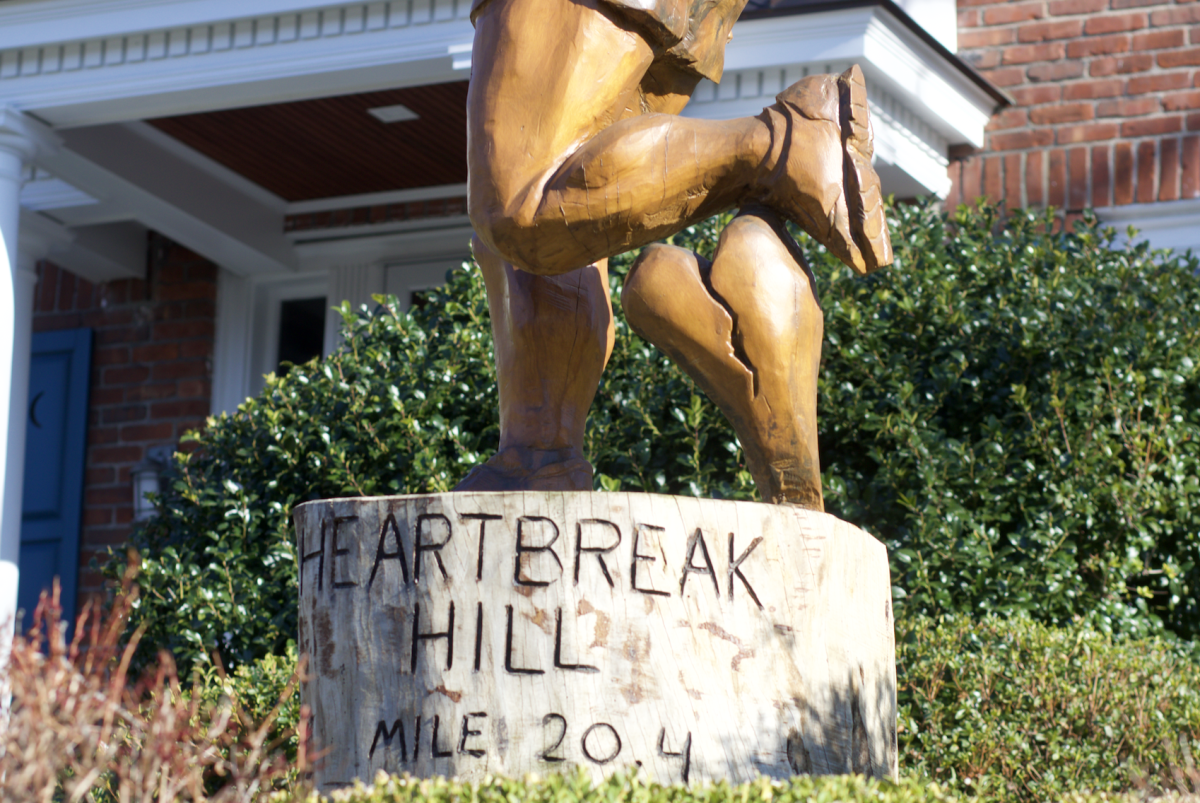
Carving Humanity: The Challenge of the Generic Runner
Normally, Packie is apprehensive about working with maple, but he did it for the purpose of the piece.
“It being maple, it’s a harder wood,” Packie said. “It’s not the kind of wood I normally use. It’s only when it’s something that’s sentimental, like this.”
Another challenge for Packie was the anonymous form of the statue. He explained that carving the generic figure took some effort—a challenge he also faced in carving Boston College’s Holy Family sculpture.
“Human form is the most difficult thing to carve, because even if you’re not an artist, we’re all so familiar with the form, you can tell when something’s off,” Packie said. “And the fact that I had to keep it kind of generic, so it didn’t look like anything was a little more difficult.”
Proctor didn’t want the statue to memorialize anyone in particular—he wanted it to be relatable.
“We weren’t looking to honor any individual or elite runner,” Proctor said. “It was just an homage to the marathon. We would have made it neither sex if that was an option. We just wanted it to be an average runner. As you might be able to tell, it doesn’t look like an elite runner. It’s a very muscular person who probably wouldn’t be super fast.”
Proctor said he was also hesitant to honor anyone in particular in the age of cancel culture. In hindsight, Packie said that he wishes he suggested a highly revered fictional character.
“I knew their concerns about not wanting it to look like anybody, and I wish I would have suggested carving Forrest Gump, like that’s an unassailable character,” Packie said. “He’ll never be canceled.”

A Neighborhood Watches and Embraces the Process
The carving process took Packie five days to complete, totalling roughly 45 hours. Packie said that this project is one of his favorite on-site works he’s done.
“That one was—it ended up being one of the more enjoyable on-site jobs I’ve done,” Packie said. “I got a good energy from doing that piece.”
The statue was erected during the height of COVID-19, so residents closely and excitedly observed its progress, Packie said.
“During COVID-19, everybody was just looking for something like a distraction—they wanted a good, fun story,” Packie said.
Proctor said the statue infused the community with fresh enthusiasm and optimism, a symbol of persevering for life beyond the pandemic.
“People seemed to almost see it as a sign of hope that life would continue, that there would be—the marathon had been canceled that year—that there would be future marathons,” Proctor said. “It was a far more endearing response to the statue than we expected.”
From Quirky Idea to Local Landmark
Proctor was concerned that his vision for the statue would go misunderstood and would culminate in neighborhood backlash.
“I thought maybe after a year, we’d be taking it down due to neighbors’ complaints,” Proctor said. “It was my quirky idea. I didn’t know if anyone else would like it.”
Now that the statue is embraced by the community, Proctor watches it closely and maintains it diligently. He sands and refinishes the top part of the statue twice a year.
“He’s a doting father to the [statue],” Packie said.
Preserving the Statue for Future Runners
Shortly after the marathon this year, the statue will undergo a makeover.
“Because it’s still planted, the base is rotting away, so we have to actually take it down and rebuild the base, because the roots are still planted in the ground, and it’s been slowly deteriorating,” Proctor said. “Now that it’s a landmark on the route, we don’t even feel we could take it down.”
As a result, Packie said he might have to reconfigure the runner’s feet.
“I might even just mount the ankle down on top of a new block and then carve a new foot,” Packie said.
Packie hopes runners feel empowered by the statue.
“I hope it just gives them a smile and just that little bit to push through and get to the finish line,” Packie said. “I wanted to capture the grind that everybody feels trying to get up that hill … And say, ‘Look that guy’s doing it, I can too.’”










Kathy Dullea Hogan • Apr 15, 2026 at 4:32 pm
Terrific innovator, that Mark Proctor, and congratulations to him and his collaborator Kenneth Packie for bringing this unique statue into being along the Boston Marathon route. What a great way of repurposing that maple tree! (This tree/statue can — figuratively and literally — hold its head high!)