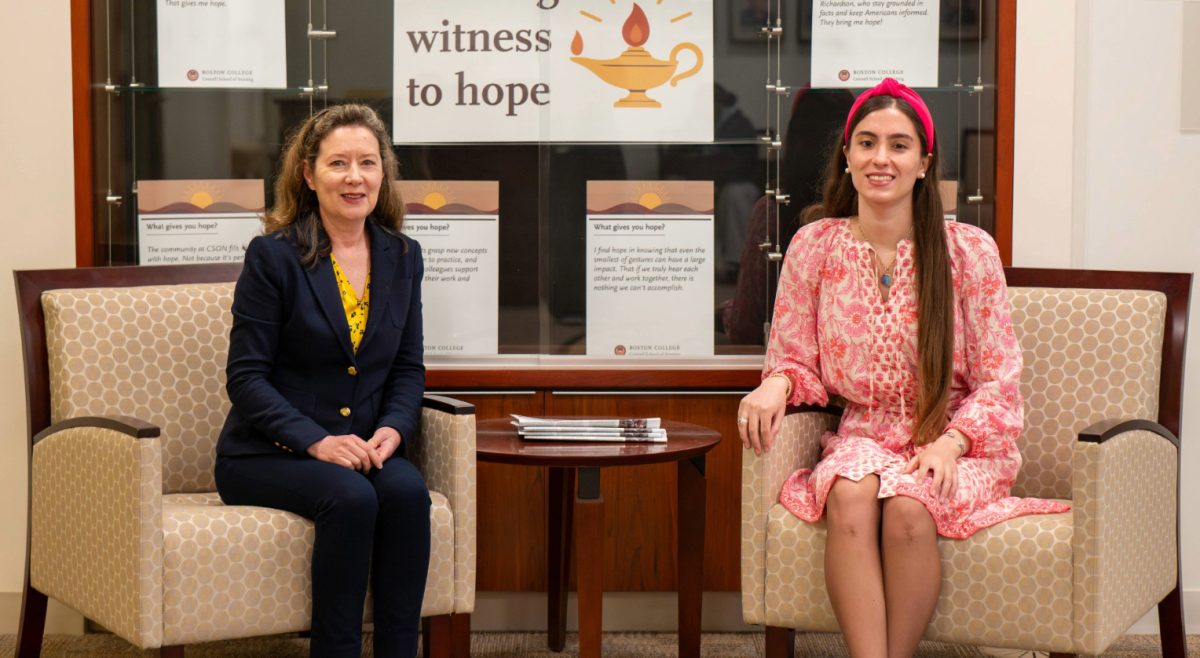
This past March, Karen Lyons, a professor in Boston College’s Connell School of Nursing, traveled to Washington, D.C., representing the Gerontological Society of America to advocate for National Institute of Health (NIH) funding for research supporting older adults.
“I think that it’s a sign of a good society that we take good care of people as they age,” said Lyons.
With a background in psychology, Lyons specializes in dyadic research, which examines both the patient and the caregiver, particularly in home settings.
“We’re now at the point where we have one in four adults in the United States that take care of another person,” she said. “That’s a lot, and it takes a tremendous toll on people, especially if they’re trying to also hold down a job.”
While in the nation’s capital, Lyons met with staffers from the offices of several Massachusetts lawmakers, including Senator Elizabeth Warren.
Specifically, she advocated for an 8.7 percent increase in NIH funding for the upcoming fiscal year—beginning October 1—and the inclusion of the Financial Accountability in Research model, which would guarantee funding for universities’ miscellaneous costs as they engage in critical medical research.
“The indirect costs are what goes to the university to help keep the lights on, the labs up to date, and keep the library running, and that’s what the federal government was proposing to cut down to about 15 percent, which would be completely unrealistic,” Lyons explained.
An 8.7 percent increase in NIH funding would represent a total appropriation of $51.3 billion to fund critical research on cancer, Alzheimer’s, Parkinson’s, and other diseases impacting seniors.
Lyons described her trip to D.C. as a relatively hopeful one, with many legislators understanding the importance of medical research and the main points of contention being specific budget appropriations.
“I would say things were definitely more optimistic and hopeful this year compared to last year,” Lyons said. “I do think there was more optimism around the Massachusetts legislators. Clearly, they understand the importance of research and health to the state.”
Kristyn Stoia, GCSON ’26 and a member of Women’s Health Advocates, brought a personal perspective on her medical condition to Capitol Hill.
Meeting with staff from the offices of Massachusetts lawmakers, including Senators Ed Markey and Warren, as well as Representatives Ayanna Pressley and Jake Auchincloss, Stoia raised awareness for endometriosis—a chronic condition that often results in infertility—and advocated for policy reforms to improve access to effective treatment.
“I can’t do a lot for my body right now, but I can go to Capitol Hill and try to make ablation, excision, more accessible for women,” she said.
Her advocacy is focused on reforming how endometriosis procedures are reimbursed.
Currently, the two most common treatments—ablation and excision—are designated the same for insurance reimbursement purposes, despite differences in complexity and effectiveness.
“Whether you operate for 10 hours or one, the hospital is making the exact same amount of money,” Stoia said. “So there’s no incentive to offer that better surgery. Ablation is like cutting your lawn, and excision is like uprooting your grass.”
Before her diagnosis, Stoia struggled with symptoms that significantly disrupted her daily life at BC.
“There were times when I couldn’t walk across campus, and I was in so much pain,” Stoia said. “I had all these symptoms for so long, none of them really added up.”
The experience, she explained, was not only physically debilitating but also isolating, as she searched for answers without fully understanding what was happening in her body.
In her advocacy, Stoia spoke on her personal experiences managing the condition and offered lawmakers surgical photographs to make the issue feel more real.
“I talk about one surgery, I open up my folder, and I’d show them what my body looks like inside,” she said. “It was so cool to show what the actual disease looks like, and this is the impact it has on me. It was so great because these staffers have to do these all day, every day, but as soon as the pictures came out … All of a sudden, they were super, super interested.”
As a nursing student herself, Stoia emphasized the role of nurses in recognizing and supporting patients with endometriosis.
“Nurses spend the most time with their patients, so they play a really important role in validating symptoms and recognizing when something might be wrong,” she said. “Even just identifying patterns that don’t quite add up and encouraging patients to seek further care can make a huge difference.”
Looking ahead, Stoia plans to continue her advocacy work, returning to D.C. in May.
Reflecting on her journey, she described it as “a little bit of a redemption arc,” transforming a once isolating experience into a platform for change.
Stoia encouraged others not to limit themselves when it comes to the causes they care about.
“Take the cause that keeps you up at night and do something with it,” Stoia said. “Go to [Capitol] Hill. Write the letter. Make the call. Healthier tomorrows do not build themselves.”