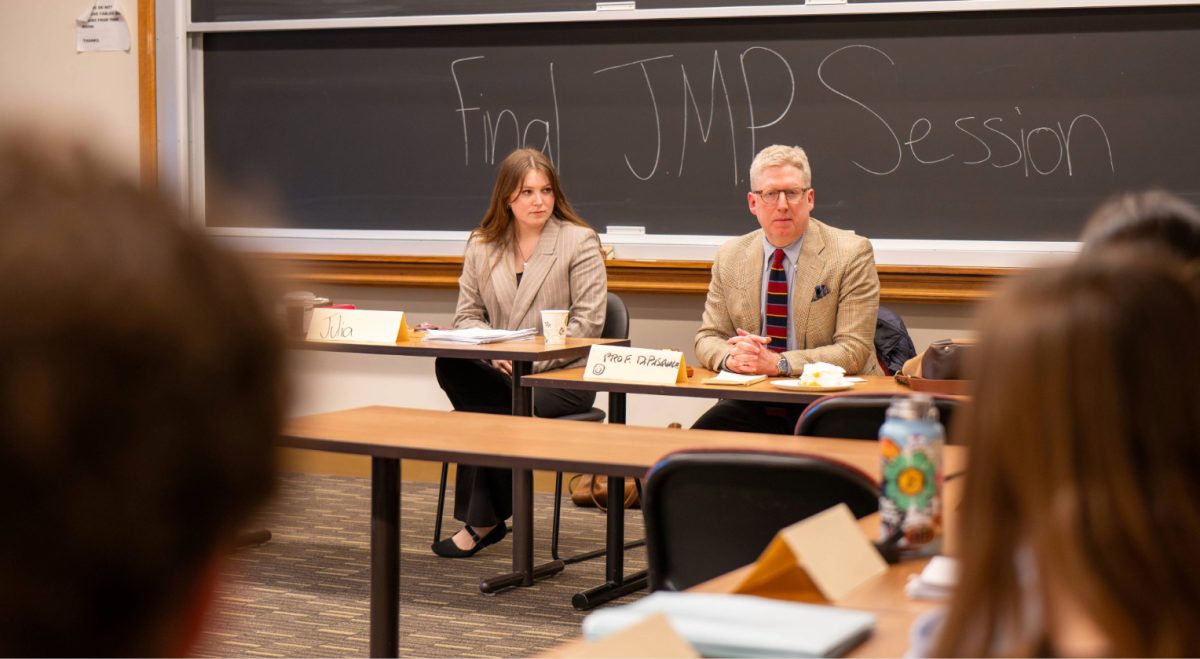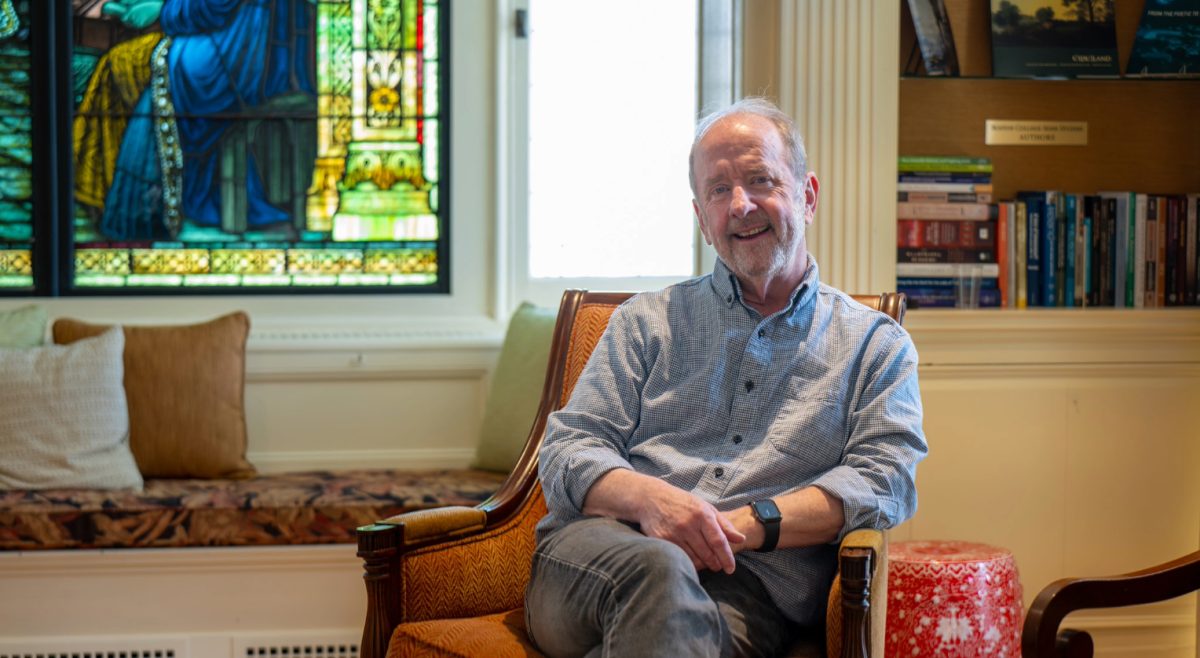

A murder charge is a difficult first case to tackle as a new attorney, especially when it involves a wrongful conviction.
But Boston College Law Professor Christopher J. Muse took on that challenge—and won.
He not only secured freedom for the man convicted, Bobby Joe Leaster, but he also won something unexpected: a lifelong friendship.
“Bobby Joe and I, we’re brothers, and the idea of race and class never changed that,” Muse said. “[Our relationship] defined both of us.”
Muse wasn’t always winning cases in court. First, he was a teacher.
He counted himself lucky to teach at a few Massachusetts schools, but the experiences of his fellow teachers led him to enroll in night classes at Suffolk University Law School.
“I saw so much burnout [in teaching] I made a conscious decision to go to the evening division of law school,” Muse said.
After graduating, Muse received a variety of job offers. He accepted a position at his father’s firm, where he took on Muse’s case—the first and most meaningful of his career, he said. He later chronicled it in his book Justice Under God: How Faith, Hope, and Charity Freed an Innocent Man and Helped Save a Thousand Lives.
“If I had taken any of those positions, I would have never met Bobby Joe,” Muse said.
Leaster had come to Boston as a young man to escape segregation in his home state of Alabama.
“He chose to go come to Boston …to have freedom … that was not part of the segregated Jim Crow South,” Muse said.
He would then serve 15 years in state prison on a false murder charge. Despite this, Muse found his spirit unbroken.
“[Not many human beings] measure up to Bobby Joe in terms of virtue, courage, and spirituality.” Muse said.
For Muse, Leaster quickly became more than just a client in need of help—he became family.
“He’s my brother, he’s my father’s son … He was the pallbearer of my dad … he was an usher at my wedding … he was the first to call on Mother’s Day.” Muse said.
After he was released from prison, Leaster began working with at-risk youth. Muse, who had become an associate justice for the Massachusetts Superior Court, was heavily impacted by his decision.
“What [Leaster] was doing on the outside always stayed with me … he saved them,” Muse said.
Their friendship lasted from the 1970s until 2020, when Leaster died. Their connection was the source of inspiration for Muse’s book. The process of writing the book solidified Muse’s understanding of Leaster, he added.
“In retrospect … he was the most perfect human being I’ve ever met in my life… [he] was inescapable,” Muse said.
Muse and Leaster worked together directly as well, as Muse made it a habit to invite Leaster to meet the court’s high school summer interns. The duo would educate students on criminal justice issues.
Geraldine Hines, Huber distinguished visiting professor at BC Law, and a close friend of Muse saw their collaboration firsthand when they worked in the same courthouse.
“It was the highlight of the summer,” Hines said.
Muse’s connection with Lester would always stand out as the most rewarding experience of his career. But, his time teaching—both as a high school teacher and now as a BC Law Professor—was rewarding in a different way.
“The students are all great,” Muse said. “They’re all invested.”
But the students aren’t the only reason he stays at BC—he also loves the University.
Muse’s love of the campus is, in part, due to his familial connection—his mother was raised in the rectory next to St. Ignatius, his father went to BC, and his parents even married at St. Mary’s Chapel. As a result, Muse grew up around the school.
“I had a real deep association [with the University] … BC has been integral … it’s a part of my life story,” Muse said.
But Muse also reflects fondly on his time as a judge. It was BC Law alum and then member of the Judicial Nominating Committee, J.W. Carney Jr., who encouraged him to run for the Massachusetts Superior Court.
“There was no plan in it, but it was a great result,” Muse said. “ I just loved it.”
Muse didn’t take his appointment lightly.
“Being a judge is huge—such an honor and responsibility,” Muse said.
It was then that Muse forged other lifelong friendships with judicial colleagues. In fact, during his appointment process Muse first encountered Hines. Sworn in days apart from one another, the two worked on the same session in the Massachusetts Superior Court.
Just a couple years later, Muse met fellow judge Regina Quinlan Doherty. For her, Muse offered something different.
“He understood the law and the need for it to be fair, to be open, to be impartial, but also that it’s a human experience,” Doherty said. “Every case is somebody’s life and it affects them. He was very sensitive to that.”
Not only did he understand his clients, but also according to Doherty, his colleagues as well.
“He is a wonderful colleague,” Doherty said. “He’ll always back you up or be helpful.”
Hines traces this work ethic back to Muse’s work with Leaster.
“[That dedication] changes a case into more than a client … part of you is still there,” Hines said.
Leaster imparted one central tenet to Muse that stuck with him.
“Without empathy, the law is fiction,” Muse said.
Now, that mindset is ingrained in all of Muse’s work.
“You have to approach the law with virtue, with courage, with empathy,” Muse said. “Bobby Joe reminded us to do that.”