
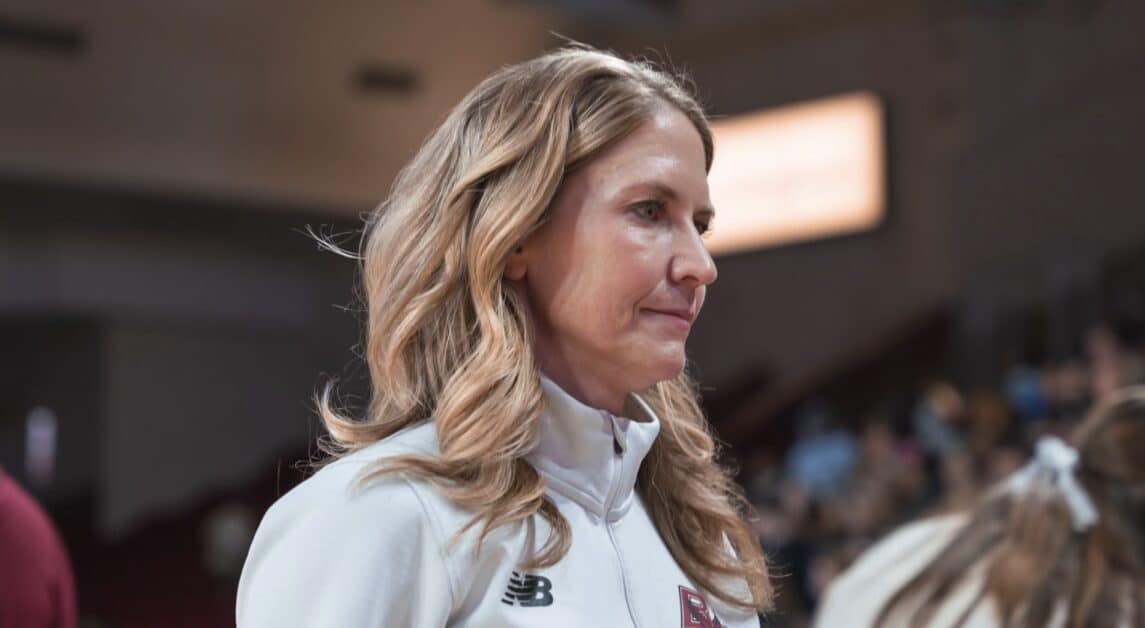
Boston College’s decision to move on from women’s basketball head coach Joanna Bernabei-McNamee was not nearly as dramatic as its firing of Earl Grant, considering her contract was up, and her team just had the worst season in program history.
But while the decision to move on from “Coach Mac” seems clear-cut at first glance, it’s more complex than casual fans may realize. Her eight seasons leave behind a complicated legacy, and quite a few questions now that the search for a new head coach has begun.
Perhaps the most important question is this: Is being the head coach of BC women’s basketball a fruitless venture?
_____
To start, it’s important to note that Bernabei-McNamee did not have trouble identifying and attracting talent to BC. As the years went on, though, she had more and more trouble keeping it around.
She began her first year at BC alongside Taylor Soule, who scored more than 1,500 points in four years as an Eagle before leaving for Virginia Tech and taking the Hokies to the Final Four. Keeping Soule at BC for four years was an impressive feat, and one Bernabei-McNamee became less capable of replicating in the years after.
Bernabei-McNamee also brought in Taina Mair, a star recruit out of Boston. Mair stayed at BC for just one season before transferring to Duke, where she is now averaging 11 points, six rebounds, and two steals per game for the Blue Devils, this year’s ACC champions.
Top-100 recruit Maria Gakdeng played two years under Bernabei-McNamee before leaving in 2023 for North Carolina, where she went to the NCAA Tournament twice. Other recent BC players currently playing for top programs are Teya Sidberry (No. 3 Texas) and T’yana Todd (No. 11 Ohio State).
The fact that Bernabei-McNamee was able to attract that caliber of players to BC seems promising, but BC’s inability to keep them around is slightly concerning—especially because it wasn’t just star players that left.
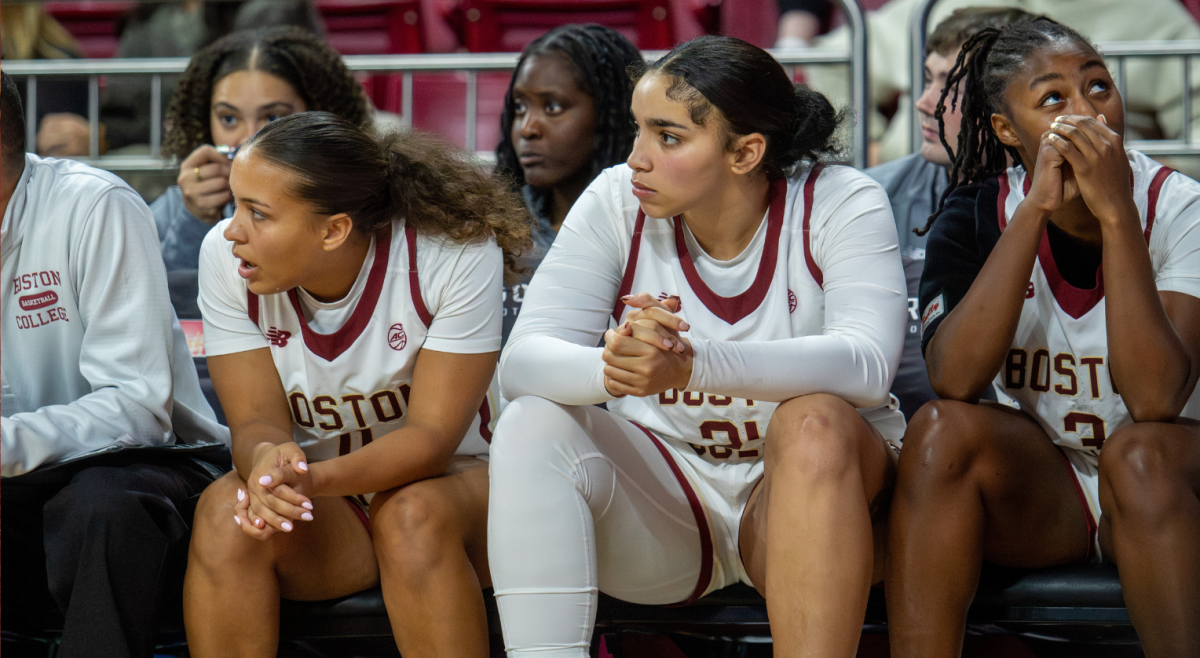
After the 2024–25 season, only one Eagle who had seen floor time the previous season chose to stay at BC. Some movement is completely normal, and perhaps even expected. But this much movement—the kind of movement where almost an entire team leaves—is not.
Is it about winning? Maybe a lack of money put toward the program? Or is the overwhelming turnover the program has experienced actually the result of some deeper issues that hadn’t come to light during Bernabei-McNamee’s tenure?
For example, Milan Bolden-Morris—an All-ACC guard who set the BC freshman record for season 3-pointers with 80—has publicly alleged that she was told to either lose weight or sit on the bench while at BC. She transferred to Georgetown after Bernabei-McNamee’s second season on the Heights.
For BC fans, it would almost be better for the answer to BC’s retention struggles to have been underlying dynamics driving players out, because a fresh coaching staff would at least have a fighting chance at reviving the program.
_____
BC Director of Athletics Blake James said on an episode of From the Desk of Blake James, a talk show hosted by Jon Meterparel, that BC would distribute its revenue sharing according to how it was laid out by federal courts in the aftermath of the House v. NCAA decision.
If this is the case, BC will give around 5 percent of its $21.32 million cap to women’s basketball. That comes out to $1,066,000, a figure relatively on par with what Power Four schools have allocated to women’s basketball in the past. That number is also independent of third-party NIL deals that the school can help facilitate.
You may be wondering: If every school has the same cap and chooses to allocate about 5 percent of the cap to women’s basketball, does that mean every women’s basketball program is on equal footing?
Well, no.
Some schools have opted to spend the entire cap on select sports—for example, Ohio State concentrated on four sports in its first year of revenue sharing: women’s basketball, women’s volleyball, football, and men’s basketball. Similarly structured arrangements could mean different universities allocating much more money to their women’s basketball programs.
NIL is also still a factor—and a big one, at that. Even if BC matches other schools’ max revenue sharing models, a lack of NIL funds will still lead to fewer incentives for big-name players to come to the school.
But it’s not as if BC is a tiny, no-name institution with no outside interest—it’s a power-conference school in a major market with big-time brand deals attached to its name. Building the women’s basketball program back to relevance may be a tall task, but it’s certainly not an impossible one. Plus, there’s a new president set to begin his tenure this summer, leading BC into what could be a new era, athletics-wise.
Letting Bernabei-McNamee walk seems like the obvious decision for both parties. But labeling the job opening as a fruitless endeavor fails to take the whole picture into account. BC is not a lost cause.
It will take a certain type of person, and coach—one who understands the institution, how to market the program to athletes, and how to create an environment that makes them want to stay—to turn BC around.
And yes, it may be tough.
But impossible? Not even close.







Tatum • Mar 15, 2026 at 9:37 pm
BC allocated $500,000 to this years squad. Todd left for $350,000 and Sidberry got the same. Whose fault? Coach Mac brought in talent. The university didn’t support her.