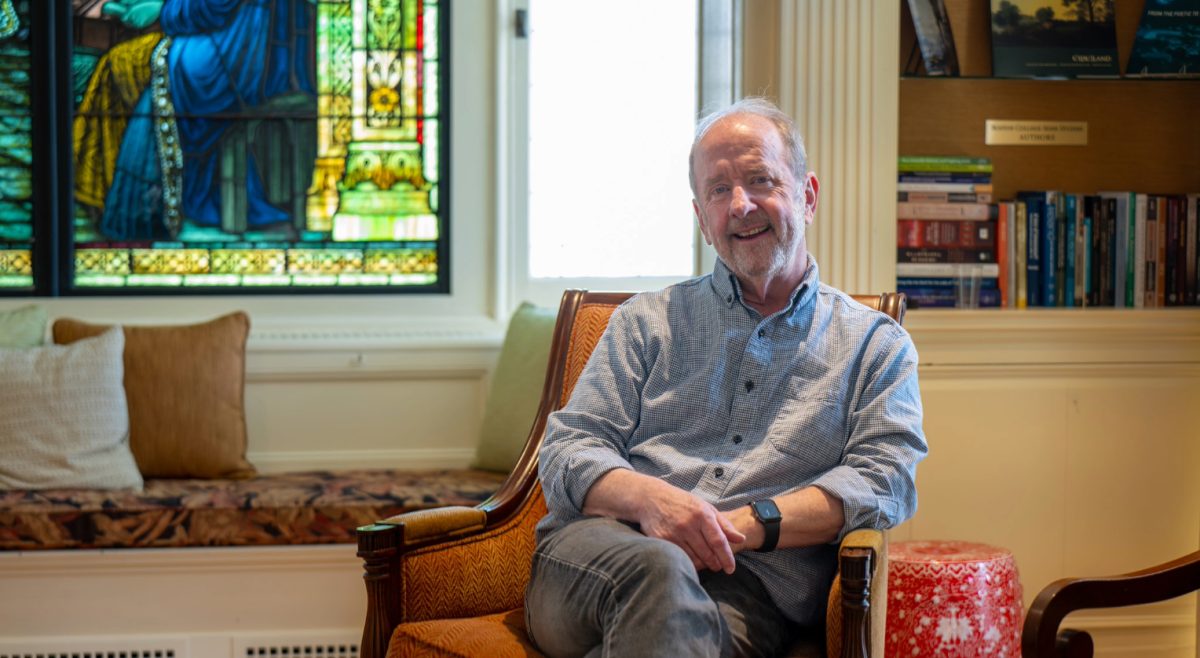

In the 1970s, Ann Burgess’ research on sexual assault and rape made her a pioneer in the field of forensic nursing. Since then, she has worked with the FBI in Quantico, Va., and has acted as an expert witness in high-profile cases, including the 1990s Menendez brothers’ trial.
Throughout it all, Burgess has served as a full-time professor and researcher in Boston College’s Connell School of Nursing (CSON)—drawing on her expertise and experience to educate the next generation of nurses.
“She clearly loves being with her students,” said Courtney Hoblock, BC ’18, a former undergraduate student in Burgess’ class, current Ph.D. advisee, and teaching assistant of five years.
Burgess began her nursing career in labor and delivery. Things took a turn when Lynda Lytle Holmstrom, a former professor of sociology at BC, came to Burgess with a new research idea in the 1970s.
“We did a seminar together, and at the end of it she said she had to find a new research topic, and I said, ‘Sure, I’ll listen,’” Burgess said.
Holmstrom’s and Burgess’ specialities, sociology and nursing, respectively, guided their research focus to survivors of rape.
“Was there backlash? Yes, there certainly was,” Burgess said. “I was told way back then that that would not help my career. Studying rape wasn’t something for nursing.”
Together, they founded one of the country’s first crisis counseling programs for survivors of rape at Boston City Hospital. In addition to offering therapeutic services for survivors, the program provided Holmstrom and Burgess with a key understanding of the experiences of victims of sexual violence.
This understanding set the stage for the rest of Burgess’ forensic career, as the FBI recruited her to its Behavioral Science Unit, where she helped develop methods of offender profiling.
“There comes a point in everyone’s career where they have to make a decision, so that was probably one of the first important decisions I made,” Burgess said. “It opened so many doors, probably because it was controversial.”
Burgess’ work with the FBI had a wide-reaching impact, according to Hoblock.
“Her work has touched so many areas,” Hoblock said. “Law enforcement, psychology, sociology, medicine. I don’t even know what people think her professional roots are.”
The 2024 Hulu docuseries “Mastermind: To Think Like a Killer,” which is based on a book co-written by Burgess and Steven Constantine, associate director of marketing and communications in CSON, focuses on Burgess and her investigations at the FBI.
At times, Burgess is mislabeled as a profiler or a psychologist, according to Hoblock—but her identity as a nurse proves crucial to her work.
“She’s rooted in nursing,” Hoblock said. “The study that started it all was working directly with sexual assault victims. I don’t think you can get more nursing than that.”
Burgess’ passion for researching understudied groups and cases remains a focal point of her career.
“She’s always put people first, and I think that’s what nursing tries to do in terms of patient advocacy, social justice, and working for the common good,” Hoblock said.
Currently, Burgess is working on a chapter for a textbook, “Jurisdictional Challenges Facing Indigenous People in Cases of Gang Crimes,” analyzing cases of missing and murdered Indigenous men.
In the classroom, Burgess aims to shape the next generation of nurses, teaching courses including Victimology, Forensic Science, and Forensic Mental Health.
According to Hoblock, Burgess fosters a welcoming environment for students.
“She never makes you feel like your perspective isn’t respected, or like you can’t know something just because you’re at an earlier stage of your career, which I think is pretty unique,” Hoblock said. “I feel like I’ve never quite seen anybody be a mentor in the same capacity.”
Burgess aims to create connections with her students, Hoblock added.
“There was one student I remember a few years ago—she played women’s softball—and she invited Dr. Burgess to come and do the first pitch at one of her games,” Hoblock said. “It’s so cute, her with her little baseball hat during the first pitch.”
For Burgess, a piece of that mentorship lies in preparing students to one day serve as expert witnesses, as she has done throughout her career.
“I really feel I’ve got to get people—nurses, experts, doesn’t have to be nurses—prepared to go and do some expert work,” Burgess said. “I think that’s very important.”
Students in Burgess’ courses express admiration for her extensive experience and knowledge in the field of forensic nursing.
“She’s so awesome, I feel like everyone is in awe every time they see her speak,” said Morgan Moriarty, LSEHD ’26, a psychology major taking Burgess’ Forensic Mental Health course.
In the class, students examine the components of human behavior and how they relate to a criminal justice setting.
“We’ve learned the motives why people do crimes, serial killers, abductions,” said Evan Friedel, MCAS 26, who is also taking Forensic Mental Health.
The class features forensic cases, including current events.
“I like when she does the more recent cases, like she did Nancy Guthrie or the Brown cases, the cases that I already know about and have happened in my lifetime,” Moriarty said. “I think that when she takes it on, it’s like another level of expertise that I can apply to.”
Burgess’ knowledge is on full display while teaching, according to students.
“In class, she’ll show a graphic picture of a murderer or something, and the way she sees the crime scene is in a nursing way,” Moriarty said. “‘The slash wounds were this deep XYZ, this is how I understand it medically.’ But then in the background there’s a pair of shoes in the corner, and they’re placed a certain way, that gives us intel about the criminal.”
Moriarty said she would advise students to take a class with Burgess.
“Before you leave Boston College, take [a class with Burgess] … she’s so special, and such an asset to Boston College,” Moriarty said. “I really believe that her class is worth taking.”
Both in and out of the classroom, Burgess forged her own path and took chances—and she encourages her students to do the same.
“Don’t be afraid of taking a chance,” Burgess said. “Agreeing to do something that maybe you’ve never done before. That is really what much of my career was—of saying yes to things.”