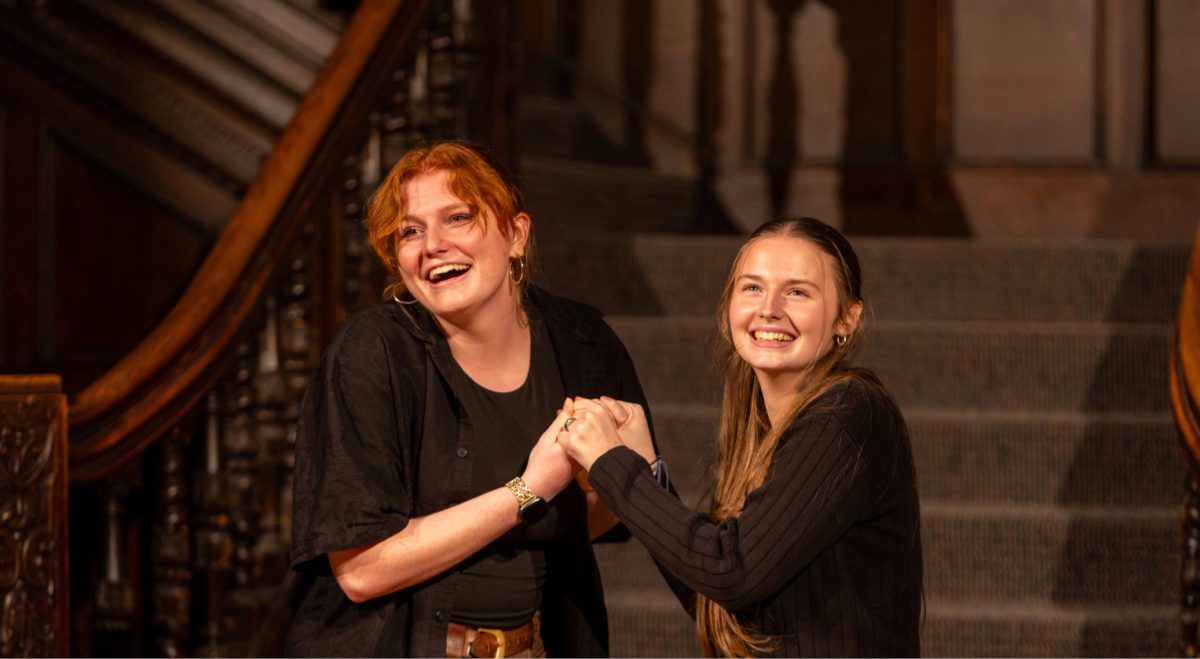

The 28th annual Boston College Arts Festival was this week, and for the grand finale, Astaza! Middle East Ensemble took to the stage Saturday night, playing music from the Middle East—more specifically, the Arab world, Iran, Turkey, and parts of Central Asia.
Astaza! is one of BC’s many ensembles, open to students and community members who want to learn and play Middle Eastern music.
This year’s theme was One Thousand and One Nights, based on the classic folktale of Scheherazade, a woman married to a king who ruthlessly executes all of his wives the day after their wedding. To save herself, she tells the king a story every night, always ending on a cliffhanger, so he spares her to hear the ending the next night. Eventually, he falls in love with her after 1,001 nights.
The show was directed by Nizar Fares, who also participated in the music by singing a couple of songs. The ensemble emerged in modern takes of traditional Arabic dress, studded with rhinestones that shimmered in the dim light. The Arts Fest audience was transported to another world.

As the crowd hushed and the director raised his arms, a solo on the oud—a traditional pear-shaped instrument—started the concert. The oud produced a mesmerizing melody that filtered through the tent. There was a moment of silence, then the rest of the ensemble joined in to play the first song, Üsküdar, a traditional Ottoman tune.
The crowd of friends, family, and students immediately recognized it and began clapping and singing along to the Arabic lyrics. The director encouraged everyone to sing along using the English translations and Arabic phonetic spellings in the provided program, even if they didn’t know the song.

Interspersed between the songs were selected poems about the tale of One Thousand and One Nights. The first of these was “Musings on One Thousand and One Nights” by Hussam Jefee-Bahloul, one of the Astaza master musicians. Dedicated to Scheherazade, the piece commended her for courageously telling her stories every night, even in the face of death.
“Why, then, do we write, and sing, and tell stories? If not to save ourselves in the face of nothingness, ruin, and death,” Bahloul recited.
Fares then told an anecdote about how he collects music boxes. He held one up to the microphone, and the tiny mechanical clinking played out “Arabesque,” a piece composed by Giovanni Marradi.

Fares shared that he was inspired to blend this piece with a song he composed, “Danden Līa Laḥnān”—in English, “Hum Me a Tune.” He invited everyone to get out of their seats and join the dabke, a traditional Levantine line dance.
The spectacular piece began with “Arabesque” played on the piano. Then, the ensemble entered, blending the two different, yet complementary, tunes.
A few of the musicians got down and linked arms, beginning the dabke. Without hesitation, many people—students, parents, grandparents, and little kids—raced to the front to join in the celebration. Soon, a snaking line of people linking arms and dancing surrounded the audience. Everyone was either dancing, clapping, or singing along to the lively melody.
The last song, “‘Alfi Lēla w Lēla,” also known as “One Thousand and One Nights,” was soloed by Manale, Fares’ mother. By the end, everyone was on their feet singing along. It was a multigenerational performance that invited everyone who listened to celebrate the rich musical culture of the Middle East.