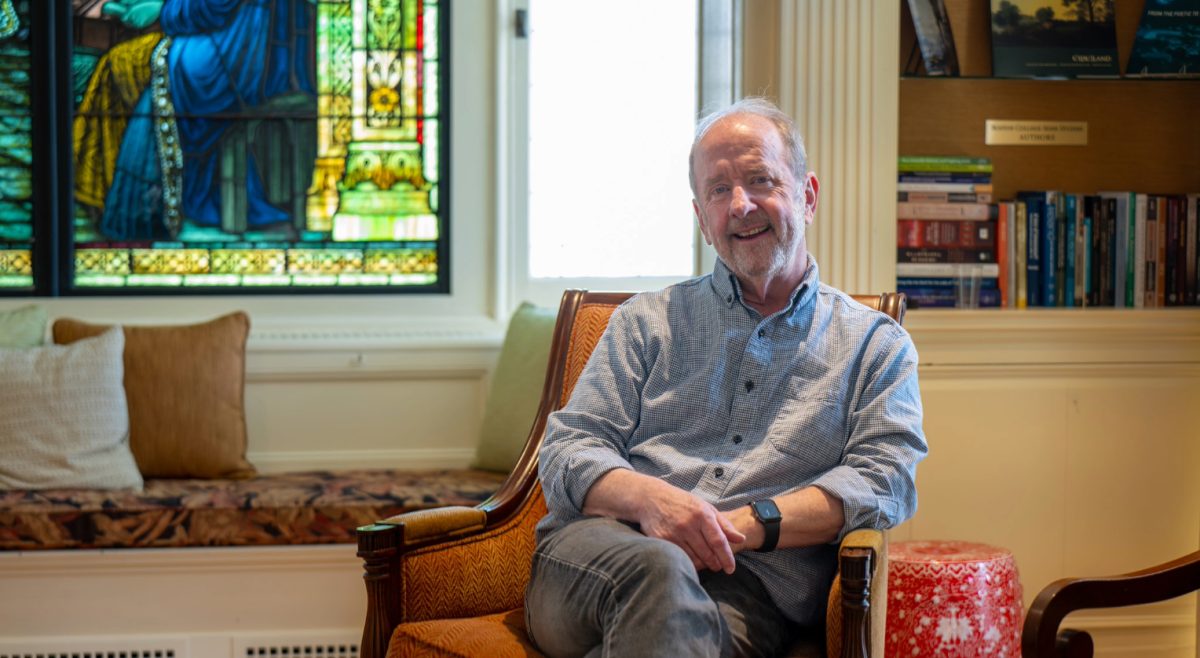

When he’s not busy treating patients, C. Dale Young, BC ’91, can be found writing poetry.
“My desire to do medicine, I think of as a calling, in terms of vocation,” Young said. “But writing poetry and fiction, to me, is more than a vocation. It’s just my life. I can’t actually imagine not doing them.”
And Young has succeeded in both of these areas. In addition to writing award-winning poetry, Young teaches at Warren Wilson College’s MFA Program, administers his own medical practice, and serves as president and chief of Sequoia Hospital’s medical staff, according to Warren Wilson College’s website.
Most recently, Young’s 2025 collection of poems, Building the Perfect Animal: New and Selected Poems, was named a finalist for the Thom Gunn Award for Gay Poetry.
Although medical references surface in his writing, Young resists the idea that his two careers have influenced each other. Instead, his experience as a doctor simply gives him more opportunities to create fresh language, Young said.
“In terms of poetry, your life gives you your images, it gives you your diction, it gives you your syntax, so it’s not that surprising to me that medical things would end up in poems of mine,” Young said.
These expressions of language can sometimes be surprising to readers, Young added.
“Someone pointed out to me that in one of my earliest poems, I talk about the scalpel of light crossing the grass,” Young said. “They said no one outside of medicine would ever come up with that kind of image.”
Young’s interest in the medical and creative fields began during his undergraduate years at Boston College, where he graduated with degrees in molecular biology and English.
Young said that he became interested in poetry after joining BC’s literary and arts magazine, Stylus. As an art editor, he soon discovered that, while there was little art to review, there were plenty of poems.
Despite not majoring in English at the time—and hearing of poetry classes described as “weird”—Young decided to take his first workshop with Suzanne Matson, professor in the English department. Matson was at first hesitant about his limited experience writing poetry, Young said.
“I went back [to her office] every day, for like five days, and finally on a Friday she said to me, ‘Fine, you need to give me 10 poems on Monday, and I just want you to know that if you get a C in this class, I warned you,’” Young said.
Young spent the weekend writing the poems for Matson. After submitting them, he was allowed into the workshop.
According to Young, once he started engaging with poetry, he realized that it was something he would never be able to stop doing. Now, writing has become an integral part of how he thinks and lives, he said.
Young said that he follows the same contradictory thought process whenever he starts working on his next poetry collection.
“I joke with myself that the only way I can write a new book is to think that I’m doing something completely different,” Young said. “The irony of it is that, invariably, when the new book is done, and I’m at the point of publication, I realize that it’s really not that different from the last book, or the book before.”
According to Ronald Palmer, a poet who works in the biotech industry, for himself and Young—both older gay men and poets with dual careers—poetry is a means of expressing generational melancholy and ensuring their own survival.
“A lot of times, as poets, we pull grief through our own bodies and through our own psyches, consciousness, in order to make sense of it, and also to get it down on the page as an artifact,” Palmer said.
Palmer emphasized the vulnerability of Young’s poetry.
“He’s also braver, I think, and takes more risks in his poetry,” Palmer said.
When it came to selecting previous pieces to form Building the Perfect Animal, Young said that many of his earlier pieces weren’t up to par. Only six of his poems from his first collection, The Day Underneath the Day, made it into the final product.
“Those were the only six poems where I could hear myself,” Young said. “That might sound like an odd expression, but I think often with people’s first books, there’s a lot of influence on you from your reading, your workshops, and your studies, and it’s often the second book for a poet that marks their voice.”
According to Young, his journey towards honing his voice involved moving away from more formal terms and presentation.
“What I noticed as I was doing the selected part of the poems for the book is that as time progressed, I became more and more casual in terms of my diction, so the poems are more conversational, more driven towards addressing the reader,” Young said. “I would never in my first two books have said, ‘Look, reader, this is how I feel.’”
According to Young, love, loss, identity, and grief are consistently explored in his works, heightened by new experiences that come with growing older. Young also cited religious traditions and queerness as perennial themes in his writing.
“I have never shied away from using religious symbolism because I think it’s incredibly rich and powerful,” Young said. “I will also add that it’s not just Catholicism. I’ve used things from Hinduism, Buddhism, Indigenous Puerto Rican—the Taíno people. I feel that almost all of the religious things or teachings involve myth. And what is poetry if not descended from myth?”
Young said he felt captivated by the Epic of Gilgamesh and the Iliad in particular.
“I know a lot of people say to me, ‘You’re attracted to these stories because of same-sex attraction or queerness,’” Young said. “And I’m like, Achilles and Patroclus, Gilgamesh and Enkidu, they might be men, but the story isn’t about the fact that they’re men. It’s about the love that they have and the grief they feel when that love is gone.”
Tomás Q. Morín, another poet, said that readers can hold fixed ideas about what minority poets write about, such as expecting Latine poets to always cover the immigrant experience.
“It’s almost like a kind of literary profiling, where they expect certain subjects to come from us, which I find insulting,” Morín said. “While yes, we do write about these things, there are more dimensions to us.”
Young’s work subverts those expectations, according to Morín.
“I feel like in [Young’s] work, one of the ways in which he’s influenced me, is that you can’t stuff his work in one pigeonhole,” Morín said. “It’s about the spectrum of human experience.”
Like his work, Young’s path in life has spanned a spectrum of experiences. He encourages others to be open to the different opportunities life presents to them.
“I would say follow your passions, and never be afraid to take a class that sounds ‘weird,’ because it might be your future,” Young said. “You never know.”