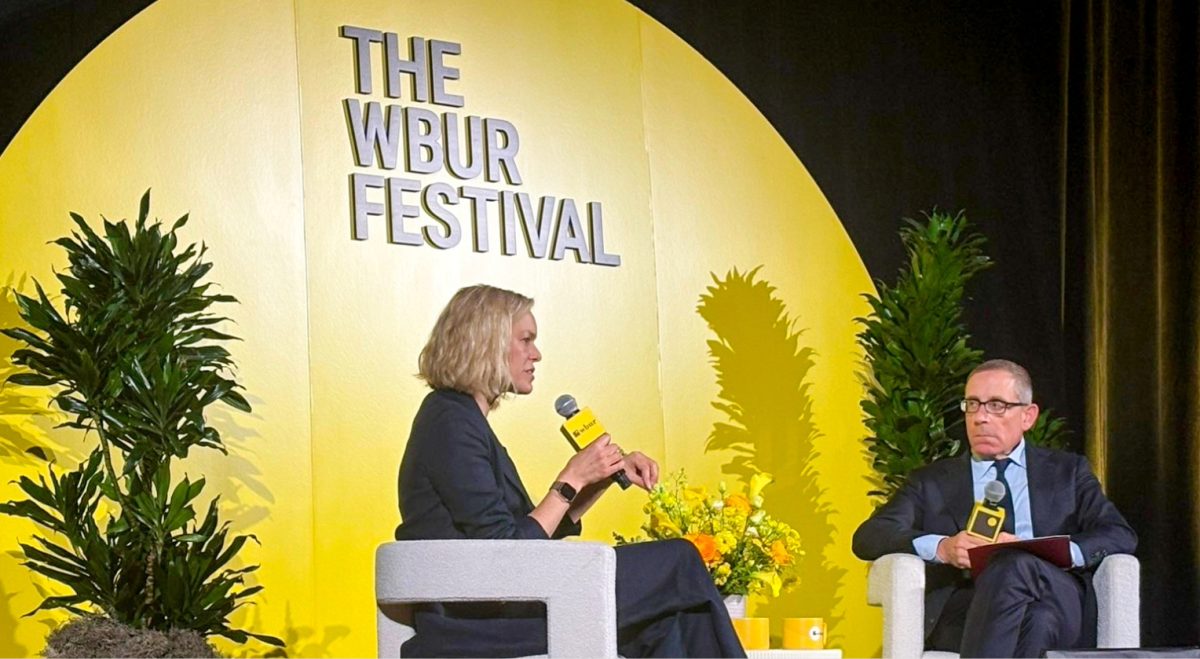

As polarization deepens both nationally and globally, Catholics should return to focus on faith rather than the political sector, according to Kim Daniels, director of the Initiative on Catholic Social Thought and Public Life at Georgetown University.
“Over these last 25 years, Catholics have confused access with influence and power with witness,” said Daniels. “What’s needed now is not just unity but solidarity, rooted in the Gospel, grounded in the dignity of all.”
In celebration of its 25th anniversary, the Boisi Center for Religion and Public Life hosted an event consisting of two panels “A Discussion of Religion, Politics, and Culture in the United States in the Last Quarter Century.”
The first panel centered around the question: How has the relationship between religion and politics changed over the past 25 years?
In addition to Daniels, the panel featured Jonathan Laurence, director of the Clough Center for the Study of Constitutional Democracy at Boston College, and Michael Sean Winters, columnist for the National Catholic Reporter and fellow at the Center for Catholic Studies at Sacred Heart University.
Daniels agreed that Catholics now play a significant role in American politics, even if this was not always the case.
“As Catholics, we are called to be engaged in public life,” said Winters.
Winters argued that Catholic values have become lost in political identities.
“The Catholic left has become as sectarian as the Catholic right and as anemic as the secular left,” he said. “This is one of the saddest stories of the past 25 years.”
In recent years, Catholic identity has been increasingly instrumentalized for partisan ends, leaving the Church’s broader moral vision fractured, according to Daniels.
“This instrumentalization of faith, using it as a means to political power, has had lasting costs for the church and public life,” she said. “The first and most profound cost has been to our faith itself.”
To aid this, Daniels said Cathlolics must emphasize core values rather than partisanship.
“What’s needed is not victory but encounter—not uniformity, but solidarity,” she said.
Daniels outlined a three-step plan to combat this phenomenon: Stand with the poor and vulnerable, defend the rule of law and democratic norms as essential to human dignity, and embrace principled dialogue and pluralism.
Laurence widened the lens, situating American debates within the broader context of global politics. In the last 25 years, he said, Islam and contemporary American politics have taken a sharp turn from early ignorance toward the center of foreign policy and security debates.
“The notion that history had ended and that liberal democracy or market capitalism had won was interrupted in part by a decade of terror attacks that exposed the unstable equilibrium of the post-colonial world,” Laurence said.
According to Laurence, U.S. international involvement in the years between 9/11 and the Paris attacks of 2015 produced foreign policy fatigue. At the same time, crises like Hurricane Katrina and the 2008 financial collapse shifted American attention back home.
Laurence raised the issue of the Middle East, noting that certain conflicts often reflect deeper structural tensions rather than being the cause of the tension themselves.
“I would categorize the non-resolution of the Israel-Palestine issue as a symptom and not the cause of tensions in the Middle East,” said Laurence.
Throughout this period, Laurence noted, one constant was the unresolved Israel-Palestine conflict. He argued that the fall of the Ottoman Caliphate created a vacuum in Muslim leadership that groups like Al-Qaeda and ISIS were quick to exploit. Further U.S. interventions in the region exacerbated traditional Sunni powers, shifting the region’s balance of power.
“The central irony is that the US has been thrust back into the middle of it all,” he said. “Despite having a president elected on an isolationist platform, we bear the brunt of the flame and the lion’s share of the credit and things.”
When asked about the rising religious nationalists across the world, all three panelists referenced Pope Leo XIV as a source of hope for civic engagement and for the resurrection of the Church’s human-centered values, which have become obscured by political partisanship.
“Francis would have answered in Spanish,” Winters said. “Leo answered in English. And what I recognized right then is that it lands differently.”