After trying to cross the U.S.-Mexico border twice, Dora Rodriguez turned to smugglers who brought her across the Sonoran desert, only later abandoning her group of 26 to die.
“On the sixth night—the sixth day—13 of my friends had died in that desert, and I survived,” Rodriguez said. “By the grace of God, I survived.”
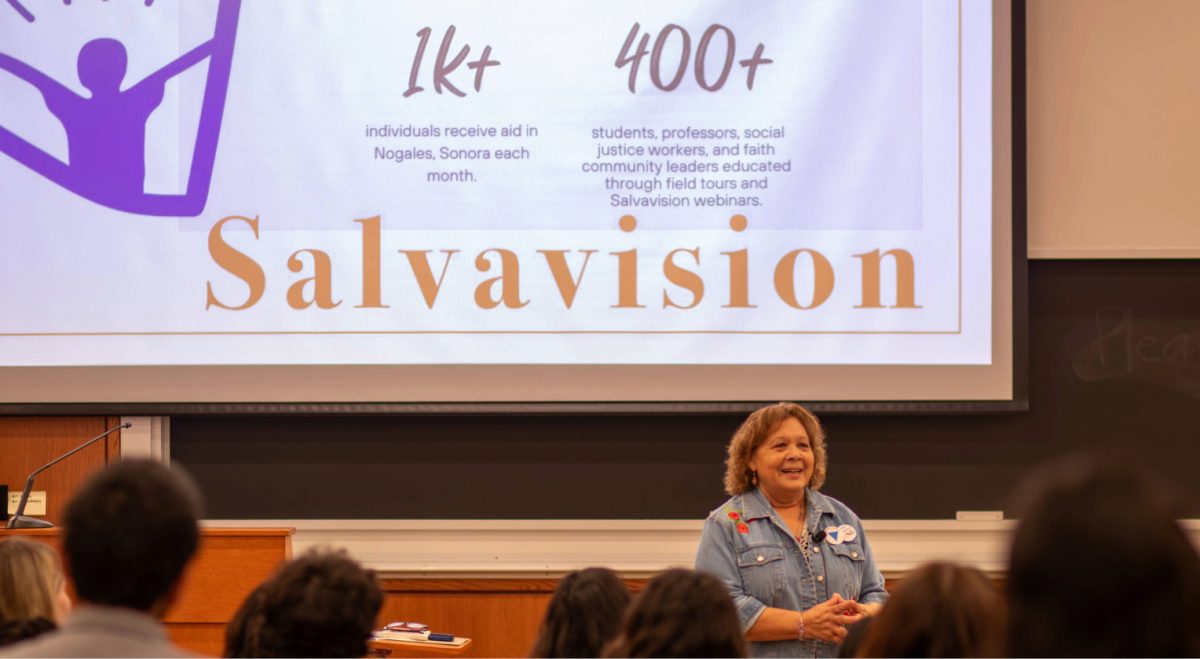
At a talk sponsored by the global public health and the common good program and the Connell School of Nursing Thursday, Rodriguez spoke about her experience as an immigrant to the United States and what she is doing to ensure all immigrants feel welcomed at the border.
“I never got to see my friends from high school again,” Rodriguez said. “So forced migration, as we know, is painful.”
When she was 19 years old, Rodriguez was forced to leave her home country, El Salvador, in the 1980s because of increased political violence against Salvadoran youths.
Since surviving her border crossing, Rodriguez has devoted her life to sharing her story and her knowledge of forced migration.
“It’s very important for me to talk about forced migration, because, you know, it’s something that not many people know about,” Rodriguez said. “We’re so quick to say, ‘Who are all these people coming? Why? You know, can they go somewhere else?’”
Despite the U.S. government’s strict policies to close the border, Rodriguez argues that no policy will prevent people from trying to escape violence.
“It is just our nature as human beings that if we don’t feel safe, we move. It doesn’t matter who you are,” Rodriguez said. “It doesn’t matter what color your skin is, it doesn’t matter where you’re coming from. If you don’t feel safe, you will move where you feel safe.”
In recent years, Rodriguez has seen an increase in the demoralization of immigrants at the U.S.-Mexico border. She recalls her interaction with Border Patrol in the 1980s, when they found her close to death in the desert and brought her to safety. She states that migrants today do not receive the same respect that she did then.
“Their job is to be right there, making sure that if people decide to cross the desert, yes, they will be apprehended, but treated with dignity and respect,” Rodriguez said. “We really are far, far away from that, very far away from that.”
While she worked with recently deported people and nonprofits that aided asylum seekers, the uptick in violence and brutality at the border starting in 2016 prompted Rodriguez to take action herself.
“I was trying to become the social worker that I always dreamed to be and be a service to my community, but in 2016, when things started shifting for us, the way that I never thought about it in this beautiful country, I said, ‘It’s now my time to start something of my own,’” Rodriguez said.
Rodriguez started her own nonprofit, Salvavision, with the hopes of taking her own negative experience with the borderlands and turning it into a beacon of hope for others.
“I want to turn this tragedy that I survived—my displacement from my home—into something that is for my people, for the people that are going through the same thing I did,” Rodriguez said.
A large part of Salvavision is ensuring that migrants at the border feel like they have a voice and are welcomed into the United States.
“[Border Patrol] get to our border and say, ‘No, you’re not welcome,’” Rodriguez said. “So we are welcoming them. We are there in the borderlands with the lines of people from Afghanistan, Africa, India, South America, Central America, everywhere.”
Rodriguez says that she has learned to love the United States and that it is a source of light for people all over the world. She argues that because of this belief, the country needs to change its policies and start welcoming people instead of sending them away.
“I had witnessed people—a woman from Africa with a little boy, 3-year-old Mohammed, this woman kissing the ground of the United States, and saying, ‘I am free,’” Rodriguez said. “This is how much we believe in our beautiful country. That’s why we have a lot of work to do.”
During her closing remarks on her work with Salvavision, Rodriguez emphasized that it’s the job of U.S. citizens to fight for the humanization of people at the border, and not let the cruelty that is currently occurring become the norm.
“We have a responsibility to not normalize what is not normal for us at this moment,” Rodriguez said.