

If “Mohini the white tiger” rings a bell, I’m sorry. Maybe you, too, had to listen to your high school counseling department tell this story at 8 a.m. on a Monday. For those unfamiliar, allow me to introduce you.
As the story goes, Mohini was a white tiger who grew up in a 12-by-12-foot concrete zoo cage. She spent her days nervously pacing the same cramped square. Eventually, the zoo raised money to move her into a new home—several acres of grass, hills, trees, and ponds. Excited to watch her flourish, the zoo released Mohini into her new habitat. But she immediately withdrew to a 12-by-12-foot corner, pacing around it until the grass wore away.
My high school presented this fable as a lecture on taking advantage of the resources around you. At the time, I rolled my eyes from a 12-foot cage of my own. I was legally obligated to be in the same dusty building from 7:45 a.m. to 2:49 p.m. Caught up in the bleak academic grind, I rarely saw anything besides my school, my home, and the 15-minute drive between them.
Now, I reluctantly admit that my high school counselors had a point. I can see the expansive world at my fingertips, but stepping out of my cage is easier said than done.
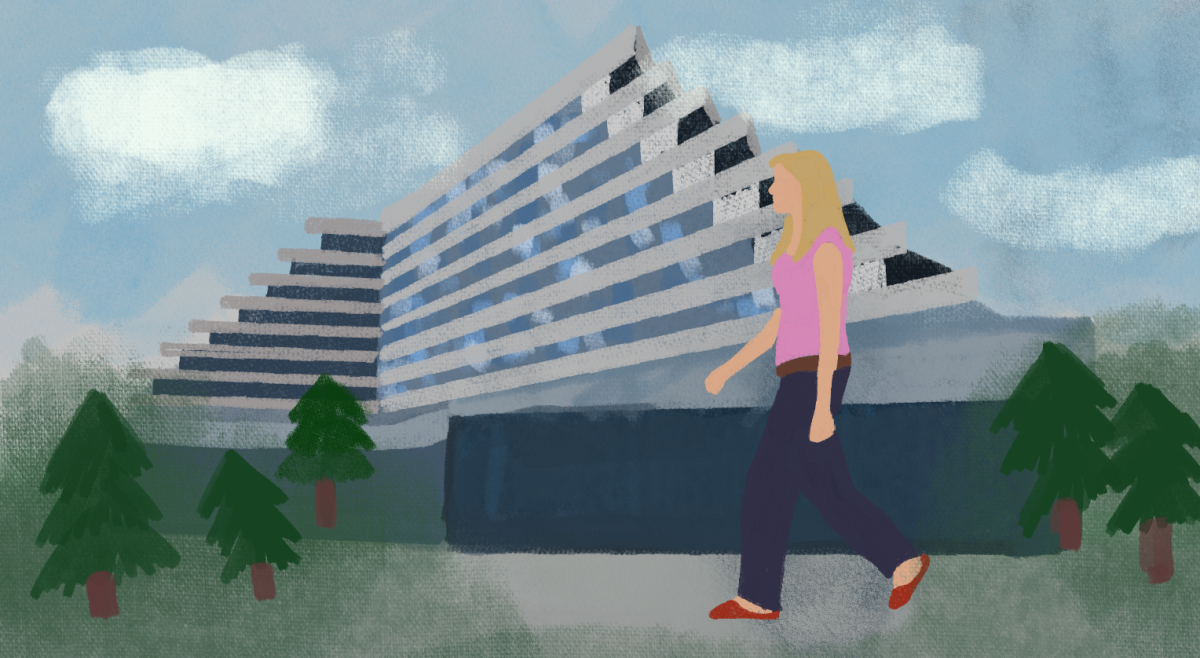
Boston College can feel almost utopian. Its breathtaking architecture contrasts sharply my hideously brutalist high school. Its proximity to Boston offers hundreds of times more richness and thrill than my suburban hometown. Yet, I often fall into the same old routines. How can I break out of my twelve-foot cage?
In Praise of the Green Line: Public Transit
Back in Jersey, we drive—and worse, we drive alongside other Jersey drivers. The only alternative to Route 22 and its horrors is NJ Transit, which is unreliable, inefficient, and often unsafe.
My first experience on the T was miraculous. I still am in awe that a clean, comfortable, safe train can take me practically anywhere in Greater Boston.
Quality public transport offers more than convenience—it broadens your world, creating more social, academic, and personal possibilities. Moreover, the mere act of riding the T invites mindfulness. With spotty cell service and the need to listen for your stop, you have to stay present.
It is also inherently social. Once, while riding the Green Line home, I ran into a classmate and enjoyed a delightful half-hour conversation across the aisle. Another time, a friendly Harvard student noticed I looked lost near Government Center, kindly helped orient me, and recommended a great pizza place nearby.
With all this in mind, I was surprised that many of my classmates opt to Uber to the city, or not go at all.
It’s true that the United States is a car-centric society. We are all too used to sitting in our gas-guzzling isolation chambers. As such, the temptation to call a rideshare or even stay on campus can easily become overpowering.
I challenge my fellow freshmen to embrace the T. Map out a few transfers instead of paying for an Uber, and spend the extra time chatting with a stranger.
Head to Boston Public Library on a weekday for the fun of it. Ride the Green Line, try to put the reels away, people-watch, or enjoy the views. It would be a tragedy to spend the year ignoring the stirring city just a few miles away or the joyful process of getting there.
In Praise of O’Neill’s Abandoned Classroom
Sociologist Ray Oldenburg defines your “first place” as your home and your “second place” as your workplace. What, then, is the “third place”?
To paraphrase Oldenburg, it’s anywhere you can hang out. A third place must be open and cannot require a formal invitation. It must be casual, cheap (ideally free), and nearby. Most importantly, it is filled with conversation, laughter, and play. The third place, Oldenburg theorizes, is essential. It reduces loneliness, and lends the sense of belonging that we new students are all seeking—it is your place, where you belong.
In high school, I lacked a true third space. A few places came close—I had my nearby coffee shop and the local public library. The former was expensive, somewhat pretentious, and usually too crowded for social gatherings. The latter had inconvenient hours and enforced a silent policy.
Campus, however, offers a treasure trove of third spaces. I can bring my math homework to the CLXF lounge and run into friends who are regulars there. I can find a familiar face in the Rat to chat with over mozzarella sticks. I can go to the often-empty classroom in O’Neill that my friends and I claimed as our “unspoken base.” We say we’re there to “do homework together,” but in reality, we talk for hours and no work gets done. Ray Oldenburg would love Boston College.
What he won’t tell you, though, is that it takes energy to engage with third spaces. After years of spending my working and free hours at home, sticking to that habit is simply the path of least resistance. But I’ve never dragged myself to a third place and proceeded to regret it. I encourage other first-year students to do the same. Try experimenting with different third spaces until you find one that feels like yours. A bit of resistance can go a long way.
In Praise of Gasson Commons: Walkability
A month after move-in, my iPhone’s health app notified me of a change in my activity trends: my daily steps had skyrocketed. While public transit gets us off campus, our sore calves know all too well that this campus is a walking one.
Yes, the stairs are brutal.
Yes, last Monday’s torrential rain made me bitter.
Yes, sometimes the last thing I want to do after a long day is trek back from Lower Live.
Even so, I’m starting to understand why social science students are so crazy about walkable cities. Beyond being incredibly convenient, BC’s walkability forces good habits. It provides you with a baseline level of fresh air, sunlight, and exercise-induced endorphins each day. Plus, it facilitates socialization. I can’t count the “hellos” I’ve exchanged in Gasson Quad. I’ve met some of my friends and acquaintances simply because we happened to be walking the same way, giving me an excuse to start a conversation.
I believe we should embrace walkability and all its benefits. I began leaving five or ten minutes early for classes to meander slowly through campus and enjoy the views, a habit I confidently recommend. Try to resist the urge to give a familiar face the “BC Lookaway” as you walk to class—start small by replacing it with a smile and wave. We are used to seeing walking as a pragmatic means of getting from point A to point B. I challenge you to start seeing it as a gift.
Escaping the 12-Foot Cage
I can’t blame any of my fellow freshmen for staying in their comfort zone—I do it, too. Old habits die hard, and some days are simply meant to be spent alone in your dorm. Everyone needs solitary confinement in their 12-by-12 square. At the same time, what a shame it would be to let our first year in utopia pass us by. I hope we all explore every last inch of our new homes, one step and one day at a time.




Karen Christensen • Nov 7, 2025 at 5:17 pm
Ray Oldenburg died in 2022 and left me, a long-time collaborator, with the task of writing a new version of The Great Good Place, the key source mentioned in this thoughtful article. I am bringing the story up to date, showing how third places can help us solve climate change, loneliness, and political polarization. More information and recent press is at greatgoodplace.org.
Auntie M. • Nov 6, 2025 at 8:43 am
Love this perspective L. Malik! May we all always leave early enough to take it all in and breathe deep!!
Alex Newquist • Nov 5, 2025 at 5:04 pm
Awesome read – great advice with themes applicable for everyone!
Auntie M. • Nov 6, 2025 at 8:44 am
❤️
Sophie • Nov 4, 2025 at 9:28 pm
Every first year student should read this- such valid and real advice!
Auntie M. • Nov 6, 2025 at 8:44 am
💕
Holly Kest • Nov 4, 2025 at 8:45 pm
Love this! Incredible writing and so true!
Sarah • Nov 4, 2025 at 4:14 pm
Beautiful writing. Been trying to get out of my own self made cage! Keep up the good work 🙂
Lex (author) • Nov 4, 2025 at 4:26 pm
Thank you Sarah! Always wishing you the best!
Adam Livnat • Nov 4, 2025 at 3:57 pm
Great article! Keep up the good work 🙂
Lex (author) • Nov 4, 2025 at 4:26 pm
Thank you!