
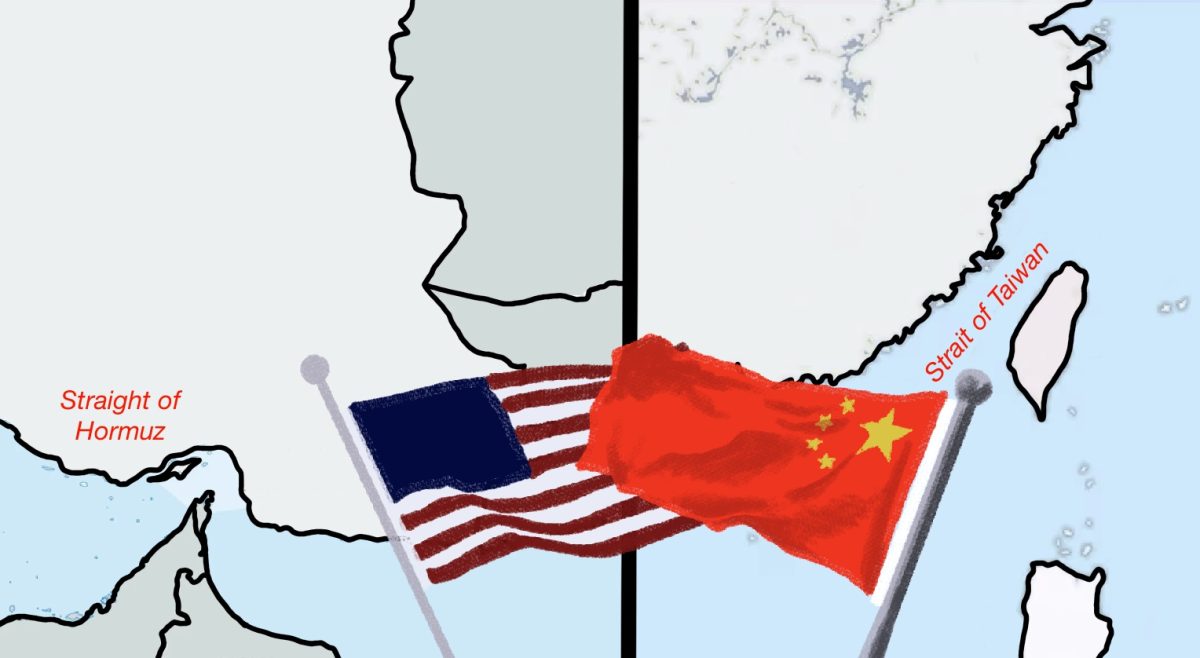
For much of the post-WWII period, the United States’ naval power has not been displayed as prominently as it has during its recent involvement in Iran, and China has been patiently taking notes.
The strategic movement of ships, Patriot missiles, and drones has effectively opened the Pentagon’s playbook for a confrontation within a narrow body of water. This heightened readiness suggests that the United States is not merely posturing but is actively refining its logistics for a multi-theater engagement. By observing these maneuvers, China is forced to reconsider the timeline of its own regional ambitions.
Before any potential ground troop deployment, modern militaries rely on aerial and naval surface combat to establish influence and power. If a conflict were to break out over Taiwan, these elements would certainly be employed as the primary instruments of war.
A naval blockade would entrap and force Taiwan to surrender, while aerial bombardment would serve to prove that Beijing could strike at the heart of the nation’s infrastructure continuously. The psychological impact of such a sustained campaign is intended to break civilian morale before a single soldier ever sets foot on a beachhead. Consequently, the effectiveness of Taiwan’s integrated air defense systems remains the greatest variable in Beijing’s strategic calculus.
Both of these are distinct possibilities, but a critical factor the Chinese must evaluate is how the United States. will defend the country and the specific tactics it will use for both military options. Since the engagement with Iran began with military strikes on nuclear sites over the summer, Beijing has been watching how President Donald Trump has navigated a geography similar to the Taiwan Strait.
The use of precision strikes against hardened targets in Iran provides a blueprint for how the United States might dismantle coastal batteries along the Chinese mainland. This real-world laboratory in the Middle East offers a sobering glimpse into the technical superiority of American electronic warfare.
One valuable lesson is that Washington still holds the upper hand in rapid maritime escalation. In early April, Tehran attempted to establish its own blockade of the strait to control the flow of ships through the waterway. The significant aspect of this was the Iranian government’s implementation of a toll system that charged each passing ship between $1 and $2 million.
Crucially, payment could only be processed in Chinese yuan or cryptocurrency. This financial maneuver was a blatant attempt to circumvent the dominance of the U.S. dollar and weaken the efficacy of international sanctions. By tethering Iranian survival to the yuan, Beijing sought to create a “sanction-proof” economic corridor through the Middle East.
This attempt at fiscal influence backfired when the United States began targeting and sinking ships belonging to the Iranian military with surgical efficiency. After weeks of striking Iranian vessels, the blockade weakened, allowing the president to establish an American blockade that effectively neutralized the threat.
The deciding factor remains the strength of the Iranian navy, which is significantly weaker than China’s naval capacity. While the United States found success against a smaller fleet, the sheer volume of the People’s Liberation Army Navy presents a far more daunting challenge for American interceptors. Beijing likely views the Iranian defeat not as a failure of concept, but as a failure of scale.
The Chinese are preparing for a war scenario and are drawing significant lessons from the current conflict with Iran regarding the durability of proxy forces. The display of U.S. capabilities, however, warrants caution against moving on Taiwan in the near future, considering Washington’s success in controlling leadership, aerial warfare, and naval blockades.
This proves that conflict in narrow waterways is extremely complicated and rarely ends in a swift, decisive manner once America becomes involved. The prospect of a long, drawn-out war of attrition is exactly what the Chinese Communist Party wishes to avoid to maintain domestic stability. Ultimately, the high cost of American intervention serves as a powerful deterrent against any immediate attempts to alter the status quo by force.







kent chang • Apr 26, 2026 at 2:51 pm
This article is just wishful fantasy from American viewpoint. It is both silly and naive to think China would want to drag things out giving the enemies time to formulate strategies or to impact neighboring countries as China has always viewed Taiwan as a domestic historical issue. The cross-strait situation is improving these days which bodes well for a peaceful solution which is the worst-case scenario for the US and Japan. In the case where a political solution cannot be reached, a lightening strike would be the best option especially when support for Taiwan Independence within Taiwan is still a minority and to minimize collateral destruction. China knows well local sentiments in Taiwan does not favor them but they also know time is on their side and local sentiment can and will change. Hong Kong is a prime example between 1997 and 2027.