First, I calculate how many hours of sleep I’ll get if I fall asleep at that very moment. Then, in a rhythmic, almost choreographed motion, I grab my phone to extend my alarm, stealing 15 more minutes of rest. Satisfied with my alarm time, I power down my phone. My thoughts continue to race. I try deep breathing. In for four, out for eight. Or is it out for six? I lie on my back, then side, then back again.
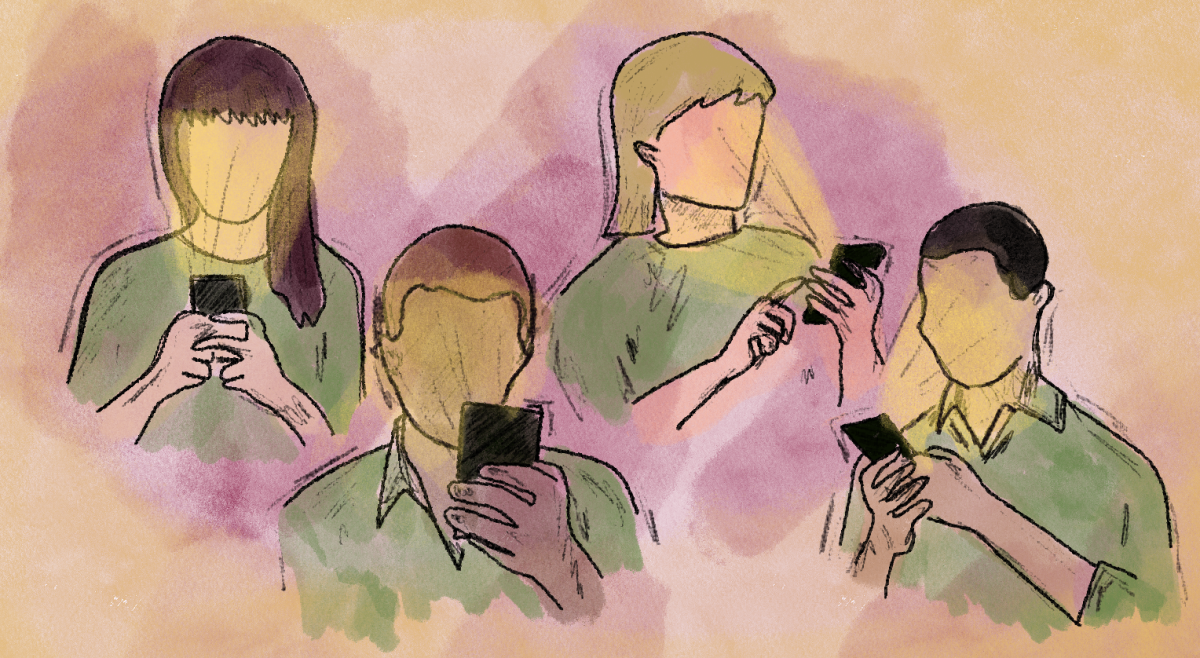
The end of the semester came suddenly and stealthily upon me, leaving me with the urgent need to create mental lists of tasks each day. I toss, I turn, I pick up my phone again to try to quiet my mind. I find myself managing my thoughts only through consuming AI-generated “slop” and influencer drama. I can only sleep when my thumb is too exhausted to manage the simple vertical motion of a scroll.
The urge to self-soothe by stepping into a mediated world has roots beyond doomscrolling college students. I recall growing up overhearing my mother’s disapproving comments directed at my father. After long, mentally taxing days at work, my dad would “veg out” (her words) in front of the TV. For him, the glowing screen was a simple, non-demanding portal to release, a way to switch off his professional brain.
Since I’ve been away at college, my mother tells me that my father, the former king of the nightly TV session, now criticizes her use of social media. She has adopted social media, primarily Instagram, as her go-to form of escapism and connection. My mother insists to him that the sole pleasure and benefit she derives from Instagram is the ability to send funny or relevant short videos (“reels”) back and forth with me.
“It’s my only way to connect with our long-distance daughter, John!” she’ll assert, her voice firm with the logic of a mother seeking connection. But even when I visit home, and we are physically in the same space, she still spends considerable time interacting with the app. More pointedly, I don’t receive any more notifications from her when I am present than when I am away. I wonder if the “connecting with Amelia” argument is merely the most defensible layer of her media use, rivaling my father’s fidelity to the TV. The fundamental desire to momentarily check out re-manifests in new digital forms.
For a video journalism class, I recently analyzed a compelling documentary produced by The New York Times that delves into livestreaming services in China. The film offers an intimate look at the lives of young female Chinese livestreamers and their dedicated audience during the social isolation brought on by the COVID-19 pandemic.
Through interviews, observational footage, and environmental shots, the documentary illustrates the strange form of social disconnection that pandemic conditions created. In this virtual world of livestreaming, women perform for donations, engaging in carefully choreographed interactions that often involve feigning intimacy with male viewers.
The women constantly respond to donors via text, strategically crafting a believable yet ultimately fabricated sense of personal connection. These consumers of virtual affection often express a deeply-held belief that their online relationships are real, or at least a viable substitute for relationships in the physical world. As one donor candidly states, “I do believe virtual relationships can replace real-life relationships.”
It’s easy to see the appeal of retreating from the demands of real life. Many viewers use social media and virtual connections to avoid difficult realities, just as I do at night or as my mother does to connect with me. It’s easy to dismiss these habits as a personal failure of attention. It’s harder to understand how these systems are built to keep us scrolling and why we willingly participate.