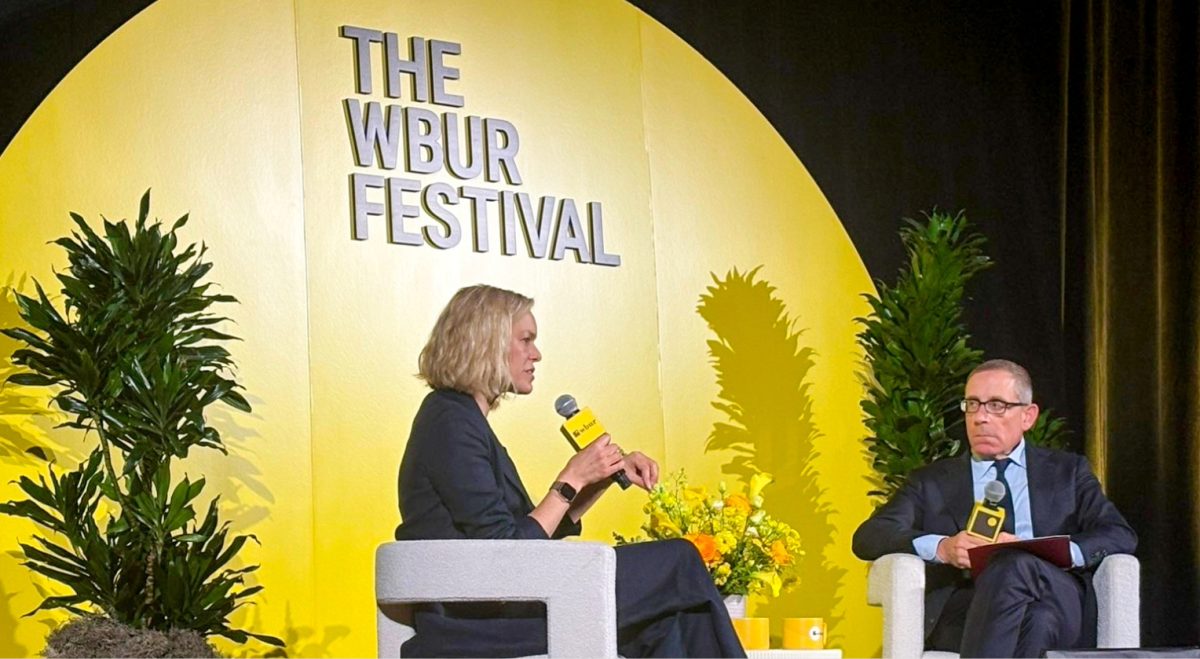

Sabrina Shankman, a climate reporter for The Boston Globe, believes climate change is inherently a local issue—and that people are more likely to care when it is communicated in those terms.
“Climate change is a human story,” she said on Wednesday to the audience gathered in the Schiller Institute Convening Space. “So just [remember] the people, and always [come] back to the people who are affected.”
Shankman discussed ways to localize reporting on the climate crisis during the second installment of the “Climate Is Every Story” panel series, a program designed to spark dialogue among journalists and Boston College faculty and students about climate coverage.
The series is co-sponsored by the Schiller Institute for Integrated Science and Society, the Institute for the Liberal Arts, the environmental studies department, and the journalism department. Wednesday’s event, titled “The Climate Crisis Is Local News,” was moderated by New York Times senior news editor Amber Williams, BC ’10, and featured three BC faculty members.
Yi Ming, a professor of earth and environmental sciences, noted that one local consequence of rising temperatures is altered monsoon patterns, affecting underdeveloped communities in the Global South.
“The Earth’s temperature has warmed by 1.5 degrees,” Ming said. “So that means, if you have 1.5 degree warming, then you’re going to have 10 percent more water vapor in the air. So when it rains, it just rains much, much heavier.”
Shankman said she has explained this figure—1.5 degrees Celsius—all too many times. She said it is often difficult for readers to understand how a tiny number can mean so much, so as a climate journalist, she’s also a “climate interpreter.”
“I feel like my job is regularly to take people’s hand and be like, ‘We got this,’” Shankman said. “‘Together, we will understand this.’”
People do not often grasp the scale of the climate crisis by looking at numbers, according to Shankman. Understanding comes from stories—especially those about people close to home, and once those stories are communicated, it becomes easier to zoom out, she added.
“If I’m writing about a polar vortex that Massachusetts is experiencing, I might be starting with Sue Davis, whose house is freezing cold and whose kids have never seen anything like this,” she said. “But by the end of the article, we’ve also traveled to the Arctic. We’ve looked at extreme rainfall in California. We’ve looked at how a bunch of events around the globe appear to be related to this phenomenon.”
Panelist Catherine Hoar, an assistant professor in the department of engineering, who studies wastewater and wastewater treatment systems, said this approach applies to more than just journalism. In her lectures, she tries to incorporate local examples to make things clearer for her students.
“I’m currently doing research with the Charles River Watershed Association on an urban stream in Newton, and so [I’m] bringing students to that stream, taking samples from that stream, seeing how it floods, looking at pictures,” Hoar said.
Neil McCullagh, executive director of the Carroll School of Management’s Joseph E. Corcoran Center for Real Estate and Urban Action and BC ’91, said that communicating the impact of his work through local, human-centric stories make the biggest difference.
McCullagh mentioned how faith-based zoning—legislation designed to help religious groups build affordable housing on their property—could bring between 50,000 and 85,000 new units of housing to Massachusetts. But he said those big numbers aren’t as powerful as zooming in.
“If you tell the story of how Habitat for Humanity has worked collaboratively with a faith-based organization to create 13 units of housing, and then you tell the story of those 13 families being able to have a better life and access local schools, then it touches home,” McCullagh said.
More than simply writing the stories, displaying them visually can also resonate more deeply with audiences, according to Williams, whose journalism career began in the scientific realm.
“My experience of covering climate over the years has always been extremely collaborative with visual departments,” she said. ”Data journalists and visualization experts, infographics, photography, illustrations can actually tell us the story way better than your words probably would.”
Even though she’s no longer covering climate change, Williams said that understanding the power of climate reporting has proven important in her career.
“So for the aspiring journalists out there, I really encourage you—even if you don’t see yourself as a science or an environmental or climate reporter—to try and take those opportunities to do those stories,” Williams said. “Because they’re absolutely going to come up, no matter what newsroom you’re in and no matter what your role is.”