
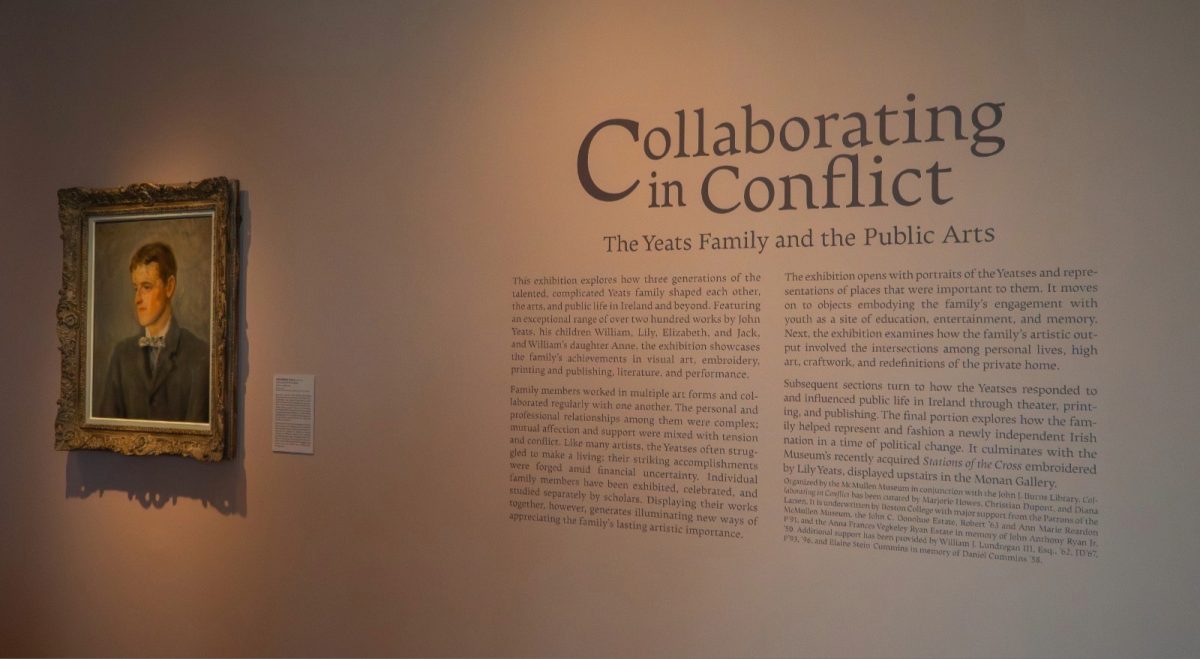
This Sunday, the McMullen Museum of Art opened Collaborating in Conflict: The Yeats Family and the Public Arts, a new exhibition that establishes itself as one of the must-see exhibits on campus this semester.
This new exhibition centers on the Yeats, Ireland’s most influential family of artists, and situates their work within the broader cultural and political landscape of Ireland at the time.
The exhibition’s greatest strength lies in its astonishing breadth of media. Over 200 works of art invite viewers to look into the creative mindset of the family. Walking through the Daley Family and Monan Galleries, onlookers notice how the space completely transforms into a living archive of artistic expression.
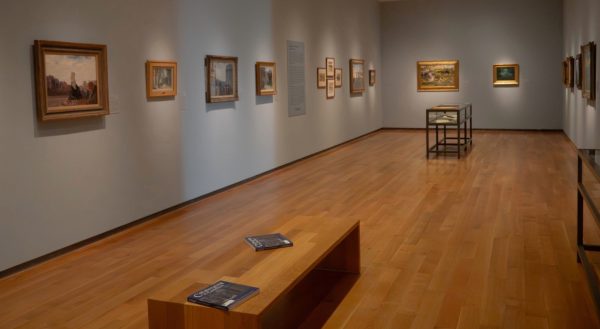
Collaborating in Conflict makes the important choice not to place William Butler Yeats—the family’s most well-known figure—at the center. Instead, the exhibition deliberately widens its scope to include works by John Butler Yeats, his children William, Lily, Elizabeth, and Jack, and William’s daughter, Anne.
This curatorial choice proves highly effective. Paintings sit beside handwritten letters, sketchbooks, and set designs in conversation with illustrated poetry. This creates a portrait of a household in which ideas circulated freely and evolved across generations.
Rather than presenting the Yeats family as a collection of isolated geniuses, Collaborating in Conflict succeeds in doing something far more compelling—it frames the family’s legacy as incredibly cooperative and convincingly human.
Another one of the exhibition’s most compelling aspects focuses on works created for private and devotional spaces. Lily Yeats’ embroidered pieces stand out for their excellent craftsmanship and unusual medium, which actively challenge conventionally accepted hierarchies of fine art.
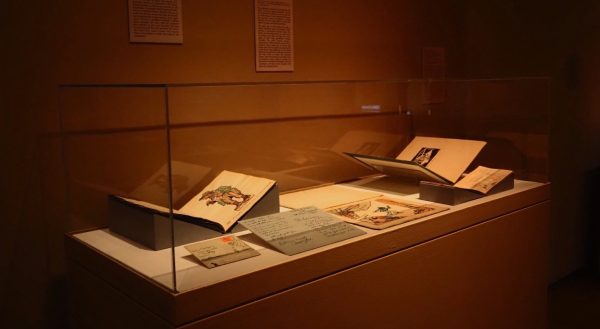
The exhibition consists of major loans from the Model, the National Gallery of Ireland, the Library of Trinity College Dublin, and prominent private collections. Many of the works are on public view for the first time, and several have never been exhibited outside Ireland, making this a rare opportunity to encounter them in person.
If there is a central, overarching argument to Collaborating in Conflict, it is that creativity is rarely smooth or solitary. The exhibition makes clear that artistic collaboration often involves tension and sacrifice, and that these forces can be incredibly productive.
Collaborating in Conflict is an exhibition that is crucial to be experienced in person. Walk through the snow-lined paths to the McMullen and experience a rare, historic collection that captures public art at its most human.






Paul G Schervish • Feb 4, 2026 at 9:56 am
Is there a virtual tour? Please let me know. Thank you.