
Despite increased immigration tensions across the country, Rev. Alejandro Olayo-Méndez, S.J., emphasized the importance of migrants maintaining hope despite hardships.
“Somehow people find a way,” Olayo-Méndez said. “They eventually find a way to rent an apartment, find a way to send the kids to school, find a way to get in touch with families.”
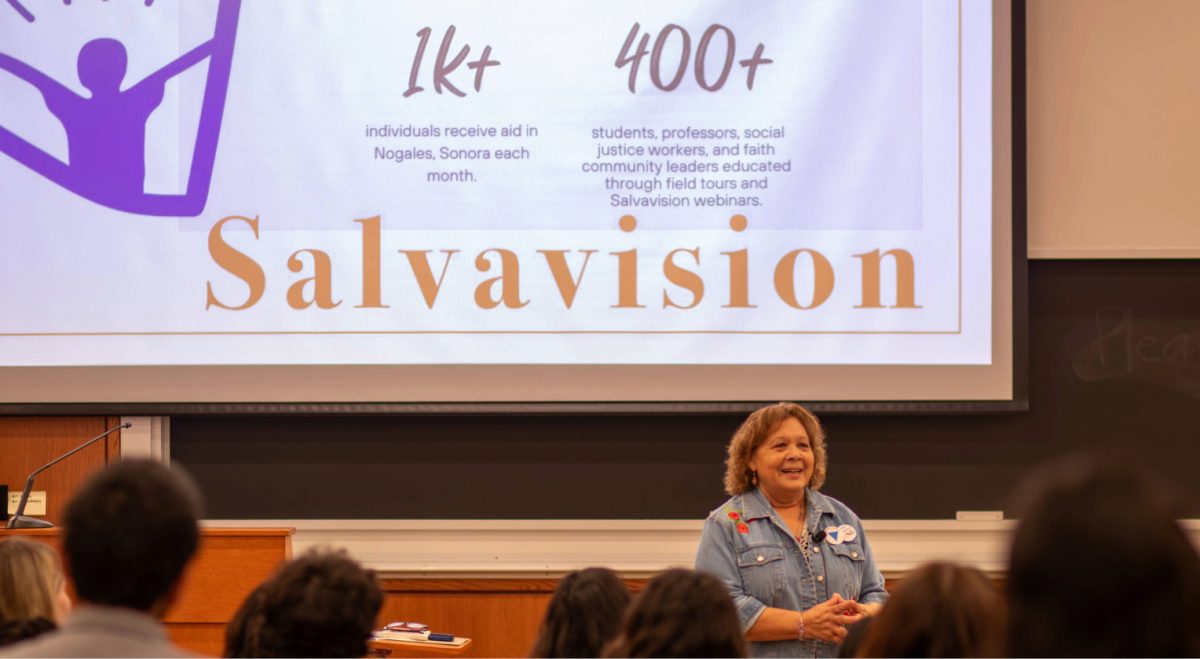
Olayo-Méndez, an ethnographer with an extensive background in migration and an assistant professor of social work, spoke Thursday at a Boston College School of Social Work Global Practice event about the violence at the U.S.-Mexico border and how and why people endure it.
Some of the most violent instances at the border are perpetrated by border control and enforcement, Olayo-Méndez noted, arguing that the way in which they operate is a spectacle meant to humiliate migrants.
“It’s a spectacle,” Olayo-Méndez said. “It’s a show off of who holds the power, the deportation element. It’s about humiliating people. It’s about showing toughness. It’s about, kind of, an exercise of power.”
While these tough policies are leading to high deportation and arrest rates and lower border crossings in the short run, they will not work in the long run, due to the instability in many migrants’ countries, Olayo-Méndez asserted.
“Eventually things will level, or people will get used to it and find new ways to cross because the pressures, and I will say this later on, the pressures do not stop,” Olayo-Méndez said. “The reasons people are leaving their countries do not stop.”
While these pressures can be economic or opportunity-based, Olayo-Méndez explained, one of the most prominent reasons people are migrating is the threat of violence against themselves and their families.
“You either get extorted, or you get ‘We’re going to kill you,’ by different criminal groups,” Olayo-Méndez said. “But the trigger point, the tipping point, is when they threaten to take away your children.”
Olayo-Méndez argued that because the pressure to leave is so great, increasing border patrol without changing the legal system doesn’t stop people from migrating, but forces more unsafe border crossings.
“The more security you deploy, the more budget Border Patrol has to patrol, to use technology, the more you force people—who may or may not have a valid claim—to cross through more dangerous routes, or you force them to hire the services of organizations that profit from that experience,” Olayo-Méndez said.
In terms of legal entry, Olayo-Méndez stated that many humanitarian workers have lost hope, as the majority of their clients do not gain prolonged access to the United States through the courts.
“You feel like you are going nowhere—that there is no way to help people,” Olayo-Méndez said.
Nevertheless, the humanitarian organizations must keep fighting despite the legal hardships, Olayo-Méndez argued, because they have hope in the few that will succeed.
“It’s very easy to feel despair when you hear a story of a woman who said, ‘I did everything right, and I was removed, and my two children are in Phoenix,’” Olayo-Méndez said. “When there’s really no legal recourse, what do you do?”
The rest of the hope at the border comes from the migrants’ resilience. Olayo-Méndez claims that they must be exceedingly resilient to make it to the border, and that resilience doesn’t stop once they reach it.
“I asked someone, ‘Why do you feel that the numbers are very high?’” Olayo-Méndez said. “They said, ‘These people made it to the border, of course, they are going to be resilient.’”
Olayo-Méndez reasoned that migrants’ ability to fight for their future shows that many still have enough hope to stave off despair.
“So the point is, the hope comes from them, and somehow, with or without humanitarian aid, with or without support of social work, people fight,” Olayo-Méndez said. “It may not look pretty, they may be in very vulnerable situations, but people find a way, and to me, that shows they are capable of hope.”