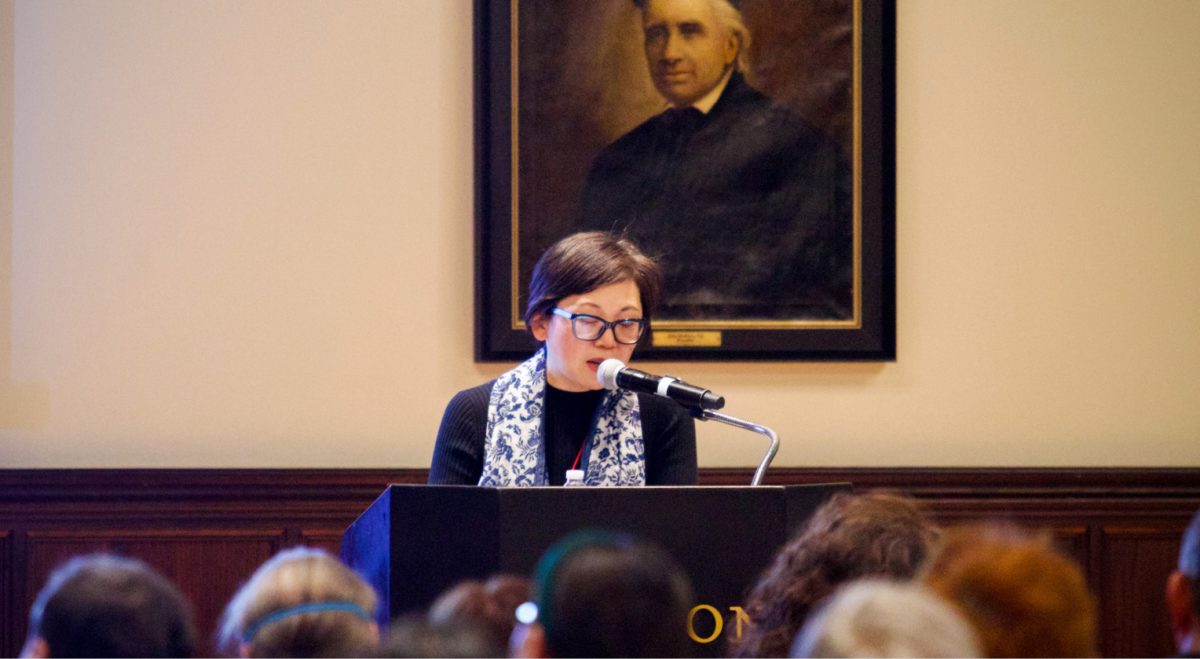
On Wednesday night, students, professors, and Boston locals flooded into Gasson to hear Yiyun Li, author of 12 books and a multitude of short stories, memoirs, and essays, speak as part of the Lowell Humanities Series, presented by Boston College’s English department.
A professor at Princeton University, Li’s many accolades include being a MacArthur Foundation Fellow and an Andrew Carnegie Medal for Excellence in Fiction recipient. Her awards reflect the frank and deeply philosophical nature of her work, achieved through a mastery of both metaphor and realism.
Li was originally meant to speak at BC over two years ago, but had to cancel after the tragic passing of her son.
She began the lecture by sharing a story about Marie Curie, the French and Polish scientist and the first woman to win a Nobel Prize. Li said that as a child, she looked up to Curie and wanted to be a physicist like her.
One of Curie’s sayings that stuck with Li was, “I will try,” which she took as a mantra and applied to her life.
Li spoke about her series of short stories published in The New Yorker about a woman, Lilian, who has lost her two young sons, Oscar and Jude. She says her most recent short story, “Techniques and Idiosyncrasies,” is a piece about living and writing. When she mentioned and described her characters, she did so with fondness, as if they were her children, and their pain was her pain.
Li then read out a portion of the story in which Lilian is in a car with a stranger who takes her to see a cabin where a young woman was murdered. The excerpt was tense and awkward, and as Li read aloud, Lilian’s anxiety in the strange situation was palpable. In this sliver of her work, Li displayed her talent of extending and pushing metaphors, squeezing every bit of meaning from every word.
Her writing is a juxtaposition of profound insights and everyday scenarios. At one point, Li writes that Lilian knows, “She could only wait for each day to arrive and then discover the meaning of that day.”
Li said that this is a keystone experience of her life: sometimes, while writing a chapter, it is too painful, so she puts down the pen, then, the next day, starts a new chapter. This is a way for her to mark time.
For Li, the frequent marking of time is immensely important—each story and each chapter is a way to mark who she was at a certain time.
Every year, Li rereads both War and Peace by Leo Tolstoy and Moby-Dick by Herman Melville, and, despite having read them numerous times, she uncovers new details every read. She is a changed person from year to year—her notes in the margins remind her of her past self and note the passage of time.
“I think marking time is the most important thing, especially when time is difficult,” Li said.
Li then read a preview of her upcoming short story, “Calm Sea and Hot Ferry,” which will be published in The New Yorker on Sunday, March 1, and is a continuation of Lilian’s story.
After she received a question about idiosyncrasies and whether they should be something writers strive for or work to avoid, Li spoke about her writing process.
“Always protect your idiosyncrasy because that’s who you are,” Li said.
She explained that every writer has their own unique quirks and traits, and that using them as an advantage is a characteristic of a strong writer.
To close, Li ended with a message of self-improvement and hope meant to encourage the creatives within the audience.
“I can never accept that I will be good—I can only accept that I am better than yesterday,” Li said.