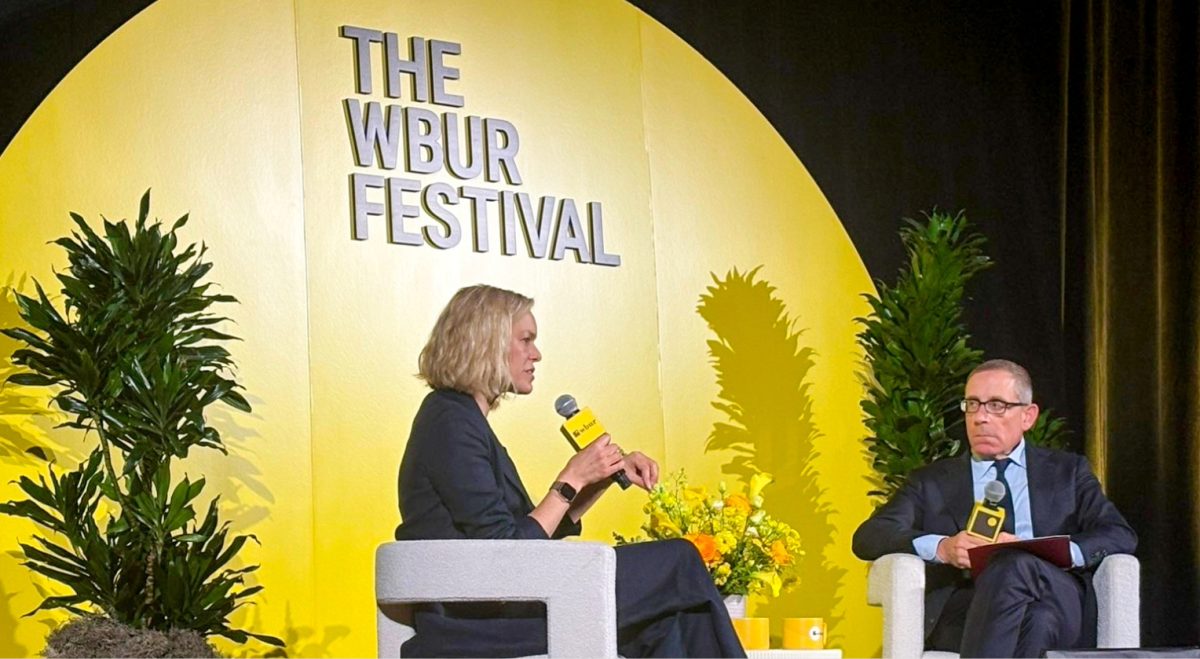

Young people have an unprecedented opportunity to effect meaningful change around the world, according to Sophia Kianni, founder of Climate Cardinals—the world’s largest youth-led climate nonprofit.
“I have never been more confident that it is the best time to be a young person who is passionate about social impact and wants to make a difference,” Kianni said. “There truly has never been a better time to innovate and to capitalize on these opportunities.”
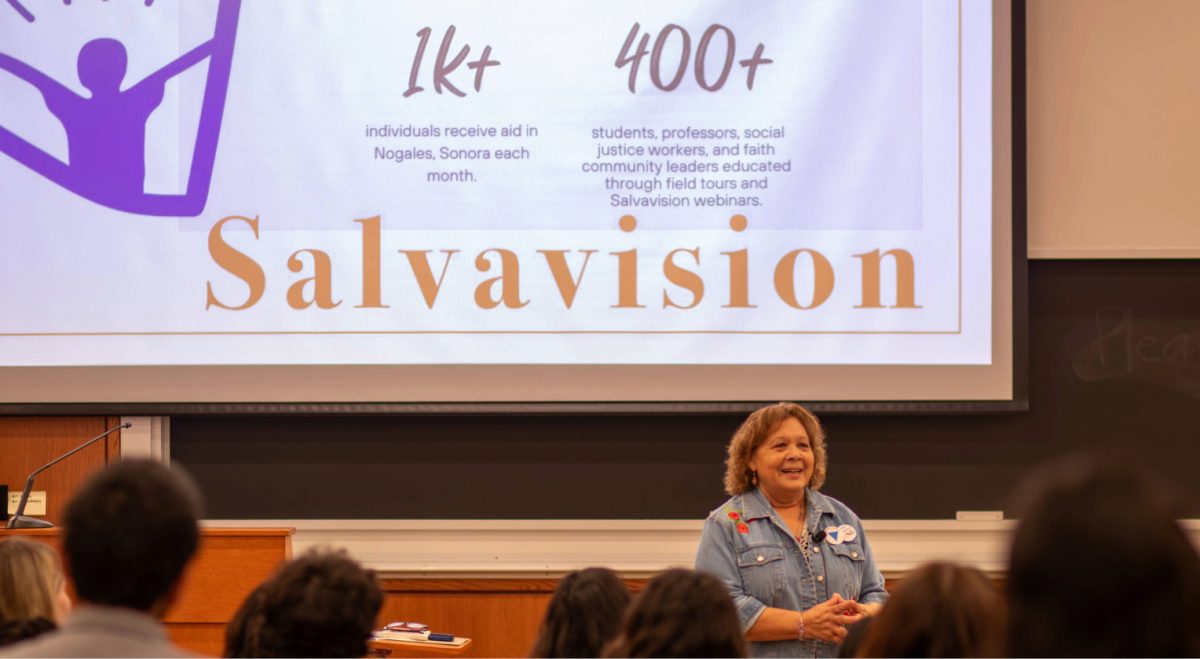
The Winston Center for Leadership and Ethics hosted Kianni’s lecture on youth-led activism.
Kianni is the co-founder of Phia, an AI-powered e-commerce platform that facilitates sustainable shopping. Kianni is also the youngest adviser to the United Nations Association of the United States of America—an official ancillary U.N. organization established to promote the U.N.’s political and public support within the United States.
Kianni’s talk emphasized the importance of an international response to climate change, highlighting her experiences as an Iranian-American and her inspiration for Climate Cardinals.
“I used to spend every single summer visiting my relatives in Iran,” she said. “I learned that every single day, thousands of people were being hospitalized because of the air pollution in Iran. I also learned that temperatures in the Middle East were rising more than twice the global average. My relatives were living on the frontlines of the climate crisis.”
Despite the prevalence of the issue, Kianni noticed that climate literacy in Iran was shockingly low.
“When I started to talk to my relatives about these issues, I realized they’d never really heard about climate change,” Kianni said. “I looked more into the literature, and learned that less than 5 percent of Iranian university students could properly explain the greenhouse gas effect.”
The greenhouse gas effect is a process through which atmospheric gases trap heat near Earth’s surface before the heat can escape into space. Fossil fuel emissions have intensified the process, causing global temperatures to rise.
In high school, Kianni was deeply involved with climate activism, working closely with various organizations to promote change. She observed, however, that resources to fight climate change had not been made accessible outside the United States.
“When I was working with these different climate organizations in high school, I noticed that almost all the resources, the organizing handbooks, every piece of literature that we’re getting was pretty much exclusively in English,” she said. “And the vast majority of people who were on the frontlines of the climate crisis are not in the United States. But they weren’t at these discussions we were having. We’re basically talking about people, but we were not talking to them.”
So Kianni decided to take action. With the help of 19,000 volunteers across 145 countries, Climate Cardinals translates critical information into languages besides English. Building this organization, she explained, was a lesson in getting people involved.
“The biggest thing that I took away from this, in terms of inspiring the people around me into taking action, was that most people are aware that problems exist in society,” Kianni said. “The issue is that they feel apathetic towards them, or they feel like there’s not anything that they themselves can do. The way that you get people to take action is by giving them tools.”
While she was an undergraduate at Stanford University, Kianni realized how inefficient and unsustainable the fashion industry was. This further cultivated her passion for fighting climate change.
“There’s enough clothes in existence to dress the next six generations of humans,” Kianni said. “I thought it was fascinating that we had created this cycle where companies were arbitrarily pumping out garments. And then people would either return items at astronomically high rates or those items would end up in landfills. It was clear that something was very, very fundamentally broken.”
To address this issue, she co-founded Phia with entrepreneur Phoebe Gates—daughter of Microsoft founder Bill Gates. The platform makes sustainable, second-hand shopping more accessible.
“It wasn’t an issue of ‘I’m not interested in that [second-hand shopping],’ it was an issue of, ‘I didn’t know that I could buy the item I was looking at for a fraction of the price, in a far more sustainable way, from a different website,” Kianni said. “The first solution we built was a Chrome extension, where, as you’re shopping, you can click a button, and it would find all of the options from across the internet at a cheaper price.”
Whether it is through her work at the U.N., Climate Cardinals, or her latest work with Phia, Kianni’s passion for youth-led action and fighting climate change has been the throughline of her career.
“Looking at my work, from Climate Cardinals to Phia, the thing that really has remained true is that young people have, right now, the biggest opportunity to make a difference and an impact with very little resources,” Kianni said. “All of this was possible with pure agency, a lot of hard work, and bringing incredible groups of young people together to work on a specific problem.”