Access to available, affordable, and respectful health care is one of the most important factors to curb poor outcomes in birth and neonatal-related health fields, according to Holly Powell Kennedy.
“We did a case study of this birth center [in northern Uganda],” Kennedy said. “They’ve had 20,000 births and never lost a mother. This is a country that has had 354 births to 1000 deaths, and their neonatal outcomes are better than what they are for Black women. What we learned was that having care that’s accessible, available, and respectful is [important for successful outcomes.”
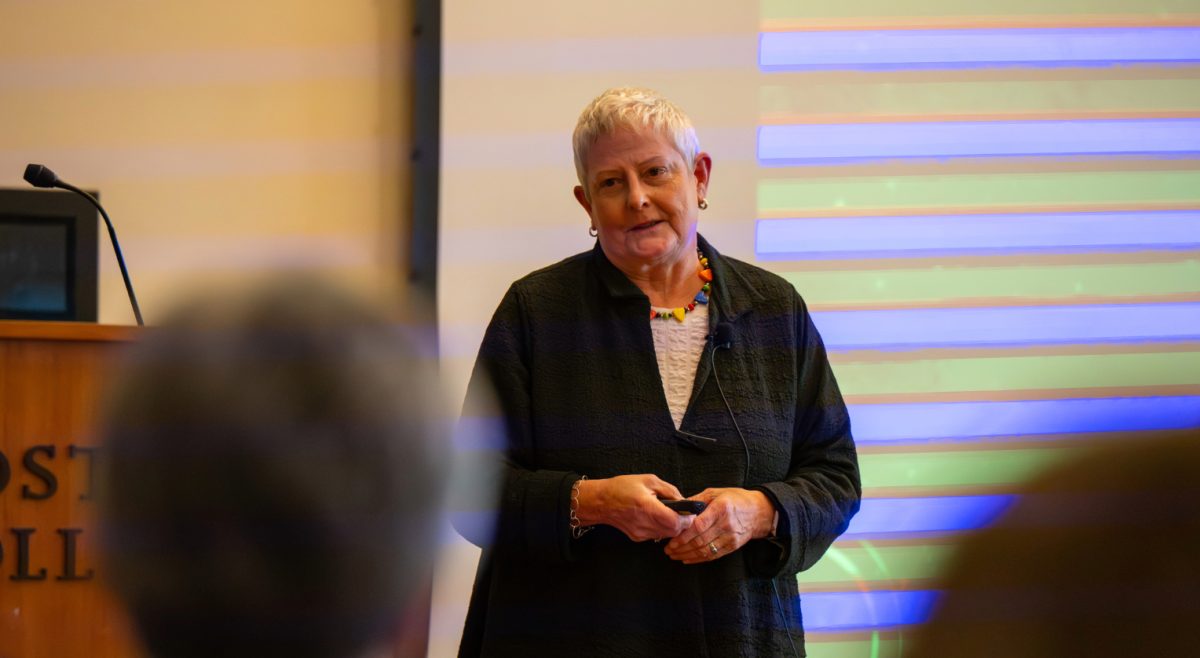
Kennedy, the Helen Varney professor of midwifery emerita at Yale University, was the keynote speaker in the fall 2025 Pinnacle Lecture Series, hosted by the Connell School of Nursing.
“Respect for the diversity of thought, ideas, and the opinions of others, and then working on solutions together, that kind of problem-solving works, and it saves lives,” Kennedy said.
After being inspired by the model of care she had seen with midwives, Kennedy began a Delphi study, which seeks to find consensus on topics through questionnaires, with 64 midwives and 71 women cared for by them.
“We asked the participants to identify what they thought the most important quality and trait was of a really good midwife, the most important processes of care, of what you do in caring for women, and what the most important outcomes are,” she said.
Through the Delphi process, her team found three key qualities consistently showed up in the participants’ answers, which became the driving force behind Kennedy’s research.
“This was the leader [of the qualities]—that a really, really strong midwife had to believe that pregnancy and birth were normal processes for the most part, the most important process of care was what they called the ‘critical art of doing nothing,’ and the last one of the outcomes was the optimal health in the given situation,” Kennedy said.
The need for these qualities remained evident in Kennedy’s work, showing up in places like the difference between the standard of care in other countries versus America, what childhood education books were promoting to women, the importance of the relationship between nurses and midwives, and understanding when and how to intervene in labor.
Factors like lack of preparation before labor, epigenetic stressors that affect the woman and newborn’s chemistry, such as endorphins and oxytocin, and even racism all impact the likelihood of a poor outcome in the United States.
“At the end of the work that came out of my dissertation, one of the things I think I learned, and especially for women of color, is that institutional racism—whether you are discriminated against day after day after day—that changes your chemistry,” said Kennedy.
Kennedy shares how, toward the end of her research, the National Academy of Sciences had asked her and her team to anchor a comparison of different birth settings.
“When we looked at [Australia, England, Canada, and the Netherlands’] health systems, we found five major areas, and that was that healthcare was affordable, it was accessible, it had a maternity workforce that emphasized midwifery, and interprofessional collaboration had respectful care and maternal autonomy that was in their guidelines,” Kennedy said.
Kennedy discussed developing an index to help various organizations, schools, and practices use a framework to assess how effectively they meet the needs of mothers and infants, and measure their birth services.
“Do you have a workforce that is organized so that you’ve got the most appropriate people doing the frontline care, and needed referral services,” Kennedy said. “That’s what all mothers and infants need. They need access to all of that. This is the scope of midwifery. That entire box is mostly preventive and systems, and is the scope of our practice.”
Kennedy notes the importance of changing what health outcomes look like, and that starts with powerful mothers and families, but they need to have the room to get there—through midwifery.
“‘If we get birth right, we get the world right,’” Kennedy said, quoting Soo Downe, a clinical and research midwife. “‘Starting life with a positive birth experience sets the scene in the best possible future well-being for women, babies, and families.’”