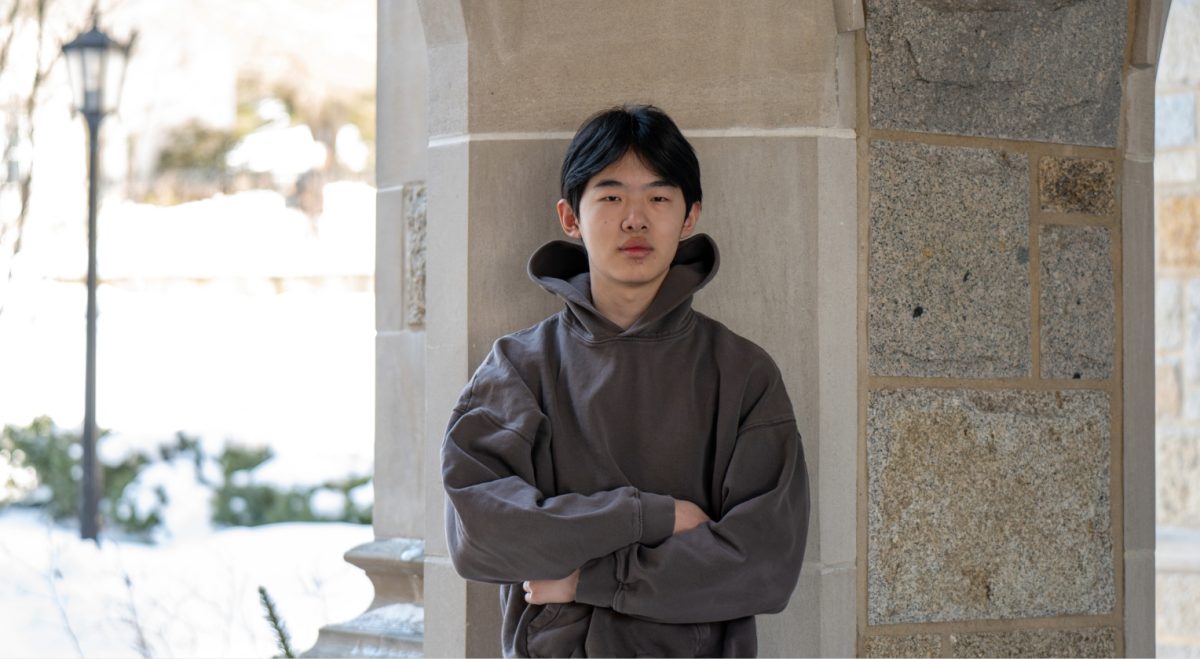
After spending years volunteering in hospitals and nursing homes, Jonathan Xue witnessed patients’ gradual memory deterioration, and soon identified a gap in cognitive testing.
“Every single time I went, the same people would ask me, ‘What’s your name and what are you going to be playing?’ even though it was the same song for months, and that turned into years,” Xue said. “It was jarring to see them decline in real time.”
Throughout his experience, Xue, MCAS ’29, soon developed a desire to address these inequalities in testing. Putting his passion into action, Xue developed accessible, at-home cognitive tests that assess memory through speech input.
“The brain is this whole mystery to everybody, and I just hope older people can use this,” Xue said.
Inspired by his grandfather, who struggled with cognitive decline, Xue said he wanted to develop a test to combat the same issues his grandfather dealt with.
“The reason I started it is because of my grandfather,” Xue said. “He had Alzheimer’s and passed away. I wanted to see if I could do something to help people with similar struggles.”
These close observations stuck with him, and Xue began to see disparities in the medical field that warranted a change.
“Usually, these tests are performed by a doctor at a clinic during a yearly visit, but some people don’t really have access to doctors or don’t go in for checkups that often, or they just aren’t aware that this testing exists,” Xue said.
Using his prior experience coding and doing neurological research at Stanford University, Xue developed an accessible set of tests that utilized artificial intelligence and voice analysis.
“I take in the voice and the times, how long they talk, and words per minute,” Xue said.
With this data, he can assess their cognitive abilities using a spectrum based on the average population’s speech speed and pauses.
For Xue, AI, when used correctly, can be a powerful scientific tool to create change and generate accurate data.
“AI is able to take in some pretty useful data in terms of the words that they say, the amount, and the time it takes for people to say the words,” Xue said.
After his initial development, Xue reached out to nursing homes for piloting. Here in Newton, at Sunrise Senior Living, Xue was able to walk residents through his tests.
“Their experience was the best feedback I could get,” Xue said. “Where they struggled to do it, or where the test broke down, that was the most valuable part.”
According to Xue, development is ongoing.
“I’m still getting feedback, still expanding it, it’s a continual process,” said Xue.
Looking toward the future, Xue hopes that his tests can provide an accessible resource for the elderly and their families.
“I think the end goal might be that a family member who’s more technologically literate can help an older family member go through it,” Xue said.
Xue’s tests, which he created and pursued on his own, are a powerful example of how far a desire to help others can take you.
“In research, sometimes you really don’t see the end product of what you’ve done,” said Xu. “It isn’t the same experience as talking with people and seeing them actually use something you made.”