As an economics major, I have been thinking a lot about the financial state of our country.
Each day, whether in class, talking to friends and family, or reading the news, it seems there are endless new developments to consider. Are artificial intelligence investments overvalued? Will war in the Middle East spike inflation? Will housing prices ever go down?
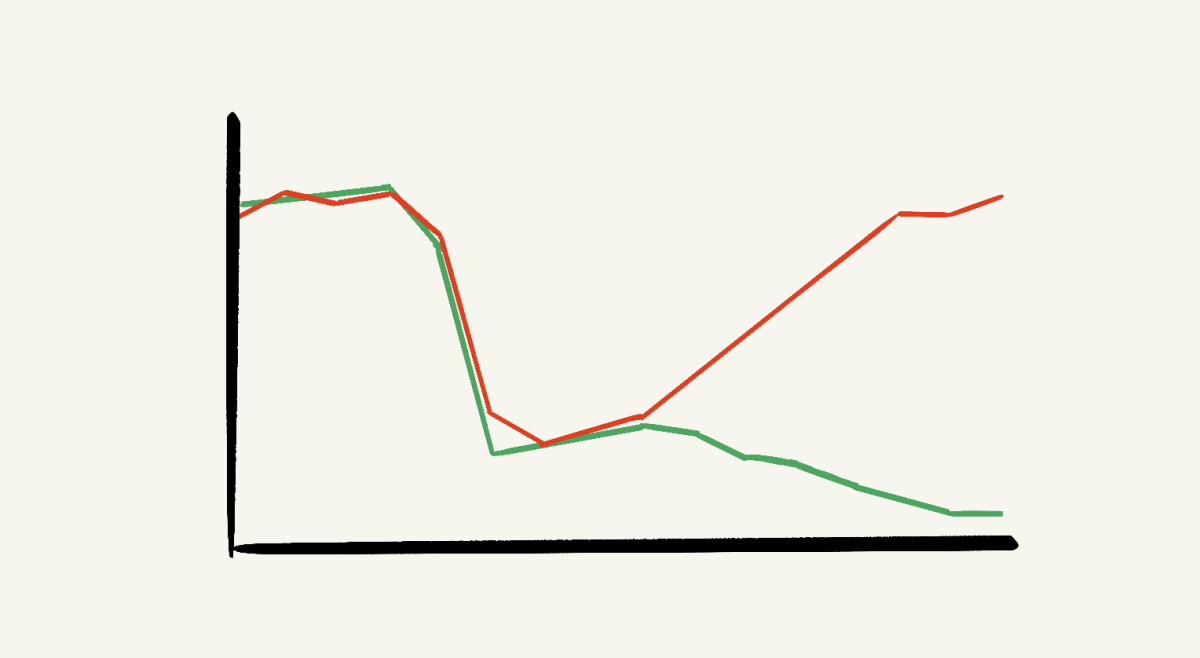
The one constant in all of the uncertainty: the “K-shaped economy.”
This phenomenon refers to a bifurcated model of economic growth in which certain groups or industries see rapid gains and an upward slope, while others struggle, trending downward. It gained prominence during the post-pandemic recovery, when wealthier households saw much larger increases in income and wealth after the 2020 recession than less wealthy ones.
But the concept has also become a widely used shorthand for growing economic inequality. As the stock market soars and the wealthy drive consumer spending to record highs, other Americans have seen weaker wage growth while the cost of living continues to rise. As a visual representation of these dynamics, the K-shaped model reflects a common refrain: The rich are getting richer, while the poor are getting poorer.
The social ramifications are an under-discussed aspect of this reality. Those on the top half of the curve are increasingly insulated from the everyday realities of the bottom. The “haves”—people with high incomes and valuable assets—often live in a kind of bubble. They are more likely to be educated at a relatively small set of institutions, network within similar circles, and go on to work in many of the same fields and locations. The “have-nots,” on the other hand, are much more heterogeneous—across races, jobs, and life experiences.
It would be wrong to suggest that Boston College is only made up of the former. But it is undeniable that, as one of the most expensive colleges in the United States, BC draws a significant concentration of students from wealthy backgrounds.
Soon after arriving at BC, many students find they have a surprising number of commonalities: the same towns, high schools, sports teams, even childhood vacations. You probably play “the name game,” as I like to call it, with anyone you meet and land on at least one or two shared connections. What we often fail to recognize is that these overlaps can reflect the similar socioeconomic environments in which we grew up. It is a small world, yes, but an even smaller world for the well-to-do.
This insularity is not inherently bad—no one chooses the zip code they grew up in or the private school that fed into their college. But it can lead us to mistakenly confuse the familiar for the universal.
When your social network is composed of people who share your economic background, it becomes easy, even natural, to assume your experience of money, opportunity, and hardship is simply “how things are.” This narrowness limits our perspective and our ability to empathize and engage with people from different backgrounds—qualities needed to act as “men and women for others” and to tackle the world’s problems once we leave BC.
The Jesuit traditions of service and social justice push against this tendency—ideals I have seen many students embrace through advocacy, volunteering, and courses like God, Self, and Society. But awareness alone is not enough if our social world remains a closed loop. True understanding requires exposure.
BC can start by doing more to bring different economic realities onto campus: expanding financial aid, broadening recruitment, and fostering a culture that actively seeks out people from across the K-shaped curve—not just those who happened to land on its upper half.
I do not pretend to have all the answers to a problem as vast as economic inequality, but I am confident that any solution begins with stepping outside our familiar circles. None of our most pressing issues—the wealth gap, housing insecurity, and the skyrocketing cost of living—will be solved from inside a bubble.