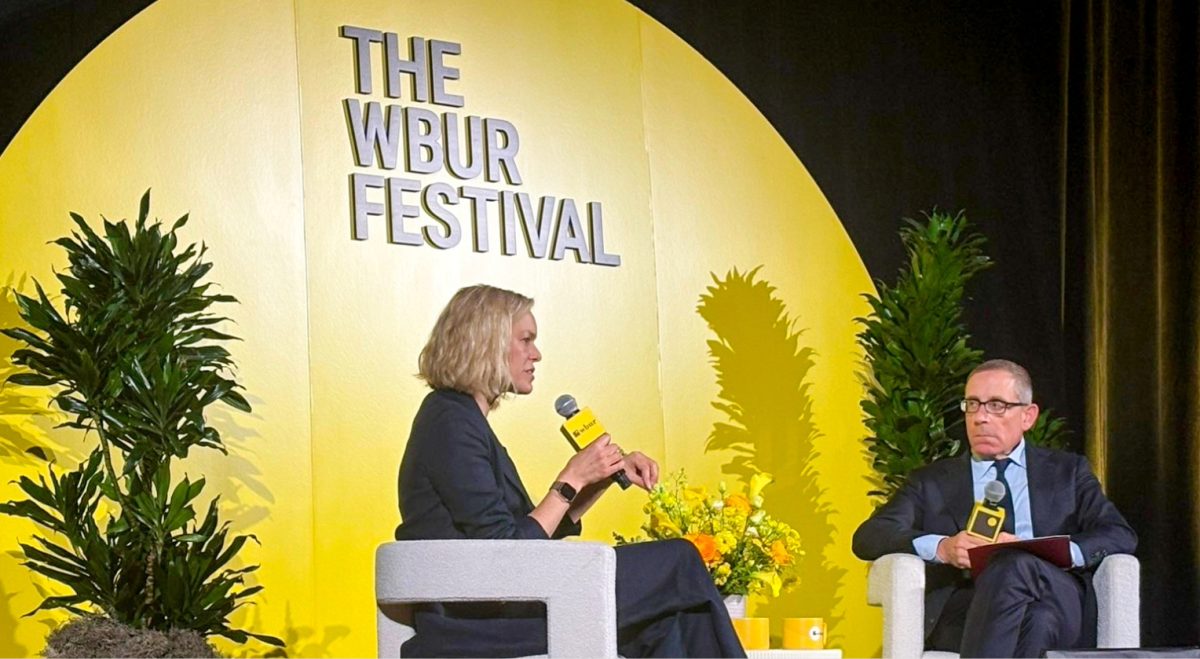

A trailblazer in American ballet, Misty Copeland reflected on the profession’s longstanding racial barriers and her journey to becoming the first Black woman principal dancer in the American Ballet Theatre (ABT)’s 75-year history during a Boston College event Thursday night.
“Joining the American Ballet Theatre was very shocking,” she said. “I entered the American Ballet Theatre, and I’m the only Black woman in a room full of 90 dancers, and that would continue for 10 years of my career.”
Copeland spoke at the Council of Women of BC (CWBC) Colloquium, an annual event celebrating women’s leadership and achievement, named in honor of Kathleen McGillycuddy—the first woman to serve on the University’s Board of Trustees and the founder of its Council of Women.
Copeland’s journey to ballet was unconventional. She didn’t begin training until she was 13 years old—considered late in the dance world—and had no prior exposure to classical music or ballet traditions.
Before discovering ballet, she found joy in performing on a drill team, auditioning with a not-so-traditional routine set to George Michael’s “I Want Your Sex.”
“How anyone let me do that?” Copeland asked jokingly. “I don’t know.”
Her trajectory shifted when she was offered a free ballet class at a Boys and Girls Club, taking her first lesson on a basketball court.
Soon after, she began training at the San Pedro Ballet School under Cynthia Bradley, who became one of her most influential mentors alongside renowned actress and choreographer Debbie Allen.
Her mentors offered her stability, encouragement, and a sense of belonging during a childhood marked by housing insecurity and family hardship.
“I felt loved and nurtured and supported,” Copeland said. “Ballet was the farthest thing from a priority for my family. To have someone like Cynthia Bradley and Debbie Allen in my corner taught me the importance of accepting guidance and mentorship.”
As Copeland advanced within ABT, she learned to advocate for herself within an institution that had historically not made space for voices like hers.
A turning point came when Copeland began engaging directly with artistic director Kevin McKenzie, advocating for herself and calling for change.
“You spend your entire training being told not to speak,” Copeland said. “Then all of a sudden you’re a professional, and you’re supposed to advocate for yourself.”
Mentors like Susan Fales-Hill helped Copeland persevere through these moments of doubt and adversity.
One pivotal moment came after a 2007 New York Times article exposed the marginalization of Black dancers, which included Copeland—the only Black dancer in the theatre—as evidence of the disparity.
The piece highlighted how Black dancers were rarely promoted to classical lead roles, often remaining in the corps or being pushed into contemporary parts.
“I remember calling Susan in tears with this newspaper and having her say, ‘But it’s okay to be the first,’ and encouraging me to stay the course,” Copeland recalled. “It was life-changing for me to have that kind of support and to persevere.”
At the same time, Copeland’s artistry was being recognized beyond the ballet world. The musician Prince, a longtime admirer of her work, invited her to appear in one of his music videos.
Their collaboration evolved into a close artistic relationship that reshaped how Copeland viewed her identity.
Prince encouraged her to take pride in her uniqueness and to transform her differences into a source of power.
“He said, ‘But you’re the only Black girl on stage, and everyone’s looking at you. Isn’t that amazing?’” Copeland recalled Prince saying. “It was about shifting the perspective and using uniqueness as strength. And if I could learn that from anyone, it was Prince.”
This narrative shift played out during her performance in The Firebird, which marked a defining artistic and cultural breakthrough. Her role in the set symbolized strength and transformation, and in Copeland’s eyes, mirrored her own journey.
As the first Black woman at ABT to perform it, her presence redefined what classical ballet could look like, disrupting longstanding visual and cultural expectations while expanding the possibilities for future generations.
“The night of my first performance in New York City, the Metropolitan Opera House [was] sold out full of Black people for the first time to see ballet,” she said. “I was staring at myself in the mirror before going on, and I was just like, ‘I am the Firebird.’”
Conversations about the cultural relevance of dance persist. More recently, comments made by Timothée Chalamet suggested that art forms like ballet are no longer central to popular culture.
“I don’t want to be working in ballet or opera, or you know things that are like ‘keep this thing alive’ even though no one cares about this anymore,” Chalamet said during a Variety and CNN town hall with Matthew McConaughey.
Copeland reframed the critique and said that ballet’s impact is not about staying “trendy,” but about its ability to evolve, reach new audiences, and continue shaping culture in meaningful ways.
But, when asked whether she had been giving the actor “laser eyes” from the Oscars stage, she didn’t hold back.
“Oh, I did,” she said.