★★★★☆
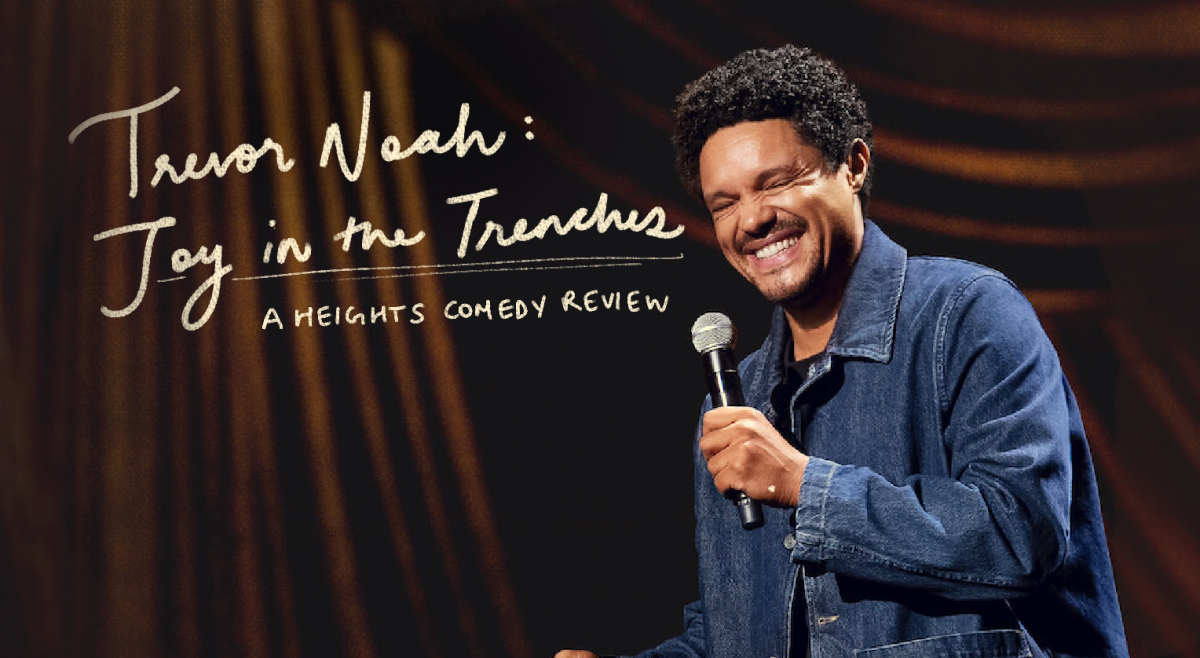
Trevor Noah returns to the stage with his latest Netflix special, Joy in the Trenches, delivering exactly what the title suggests: humor in an increasingly uncertain world. Whether it’s the chaos of the present global landscape or the everyday ups and downs of modern relationships, Noah invites the audience to laugh through it all—because at times that feels like the only option.
The opening segment draws from Noah’s recent experience of hosting the Grammy Awards, along with the strange afterlife of televised moments. While the more obvious jokes land, the starting set feels less like a cohesive performance and more like a running response to the Grammys. Rather than building a strong foundation, the early minutes come across as reactive, still warming up before hitting its stride.
This carries into the next stretch, where Noah moves through bits inspired by global figures and hypothetical scenarios. The humor is there, but rarely surprises. Many of the jokes feel predictable, landing when you expect them to, sometimes a beat before the punchline even arrives.
But Joy in the Trenches shifts when Noah steps back from specific references and leans into a broader idea: what it actually feels like to be “living through history.”
This is where the special finds its footing. Noah reframes history not as something distant or predictable, but as messy and uncertain, drawing a parallel between today’s reality and the past.
He highlights this by contrasting how history is taught with how it unfolds in real time, where each action seems more unsure than the next.
“The trenches” captures this perspective perfectly, placing both Noah and the audience in the present moment, without the benefit of hindsight.
The humor becomes more reflective and effective here. Instead of relying on rapid-fire references, Noah lets his stories breathe, building jokes around shared experiences of the unknown—waiting, reacting, processing. The result is a quieter form of comedy that doesn’t aim for constant laughter, but for recognition.
This shift also brings out one of Noah’s strongest instincts: using comedy as a way to process, rather than simply comment. His question: “Who will you be when history calls?” lands as one of the most memorable moments of the special. It’s funny, but it doesn’t undercut its own weight.
The question lingers, reframing the role of the audience as not just observers in history, but as participants in it.
The latter half of the special reflects this change in tone. It feels more cohesive, intentional, and at times more genuinely funny. Noah leans into storytelling over punchlines, letting ideas fully develop before rushing to the next joke. Even when callbacks to earlier themes appear, they feel more integrated than repetitive.
While the opening leans on familiar, topical humor, the special quickly settles into a more thoughtful and engaging rhythm.
Ultimately, Joy in the Trenches succeeds not because it perfectly balances out humor and commentary, but because it embraces the uncertainty it describes. It doesn’t try to neatly resolve the chaos of the present. Instead, it chooses to sit within it, finding humor in that discomfort.
In doing so, Noah reminds his audience that comedy doesn’t always have to provide answers. Sometimes, its purpose is to simply make the moment feel more manageable. And in a time when everything feels up in the air, that might just be enough.