

This column is the second installment in a three-part series.
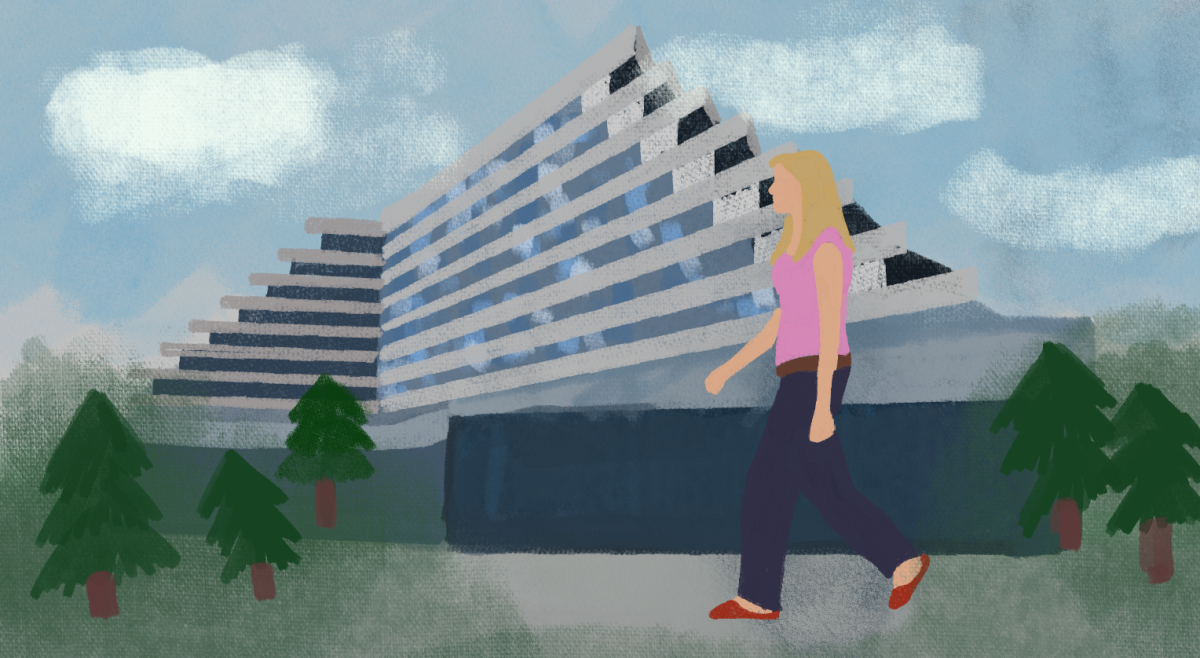
Rewind the clock a few years, and suddenly I’m back in Pennsylvania with Paul at Penn State, embarking on yet another wild undertaking. Just as the snow began melting in the spring of my freshman year, Paul asked me to spearhead the marketing of a new business he’d already set in motion.
For privacy’s sake, I won’t get into specific details, but the moment he described his innovative new app to me, I was instantly all-in. The level of thought and intention Paul put into his ingenious, yet simple software was undeniable, and I was sure it deserved all the recognition and success in the world. For weeks, I spent hours designing logos, writing catchy taglines and slogans, crafting ads and infographics, and most of all, creating eye-catching visuals for our posters. By the time our physical launch rolled around, we were well set up to draw in as many passersby as possible in one of Penn State’s dining halls.
It was a smashing success, and we all walked away from the launch giddy with excitement, talking over one another in a clamour of voices bursting with new possibilities. But swept away in our excitement, we’d neglected to have an upfront conversation about the division of compensation. Here, we arrive at my first major blunder: Paul and I were such good friends that the conversation felt unnecessary; of course we’d be on the same page!
After the launch, however, I quickly discovered that while he thought I’d taken on this role as a friend volunteering to help out, I had dedicated all those hours to the company believing that eventually I’d be compensated for my time. Unfortunately, when I brought this up, Paul didn’t want to engage in the conversation. He simply stated that because he and his co-founder had been working on the app for longer than I had, he didn’t even want to discuss compensation until I’d worked on it for the same length of time.
“We’ll revisit this conversation in six months,” was his repeated refrain. Six months of uncompensated labor with only a vague promise of a potential payoff was a bit more than I bargained for, but I chalked it up to the fact that we were only freshmen, so maybe Paul hadn’t thought it through. A perfectly fair miscommunication, I surmised. After clarifying that I didn’t have the bandwidth to continue, considering I’d been operating under a very different set of assumptions, he completely understood. I left the company, and all was well.
That is, until a friend of mine reached out to me a week later with a strange update—Paul had apparently asked her to give him all the posters I’d made, without consulting me. Odd, I thought, but perhaps it’s just another misunderstanding. She directed Paul to me, so he called me that same night.
Initially, it was the same as always—we maintained our characteristic upbeat banter, and jokes, catching up like we always did. Then, he asked for the posters, still in the same light-hearted tone. But something made me pause.
I’d dedicated extraordinary amounts of time to making these posters, staying up until well past 5 a.m. some nights at Penn State’s makerspace, all under the assumption that I’d be compensated in some way.
Even if the compensation were not monetary, I would have gladly accepted a fraction of equity, though I knew that would likely lead nowhere due to the company’s low likelihood of success. It was about the principle of it all. After all, we’d been building this thing knowing that even if the company didn’t get off the ground, we would all sink or succeed together.
I told Paul how I felt and said I’d be more than happy to sell them to him for a discounted price if that suited him. A long, pregnant pause ensued.
What followed, I remember only in fragments, but my most vivid memory is his voice. It had always been filled with warmth when we spoke, his pace often quickening as his excitement mounted. At that moment, however, every word became slow and measured, suddenly cloaked in hostility and bitter, bitter cold.
“I never thought you’d be so entitled. I really thought you believed in the mission of the company, but if you keep the posters without giving them to us for free, you’re just keeping them out of spite,” was the first accusation he levied against me.
Taken aback, I felt like I’d been sucker punched. I greatly respected Paul’s judgement, so my gut instinct was to believe him and try to remedy the situation. So I instantly walked back my initial statement and said I could maybe give him the posters for free, but first, I just had to call my dad and ask for his advice. As an entrepreneur, he’d know what would be considered normal in the business world.
My dad, however, felt even more strongly that I shouldn’t give them away for free: “I know you do a lot of volunteer work and community service, but this is completely different. In any business setting, no one should ever be working or doing any labor without being explicitly offered some form of compensation in writing.”
So when I called Paul back and relayed these sentiments to him, all pretense of civility went out the door as he unleashed round after round of insults, each wilder and crueler than the last, each designed to cut deep.
“I do not respect your reasoning at all. You have always been one of the people I’ve respected most on this campus. But now, that’s completely changed.”
When I asked if we could talk this through and come to a compromise, he responded with cold laughter, “No, I know you won’t change your mind. I know you’re a very decisive and stubborn person, and once you make a decision, you won’t change it.”
After 45 minutes of similar attacks on my character, all that was left was to simply extend my sincerest well wishes for the success of his company and his life moving forward, to which he responded, “I don’t think you mean that.”
It was heartbreaking—not only to be treated with such contempt by someone I’d once felt so close to, but to feel I lost a part of myself along the way. In him, I’d found a kindred spirit, someone purpose-driven and excited to put ideas into action. Before or since, I’ve never met someone with whom I felt so immediately aligned ambitions-wise. That’s why this splintered friendship began to crack open my previously unbreakable trust in my own intuition.
………………………………………………………………………………………………….
Fast forward to the summer after my freshman year, and I’m with Barry, basking in Prague’s summer sun, aspiring to embark upon yet another exciting venture. As a refresher, we worked at the same marketing company, but he was the assistant director of a separate department. Incidentally, and as luck would have it, I needed to collaborate with his department to launch one of the event ideas I was most passionate about for the company.
When I pitched the idea to him, he was immediately on board, and we were off, excitedly scheming and planning for how it might be actualized, though I’ll again omit specific details for privacy’s sake. Before the idea got off the ground, though, he had to secure his department’s approval. In the interim, we became closer with every passing day as we embarked upon increasingly absurd adventures. We sat in the front row at horrible open mic nights. We even discovered strange board games together, like ICECOOL, an odd game where each player takes turns flicking a tiny penguin piece around the board.
These experiences snowballed, one after another, and before I knew it, I was meeting his family outside a Czech ice cream shop. They’d flown all the way to Prague to visit him, and they were each exactly as Barry had described. His brother gleefully made fun of him for choosing Pink Whitney as his go-to alcohol, his younger sister kept adding coins to a nearby gumball machine, and his parents fondly shared embarrassing stories from his childhood. It was right out of an idyllic scene from a postcard.
All too soon, though, Barry told me how worried he was about the end of summer when we’d head back to the States; he felt long-distance would be too difficult unless we officially started dating soon, so that we could spend time together in person before trying long distance. The problem was that, as real and beautiful as our blossoming connection was, it had only been a few weeks since the day we met, and I wasn’t ready for that kind of commitment.
When I told him as much, he was understandably hurt and immediately distanced himself in response. Especially since I had just met his family and our connection felt all-in from the very start, he must have felt extraordinarily blindsided by my dismissal.
I soon found that this kind of guilt has no parallel. There is no consolation in knowing how deeply you’ve entrenched yourself in someone else’s life only to eventually break away. Even if the relationship was short-lived, even if you have agency and are allowed to decide one way or the other, it’s still a sorrow that time can never fully mend. No matter how much I might reflect and grow from this experience, I’ll never forget the pain my choice caused. There’s no avoiding it, and the only way out is through.
Despite this seismic emotional upheaval, I still had this event idea to contend with, so I reached out to him soon after. “I still really want to pursue the event, so I’ll talk to the director about it, and if you want to be involved, you’re more than welcome to, but if not, I completely understand.”
He replied, “I’m gonna let you know as we meet and talk about it. Right now, we aren’t certain that’s the direction. You will be kept in the loop.”
A month and a half passed, and I heard nothing. I assumed that the director probably wasn’t on board. Not wanting to overstep any boundaries, I didn’t push the issue, and all was well.
Then came one of our routine, twice-a-month all-team meetings. With a staff of around 120 members, these meetings were usually spent planning events and presenting exciting, new ventures. I was sitting in the third row, zoning out slightly, when suddenly the name of my event flashed across the projector screen. Not a skeleton of an idea, not an initial proposal, but a polished event that had been fully fleshed out for the past month and a half. A date had been set, digital posters made, a marketing plan put together, a committee assembled to plan it, and all of the logistics had already been organized–all without my knowledge.
My stomach dropped. I felt a hollow sensation spread through me at the shock of witnessing my idea suddenly materialize in front of me without having had the slightest chance to contribute to it. Indeed, this idea was one of the first I presented in my interview for the company a year prior. It had been a large part of the reason I’d joined the company in the first place, so I was extremely excited to pursue it.
Similar to the situation with Paul, however, my gut instinct was one of understanding. Perhaps someone had tried to communicate this to me and it had simply fallen through the cracks. In fact, I was so deluded that I thought maybe I was added to the planning committee but had just missed an email a while back or something.
I was too frazzled to discuss it with anyone right away, but I knew the department hosting the event met right after our all-team meeting, so I waited outside in the hallway until the meeting was finished then stood to head inside once people started filing out. Barry was among the first to leave, and when he saw me outside, he pulled up instantly, surprise and confusion registering on his face.
Again, the events that followed are fragmented in my mind, but my most vivid memory is his demeanor. Once so full of warmth and joy, always glancing over to see if he’d made me laugh, he was now cold, putting on an air of apathy, and barely making eye contact.
“What are you doing here?” The words themselves were completely harmless, but their delivery was judgmental, accusatory, and clearly implied that my presence was overstepping.
Flustered, I replied, “Oh … I’m just here to see if I can have the chance to contribute to the event,” since it was my idea. The words remained unspoken because I didn’t want to stir up any drama.
He and his friend laughed outright, joking to each other, “Oh, but this was your idea right, Barry?” “Yeah obviously,” riffing back and forth, not addressing me further, then leaving together. I didn’t understand the joke, and it’s possible I’m not quoting the words exactly right because it’s been so long, but the way they made me feel remains lodged in my memory—publicly and openly humiliated.
Indeed, he called me after this happened, and his first words—“well that was weird”—implied that even attempting to be involved in planning my own idea was somehow a huge overstep, making me feel even more humiliated.
The rest of the phone call passed with various excuses, “We’ve already planned everything and have our team fully organized, so bringing you in would actually be a hindrance at this stage. Also, it would make me really uncomfortable to be in a planning meeting with you after everything that’s happened, since I’m the co-director of this entire event.”
This rhetoric cleverly painted me as disruptive, as if I were the instigator of my own ostracization. Setting aside that I never asked for this event to be planned behind my back, I truly understood how he felt. Perhaps it had been just too painful for him to communicate with me, so he hoped that by ignoring the problem, it would ignore him too.
Indeed, in due time, it was all chalked up to a misunderstanding: Apparently, in the very same department, someone had come up with precisely the same idea as me, and that’s what justified not contacting me about this event (though none of the others knew of my involvement).
Either way, by the time the event happened a month later, it was a smashing success, so I wanted to be courteous to my colleagues who’d planned it. I walked up to one of them afterwards and congratulated them for all the work they’d put into organizing the event, to which they responded, “Don’t thank me! This whole thing was Barry’s brainchild!”
I’ll admit that one stung a little bit.
Whatever the case, nothing could change the fact that building such a tightly-knit, warm, undeniable closeness with Barry, only for that connection to turn cold as ice, closed, and dismissive of something extraordinarily important to me, dealt the final blow to my intuition.
How is it possible to rebuild confidence in one’s discernment after such shattering experiences of misplaced trust? What does it say about a person’s judgment if they’ve been “duped” not once, but twice by people they would’ve sworn up and down would never have treated them with anything but glowing respect? Can there be any path forward but drawing shutters closed and treading with paranoid caution?
These two experiences, along with the lessons they taught me, will be explored in part three—the final installment and final piece of the puzzle—as to how these two stories, and their impacts, ultimately tie together.




Anushkaa • Nov 17, 2025 at 3:08 pm
Wonderful piece, as usual. As I write this comment from my work computer, I don’t have the capacity to materialize all my thoughts into this comment, but i do want to say, the way you see people is truly commendable. I am sorry you had to g through these harrowing experiences. Diligently waiting for the next piece. Miss you <3