
You can’t care for other people unless you take time for yourself first, according to Shawna Cooper Whitehead, vice president for student affairs.
“Unless you schedule those types of things, you’re not really taking care of yourself, and you don’t always have to show up for everybody all the time,” Cooper Whitehead said. “If your energy is depleted, you can’t really show up fully.”
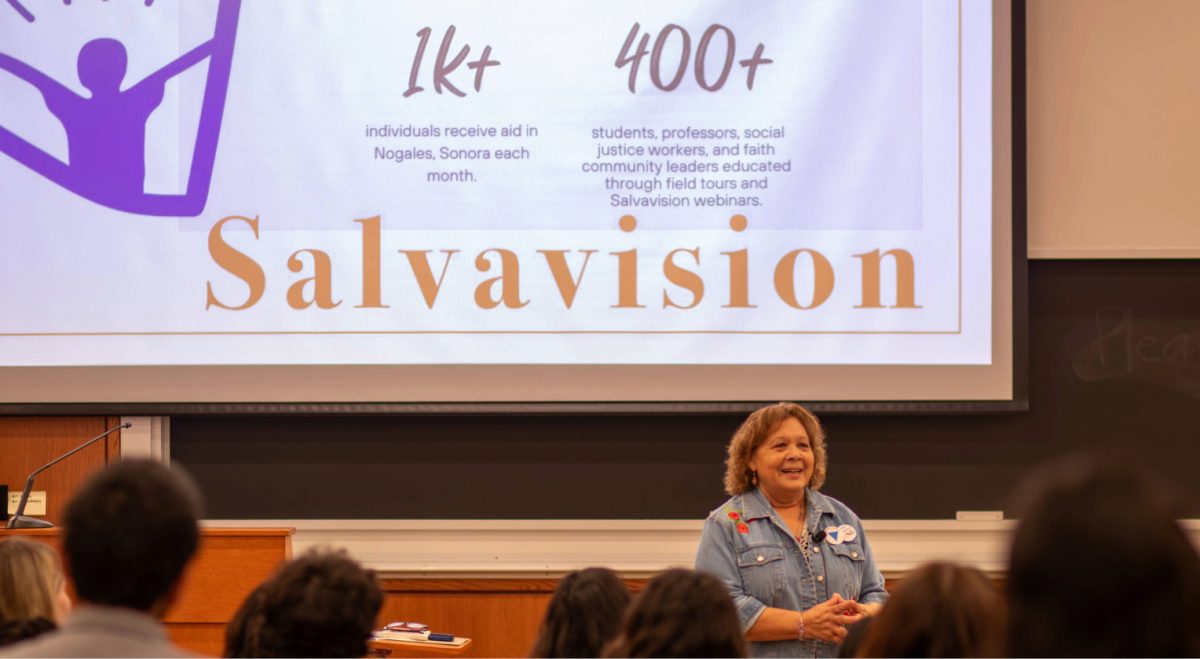
The Boston College Summit welcomed Cooper Whitehead for a conversation about her background and current position on Nov. 6. The event, titled “A Seat at the Table,” was a collaborative effort among the Women’s Center, Career Center, Office of Student Involvement, the Thea Bowman AHANA and Intercultural Center, and the Essence Project.
The event gave student employees of the Women’s Center and other attendees the opportunity to ask Cooper Whitehead questions over dinner.
Cooper Whitehead reflected on what it means to be completely herself, or as one of the student employees described it: “her essence.”
She said that much of her essence is what she does everyday at work—as a Black woman, fostering a sense of togetherness and diversity among the BC community is a big priority. Talking to people from different backgrounds in the community is crucial to ensure all voices are reflected and progress is made, she added.
“I don’t do anything that I don’t consult others on,” she said. “It is important that I talk with folks, that I work with colleagues that are awesome and wonderful, but I also hear the students.”
Student employees asked Cooper Whitehead where she plans to be in the next 10 years professionally. She emphasized having a positive mindset on change and progress, explaining that she does not want to keep at a job that becomes stale and fosters no growth.
In 10 years she sees herself in a different position, but still pushing for change. She also highlighted the importance of rest and not working yourself too hard.
“So real talk, in 10 years, I’m probably going to be at the tail end of my career,” she said. “I’m not going to joke, I’m trying to retire at about 59. But part of that is because I also think sometimes in American culture, we work really hard, and sometimes too long.”
Cooper Whitehead noted some of the black women who inspired her to get to the position she is in today. Her biggest inspiration is her mother, who graduated in 2005 with an undergraduate degree at the age of 55. She said her second biggest inspiration is Kamala Harris.
“Regardless of how you feel [politically], it was pretty phenomenal to see a woman of color run for vice president of the United States, and then run for president—something that I’d never seen in my lifetime,” she said. “That she held her head high when she lost, that she still wanted to connect with people she found in her book that’s still biting her. That’s really inspirational to me.”
As she shared her story and perspective on impostor syndrome, Cooper Whitehead recounted growing up in a predominantly white community and how it taught her valuable lessons on being confident in herself. According to Cooper Whitehead, actively opposing racism and stereotypes became a big priority, and as a result, allowed her to be more engaged in her community.
“And so I was like, you know what? I’m going to try to dispel any stereotype that they have about Black people,” she said. “So when I tell you, if there wasn’t just an honor roll, I’m going to make high honor roll, that I’m going to be on every team, that I’m going to run for student government and do my best to win.”
Cooper Whitehead encouraged the audience to take setbacks in stride, emphasizing the importance of redirection. She invited students to come talk to her if needed, and not hesitate to ask for help.
“I think about all these kinds of challenges, failures, and defeats as kind of different—it wasn’t meant for you,” she said. “It doesn’t mean that there’s any indication of who you are as a person, how smart you are, or how talented you are. It has nothing to do with that.”