Former Ethiopian Minister of Health Lia Tadesse Gebremedhin urged nations and donors to rethink the way global health assistance is designed and delivered, warning that ineffective governance and short-term planning continue to limit progress in developing countries.
“When you look at foreign aid it’s been critical in saving lives and building systems,” she said. “It also accounts for an average of 25 percent of health spending in low income countries, and in some countries, it actually could be as high as 50 percent. Globally, when you look at foreign aid, it’s not that high, but zooming into countries, particularly in Africa, it represents a significant portion.”
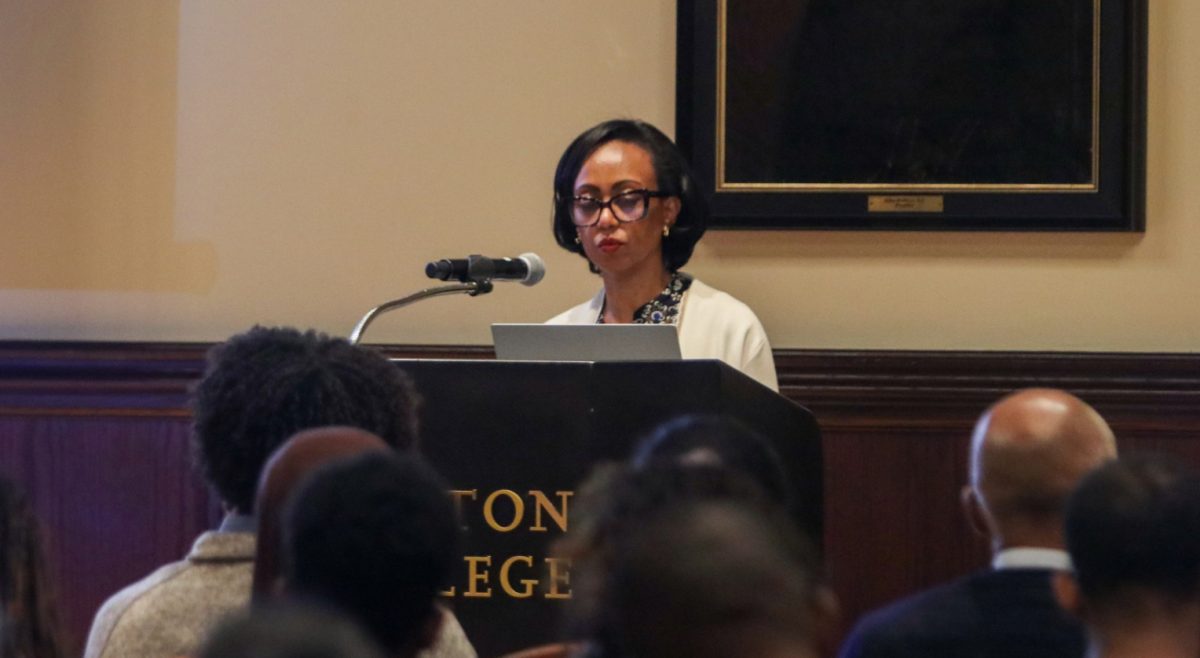
Speaking at Boston College on Wednesday for the Winston Center for Leadership and Ethics’ fall lecture series, Gebremedhin highlighted the critical but often precarious role foreign aid plays in supporting the health budgets of African countries.
Despite these investments, Gebremedhin argued that the absence of a centralized global authority to direct efforts has left international health initiatives increasingly fragmented and inefficient.
“There is an absence of a clear overarching institution, which has resulted in an increasingly fragmented global health agenda,” she said. “The WHO, for example, tries to play that overarching role, but it doesn’t necessarily cover all areas. That’s one of the key challenges in global health.”
She also observed that the global landscape for aid has shifted in the years following the COVID-19 pandemic.
“The post-pandemic era has brought a decline in funding due to policy changes in the U.S. and other countries,” Gebremedhin said.
Tadesse underscored the urgency of developing more sustainable and inclusive approaches to public health financing, specifically, those that allow African nations to lead their own development agendas.
“Navigating towards sustainability requires strategies, again to efficiency, innovation, but also equity,” she expressed.
To illustrate how investments in health can yield measurable benefits, Tadesse pointed to data showing the link between spending and improvements in life expectancy over the past four decades.
“Within the last 40 years, a 1 percent increase in health spending is associated with a 0.24 month increase in life expectancy,” she said, attributing the increase to factors like HIV control and reduced mortality rates.
Gebremedhin reminded the audience that the concept of ‘development assistance for health’ goes beyond monetary support and should consist of ever-evolving partnerships across industries and nations.
“Development assistance for health refers to both financial and technical support provided by international dollars, which include bilateral, multilateral, and philanthropy,” she said.
Gebremedhin—executive director of the Harvard Ministerial Leadership Program and a professor at the Harvard T.H. Chan School of Public Healt—called on students and policymakers alike to view global health not as charity, but as a shared responsibility.
“Addressing equity gaps within these countries should be a global responsibility, because, of course, many of the diseases do not have borders,” Gebremedhin said. “There’s a need for global solidarity, there’s a need to reform how aid is allocated. When we talk about country leadership, it all comes down to enhancing domestic financing through different mechanisms with innovative financing and other ways that require more commitments on the ground.”