
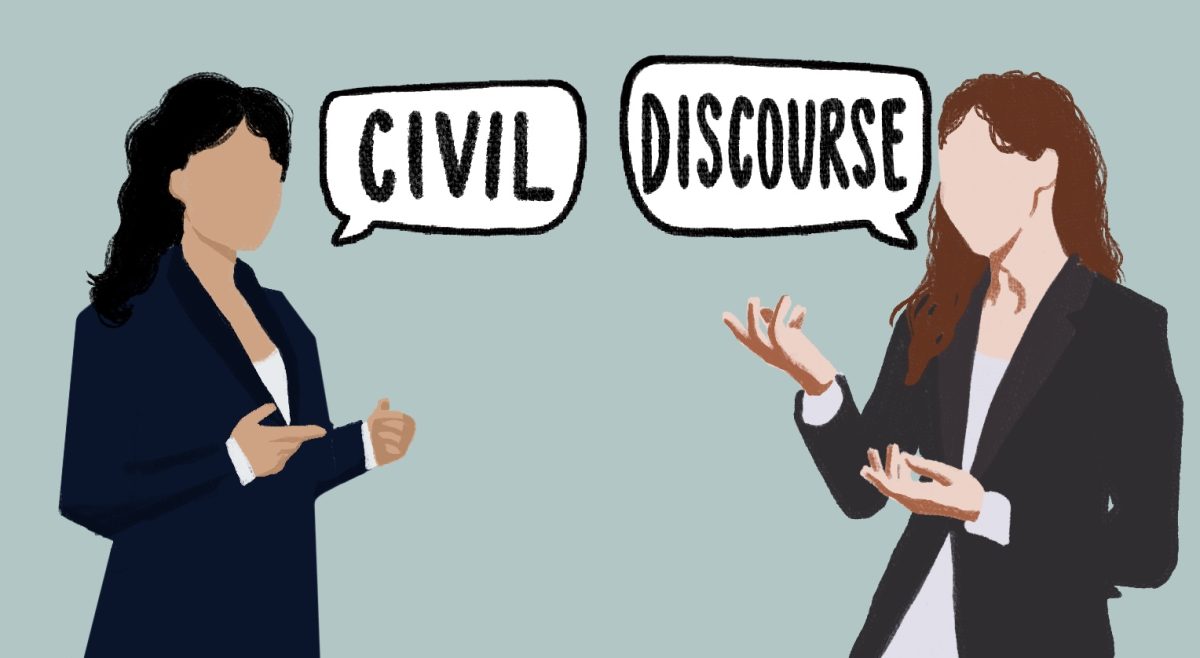
Editor’s Note: This is the third installment of Civil Discourse, a column where columnists Helen Nguyen and Addison Walsh share their perspectives on a political story or event covered by The Heights. This third column is a response to “They Will Kill You”: BC Republicans Speaker Urges Audience to be Willing to Die for Conservative Beliefs.”
Helen Nguyen:
Nick Solheim claimed that “the so-called marketplace of ideas … is long past.” But the marketplace of ideas never closes—people like Solheim are simply too scared to enter. Engaging appropriately in the marketplace of ideas—in civil discourse—requires prescription, flexibility, and the capacity to listen. Given all these requirements, simply shouting out ideological maxims is far easier.
Solheim’s comments were dangerous and counterproductive. They do not belong in the free marketplace of ideas because he doesn’t regard them as ideas, but instead as truth. The fundamental issue with his remarks is how they disguise themselves as fact and attach themselves to an identity. Warning students that their political opponents will kill you and everybody that you love to get what they want” is blatantly hyperbolic, yet delivered with confidence and an angry tone, it seems like an actual threat.
Solheim quoted Tucker Carlson, saying “that’s not how white men fight,” in reference to the violent murder of Charlie Kirk—while dismissing the fact that the suspect in Kirk’s shooting is a white man and that “white men” is not a political identity. What is most dangerous here is how the comments attempt to isolate the experience of white men. Singling out an identity group forms a superficial air of exceptionalism that further divides our political scene. We hardly need more division.
Nevertheless, the BC Republicans are a legitimate campus organization, and they deserve to voice their opinions, so long as they can back them up. Though the club denounced Solheim’s remarks and rhetoric, inviting him to speak in the first place suggests that they found value in his ideology and in American Moment. I would love to see them flesh out these points with the elegance of a student in Jesuit higher education.
Accordingly, the BC Republicans should host an open debate on campus in response to the backlash over Solheim’s speech. Debate, and learning how to debate, is essential in an academic environment like BC’s, which strives to cultivate both social justice and an informed worldview.
Today, engaging in politics as young people often means retreating to echo chambers, looking scornfully at the “extremists” on the other side. Social media algorithms only exacerbate this politicization.
BC Republicans’ values—however contradictory and infuriating they may seem to the Democratic masses—deserve a place in our campus’ marketplace of ideas. We need to learn how to engage with beliefs that differ from our own and respond with thoughtful, original rebuttals.
We’ve all seen what poor debate looks like (remember the 2024 presidential election), and that is not the model we should follow. So, instead of letting people scared of civil discourse influence our political beliefs, let us embrace the real marketplace of ideas. Our political advocacy will be stronger and more informed when it comes from the conversations we have—both with each other and across our diverse ideologies.
Addison Walsh:
In an era of unabashed political tribalism, our right to freedom of expression—both as students and as Americans—is increasingly under threat. By attacking student protestors, censoring university curricula, and taking legal aim at its most outspoken critics, the Trump administration has demonstrated a tenuous commitment, at best, to free speech.
High-profile acts of political violence and subsequent finger-pointing have left Americans shaken and perhaps questioning whether the long-heralded pillars of tolerance and cooperation still stand. Of course, the omnipresence of social media and relentless discourse on the merits of “cancel culture” only adds to this tension.
Fast forward to Nick Solheim’s speech to the BC Republicans. The CEO of American Moment—a right-wing organization aimed to train the next generation of conservative policymakers—Solheim’s speech titled “How to Implement the MAGA Agenda” that portrayed ideological disagreement as an all-out-attack.
He told students “[they] need to be willing to be killed” for their beliefs, warning that “millions” of Americans would kill them simply for identifying as Republicans. Citing the assassination of conservative influencer Charlie Kirk—along with a slew of other acts supposedly committed by “transsexual deviants” and “libtard protestors” among others—Solheim asserted that “the enemy” encourages mass violence out of merciless hatred for conservative, Christian values.
These statements go well beyond partisan bluster, crossing the line into all-out demagoguery. This was not some riff to entertain a like-minded audience. It was a rallying cry meant to radicalize them. Young Republicans, he suggested, ought to feel such deep-rooted fear—for different races, identities, ideologies—that they are compelled to act.
To his credit, Solheim explicitly denounces the use of violence as a means of resistance—albeit with the grotesque, bigoted rationale (via Tucker Carlson) that violence is “not how white men fight.” But this condemnation rests upon an even more alarming premise. “No, we’re not having a tidy debate in the so-called ‘marketplace of ideas,” he said.
This is where the true danger in his speech lies. It is clear that Solheim believes, as I do, that our current political environment is hostile to fair debate. But instead of treating this dilemma as a collective problem we must work together to overcome, he casts the blame on some exaggerated caricature of liberal hatred. This emotional framing of ideological disagreement—enemies versus friends, oppressors versus oppressed—provokes the very brutality the speaker claims to stand against.
I agree with Solheim that free speech means far more than being able to use offensive terminology without repercussions (though I fail to understand what makes his chosen words any more acceptable at this moment than they were four years ago). Free speech is the ability to share opinions and ideas widely—without government censorship, yes, but also without fear for one’s physical safety.
When people feel that their lives and the lives of those they care about are under threat, they turn to desperate, often violent measures as misguided means of protection. In demonizing Democrats and minority groups with combative language, Solheim inherently encourages a self-righteous brand of violence. This inflammatory rhetoric endangers our marginalized peers and, ultimately, emboldens the perilous state of self-expression in the United States today.
While BC Republicans made the right call in disavowing these remarks. I can only hope their response would have been the same without the backlash. Rejecting these sentiments—and people who seek to normalize them—is the only way to prevent dangerous ideologies from creeping into the mainstream.
I think it is important to remember that the First Amendment prevents the government from infringing on the expression of its citizens, it does not stop private entities—including campus organizations—from taking action against speech they oppose.
The question we must answer as future leaders is this: Where is the line?
A quarter into a century that has already seen ceaseless wars, stock market crashes, several high-profile assassination attempts, and an armed insurrection—along with seemingly-constant political turmoil—it’s hard to gauge which statements are truly dangerous and which are hyperbole. Frankly, it is difficult to find any threat un-likely when we see innumerable shocking headlines every day on social media.
As BC students, we have an obligation to model an open, respectful marketplace of ideas for those, like Solheim, who have declared it extinct.
Write the op-ed. Ask your friends —and even less-than-friends—what they think about current events. Question your professor’s characterization of a historical figure. I only ask that you do so out of appreciation for different perspectives, not fear of them.






Curious George • Nov 24, 2025 at 12:07 pm
I think that the irony of this column is that it wants to celebrate the “marketplace of ideas” while quietly loading it with what you could call regulatory fine print. When Helen Nguyen writes that the marketplace “never closes—people like Solheim are simply too scared to enter,” she unintentionally reveals the deeper problem: many on this campus think they get to decide who is a legitimate participant in that marketplace and who isn’t.
You cannot insist on “civil discourse” while policing which ideas are permitted to show up.
A genuine marketplace does not require the permission of its competitors.
Nguyen also writes that Solheim’s remarks “do not belong in the free marketplace of ideas because he doesn’t regard them as ideas, but instead as truth.” That sentence alone betrays a profound misunderstanding of free speech. In a free society, individuals should present their views as truth: that is what moral conviction looks like; otherwise, public debate collapses into a kind of timid relativism where no one is willing to stake a real claim about what is right, good, or worth defending.
Declaring that someone’s ideas “do not belong” because they are spoken with conviction is not civil discourse. It is political suppression disguised as virtue.
Addison Walsh then claims in the second piece of this article that Solheim’s rhetoric is “dangerous,” “radicalizing,” and “encourages a self-righteous brand of violence.” But isn’t this exactly the type of expansive, subjective language that has historically been used to justify censorship? The test for whether speech is allowed in a free society cannot be whether a listener feels “endangered” or “triggered” by hearing it. If emotional discomfort becomes the standard, then anything outside the progressive orthodoxy can be dismissed as “dangerous” without ever engaging its content.
Ron Paul, I believe, put it best: “We don’t have the First Amendment so we can talk about the weather. We have the First Amendment so we can say very controversial things”.
One of the most telling lines in the article is Walsh’s reminder that “the First Amendment…does not stop private entities—including campus organizations—from taking action against speech they oppose.” True—but that statement cuts both ways. A private organization like BC Republicans also has the right to invite speakers whose ideas are unpopular, controversial, or provocative. Freedom for me but not for thee is not a serious principle.
If this campus truly values the “open, respectful marketplace of ideas,” it must start by abandoning the reflex to pathologize dissent. You don’t strengthen the marketplace by excluding vendors.
You strengthen it by proving them wrong in debate.
Drew • Nov 28, 2025 at 7:02 pm
Your comment claims to defend free speech and the “marketplace of ideas”, but you don’t actually engage with anything the author argued. Instead of responding to the substance of the critique, you pivot to warning about some vague threat to free speech without showing how the author’s points undermine it. You’re using the language of principle to avoid addressing the ideas themselves. If you genuinely want to participate in the marketplace you’re invoking, then respond to the arguments on their merits. You’re side-stepping the exact debate you’re claiming you stand to defend.