With severe Medicaid cuts expected to take effect this year, the Campus School at Boston College is already bracing for the impacts the country and some families will face.
“There’s concern that lower eligibility, or the barrier of the paperwork and possible reduction in reimbursement rates, is all going to narrow the scope of what’s available to people,” said Patricia Mason, executive director of the Campus School.
The impending cuts to Medicaid, which covers nearly 70 million Americans, come after President Donald Trump signed the One Big Beautiful Bill Act (BBB) last summer. The BBB plans to curb federal Medicaid spending by nearly $1 trillion, tighten its eligibility requirements, and mandate more frequent coverage renewals.
Included in those 70 million are families at the Campus School—which provides education for students aged 3 to 22 with extensive support needs—who rely on the insurance coverage to cover essential medical devices, such as wheelchairs and orthotics.
One of the biggest changes to Medicaid included in the BBB is the requirement that coverage is renewed every six months, rather than the standard yearly renewal. While this won’t affect families of the Campus School, Mason warns it could lead to higher rates of coverage loss due to the volume of paperwork for other Medicaid recipients.
“The additional paperwork, which can be really overwhelming for people, and making sure that’s done very timely is so important, and the fear for many groups is that that may become more of a barrier for families and individuals and adults, because it affects more than that, and that those that could be eligible might not access those benefits because of that barrier and support,” Mason said.
The cuts, according to Mason, will likely decrease the school-based funding that districts have available for families, which helps provide medically necessary services to eligible students in schools.
“If you don’t have the Medicaid, then our districts can’t bill and get school-based Medicaid to help them pay for the services for kids,” Mason said. “The Campus School doesn’t directly get that money, but it helps our districts, and it helps them send kids to where they belong.”
Beyond school funds, Mason explained that the cuts could also harm funding for community-based services that offer long-term care and respite services for families at their homes rather than in hospitals.
“One of the areas that the disability groups are closely watching is the community-based services because all the wonderful Medicaid waiver monies [go] to support keeping kids in the least restrictive environment and giving their families all the support they need, including when they become adults,” Mason said.
As hospitals have launched efforts to vocalize concerns and curb the impending Medicaid cuts, politicians, like Democratic Senator Ed Markey, BC ’68 and BC Law ’72, have become vocal critics of the cuts.
Markey visited the Campus School in late November to meet with students and see firsthand how critical Medicaid is to the families there.
“Senator Markey chose to come to the Campus School exactly to talk to us, to meet with the students, and find out exactly who would be hurt by these cuts,” said Jessica Pugliesi, director of the Campus School and GLSEHD ’26. “And he took the time to meet with every single one of our students.”
Markey also met with Campus School parents, who provided testimony on how critical Medicaid and federal funding are to maintaining their children’s quality of life.
“We had two moms here who were able to really speak with Senator Markey about just their experience—what they go through, their family and their child go through on a day-to-day, and why this funding is so crucial,” Pugliesi said.
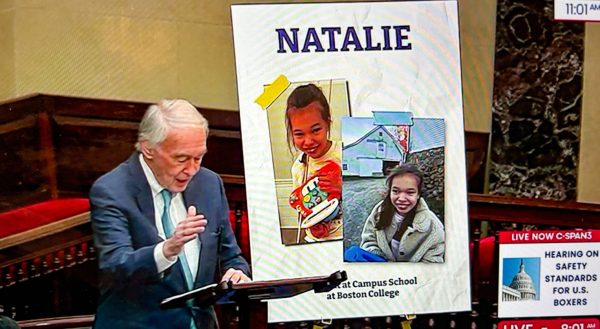
Markey went on to deliver remarks on the Senate floor to emphasize the importance of maintaining federal funding and upholding the Individuals with Disabilities Education Act, sharing his experience at the Campus School.
While many of the changes to Medicaid will not directly affect primary caregiver parents, Mason noted that the possible downstream effects have created worry among families.
“The intent of the administration is not to do harm to people with disabilities,” Mason said. “But, like many new laws, we don’t always understand the consequences of the way things are written until they play out, and that is a very serious concern at this point.”
Currently, between MassHealth and the Children’s Health Insurance Program, Massachusetts assists families in covering quality-of-life costs for children, but that may change under the BBB.
“Basically, it’s no cost, and that’s the way it should be for kids that are in and out of the hospital or have very expensive seizure medications,” Mason said. “That is going to be an issue if they lose that insurance.”
Included in those costs are specialized wheelchairs and orthopedic braces, which can cost tens of thousands of dollars, and without assistance from federal funding, parents might have to buy those tools out of pocket, according to Mason.
“So losing the [insurance] that covers 100 percent is a really big deal,” Mason said. “Not to mention the burden of then maybe going to common health or private insurance with the deductibles—it’s not sustainable.”
Mobility costs aren’t the only equipment that families must purchase. Many of the students at the Campus School rely on iPads or augmentative and alternative communication devices, which Medicaid often covers, Pugliesi noted.
“Those are expensive, and right now, the districts provide most of those,” Pugliesi said. “So that’s definitely a big challenge.”
Cuts to community-based programs and other necessary support systems for children with high needs can also impact parents or primary caregivers, according to Pugliesi, especially if community-based services are shuttered or low-staffed.
“That means parents that are working full-time have other children—some of them might be sick or going through something themselves,” Pugliesi said. “Then [they] have to somehow either quit their job and stay home with their child or somehow figure out a way not just to keep their child safe, but also to have them have an enriching day.”
With the changes to Medicaid yet to take effect, Mason encourages individuals to understand the toll the cuts will have on families and use their voice to oppose them.
“We just all need to be advocates—strong advocates—for all of this, because people don’t completely understand the unintended consequences of what this can do,” Mason said.
Correction (2/9/2026, 8:58 a.m.): An earlier version of this article stated that Campus School families would have to renew their coverage every six months under the BBB. These families are not affected by the change, and the article has been corrected to reflect that.