
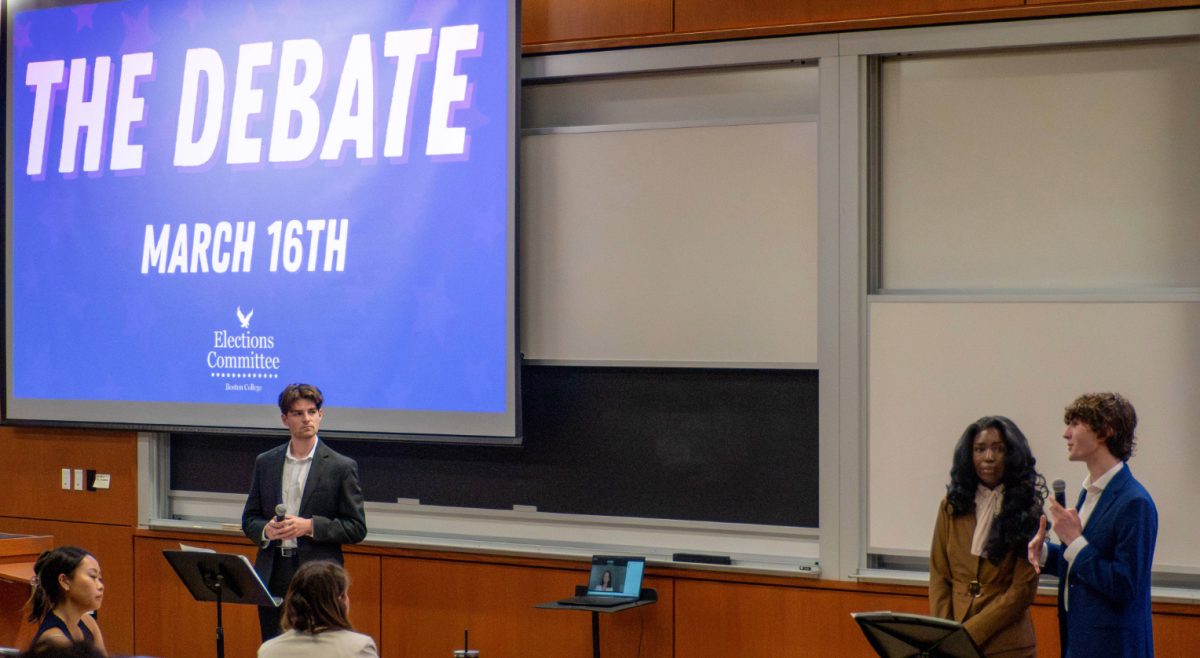
UGBC presidential and vice presidential candidates faced off Monday evening, tackling the organization’s budget allocation, creation of an LGBTQ+ resource center, and UGBC’s reputation ahead of Thursday’s election.
The two tickets are Mary Oliver and Colin Snyder, both MCAS ’27, and Jonah Renz, CSOM ’27, and Addie Weiss, MCAS ’27.
Organized and moderated by the Elections Committee, the debate allowed candidates the opportunity to explain their campaign platforms.
Oliver shared that she and Snyder want to use their platforms as president and vice president to serve as student advocates.
“It’s about addressing it with the right leadership, structural reform, and approaching it community-based, bringing together the student body, org, and admin, to make sure that we’re being truly representative and amplifying your voices is what me and Colin are dedicated to,” said Oliver.
Renz and Weiss noted their desire to build community and prioritize students’ best interests.
“We want to be approachable to every single student,” said Renz. “We both care so passionately about the environment of this school, and environments are made up of individuals.”
Weiss also addressed UGBC’s public perception during the debate, reiterating that UGBC must confront the issue.
“I look more specifically at the ways that students feel about UGBC, and I think that the fact that students, again, like I mentioned before, either don’t know what UGBC is supposed to do, or actively think it is working against them, is a real problem,” said Weiss.
Budget Allocation and the UGBC Retreat
A major topic among the candidates was the $15,000 annual UGBC retreat.
Oliver shared her plan to reallocate funding, arguing that the retreat doesn’t efficiently improve UGBC’s internal dynamics.
“Based on my experience working and talking with members in UGBC, they say that they felt it was pretty ‘summer camp vibe’ and not as beneficial in actually building and cultivating team building that was responsible for the momentum carried on throughout the year and UGBC executing its initiatives,” said Oliver.
Rather than directly fund the retreat, Oliver explained that she’d use the money for campus initiatives, such as a free football ticket lottery, food pantries, and affordable transportation to Boston Logan International Airport.
Oliver proposed using voluntarily donated meal-plan money to fund the retreat instead—a plan that Weiss believed would diminish the retreat’s goal.
“What I’m gathering from that is that the retreat would be happening after the school year had already begun, and I think that fundamentally undermines the purpose of the retreat, which is to hit the ground running with the strong sense of community and shared mission as an organization so that we can best serve students,” said Weiss.
Renz noted that the current UGBC administration determines the 2026–27 budget, which already includes funds for the retreat.
“In future years, the budget can be allocated differently, but in terms of the actual year itself, [the retreat] is something that is going to be happening,” said Renz.
Still, Renz shared that the incoming administration can make changes to the retreat.
“There’s things we can do on the retreat that make it different, but we want to make sure that the retreat is serving its purpose,” said Renz. “It’s an introduction for students in UGBC—for them to get familiar with the organization, to learn their purpose, to learn their understanding.”
Mental Health Resources
Snyder and Oliver emphasized that their vision of improving mental health at BC is rooted in fostering stronger community engagement.
“I think it also looks like looking bigger than just mental health services here,” said Snyder.
The teams disagreed on the appointment booking process for University Counseling Services (UCS). Leveraging their experience working with administrators, Renz and Weiss stated that the current system prioritizes medical triaging.
“In conversations with administrators, we have learned why they have a system the way it is,” Weiss said. “Being able to talk on the phone not only builds the social skills that are needed in the adult world, but also allows medical professionals to triage in those instances and gain a sense of more clarity of the situation that online booking wouldn’t allow for.”
Snyder pushed back, however, arguing that this system is an unnecessary hassle for students trying to manage their appointments.
“As someone who actually does go to UCS and uses their services, booking appointments and canceling appointments after you’re an established student that goes to UCS does not involve a triage or phone call where they’re checking in on how you’re doing and your mental health,” said Snyder.
Minority Student Resources
The candidates then shifted to discussing on-campus resources for minority students.
Snyder shared his intent as vice president to condemn incoming University President Rev. John “Jack” Butler, S.J.,’s remarks that a standalone LGBTQ+ resource center is “unlikely.”
“Thinking of my work with queer people, I think one of my first actions as vice president would be to introduce a resolution in the Senate to condemn the incoming president’s—Father Butler—statement of not thinking that we should have an LGBTQ Resource Center,” said Snyder.
Oliver also emphasized that her approach to providing resources to LGBTQ+ students would be data-driven.
“It’s about sitting down and doing the work and hearing ‘what do you need?’” said Oliver.
Renz and Weiss stated that they would stand by historically underrepresented student populations at the University.
“I think that a large part of what Jonah and I want to do with UGBC is ensure that we are representing the students who have systematically gone underrepresented by the University,” said Weiss.
Renz also shared that he is considering using some of the UGBC budget to create an AHANA+ scholarship for students.
“This doesn’t require a whole lot of funds, but it’s a direct UGBC scholarship for an AHANA+ student,” said Renz. “We think this is a great opportunity, because it directly shows that we’re trying to get some of our resources that were allocated and giving it directly back to those students.”
The candidates also explored initiatives to support low-income students at BC.
To combat wealth disparities, Renz proposed more on-campus programs that don’t require students to leave campus to participate.
“That’s also why creating programming on campus is so important, so that students don’t have to think about going off campus for a lot of things,” said Renz. “If we have a lot of fun events for students to think about, they don’t need to be bringing about these financial issues in the first place.”
Weiss, a QuestBridge scholar, chimed in with her own experience, noting that she feels the Montserrat office is often under-resourced.
“I’ve had a lot of experience working with Montserrat, and I think that it has a great mission, but it’s under-resourced,” said Weiss.
Weiss emphasized the importance of offering additional support to these resources for low-income students.
“So working with them to make sure that they have as much support as possible to give back to students, and then also working specifically on initiatives that I’ve started in the past with QuestBridge students in particular, to make sure that there’s as much transparency around what it means to be a QuestBridge scholar,” Weiss said.
Oliver also noted the difficulties that many middle-class students face on campus.
“We also want to call in the middle class—the average middle-class student,” Oliver said. “At least from my experience and perspective as well, in higher education in America, it’s a weird spot to be in, because you’re not explicitly defined as the highest financial need.”










Micky Moniak • Mar 17, 2026 at 7:35 pm
Jonah Rentz is the ideal candidate for UGBC president. If I have learned anything from being drafted number one overall by the Phillies in the infamous 2016 draft, its the importance of competent leadership! I see that in Jonah Rentz!
Earl Grant • Mar 17, 2026 at 7:37 pm
keep coming