

I love to watch for signs of winter’s end: how the sun stays up a bit longer each week, and how the temperatures slowly approach—or even exceed—freezing.
But what is happening under our feet is often most illustrative.
Every year, whether I am in New York, London, Tokyo, or Chestnut Hill, I scan the flower beds for the little green shoots that signal spring’s arrival. I consider it fair game to start this search after Groundhog Day.
As I trek across campus this week, I see the little green buds hard at work once again. Despite the enormous snow cover we had just two weeks ago, they have pushed their way out of the ground, telling winter to “Scram!” as Oscar the Grouch would say on Sesame Street.
So what?
My young-adult kids would probably say, “That’s nice, Mom,” without fully grasping my sense of wonder.
But over the course of my life, I have developed layers upon layers of experience, creating a global view in which new thoughts have to fight their way through a layer of permafrost. This is not all bad—much of that frost comes from wisdom earned in the “school of hard knocks.”
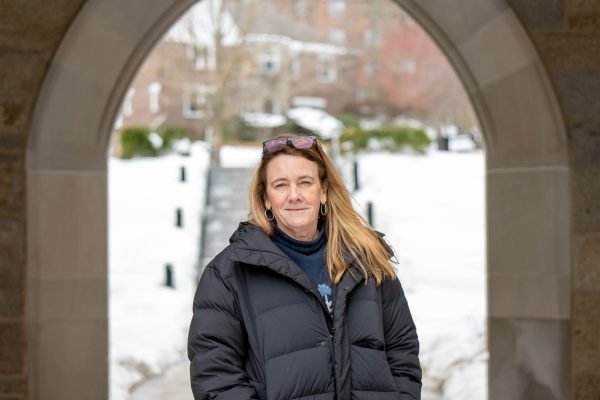
But after retiring from my career at Ernst & Young, I craved new experiences and fresh ideas—I wanted to allow wonder to melt some of the frost in my thought process, and what better way than education?
In my Fundamental Concepts of Politics class, I feel genuinely intrigued by what I am learning from Professor Behnegar and her students, as well as from Thucydides’ History of the Peloponnesian War. As I reflect on the conflicts I have seen throughout my life, both today and in the past, I see striking similarities in human behavior, our common desire for justice, the role of empire, and the challenge of defining the common good. Still, connecting ancient Athens to today feels wonder-inducing, eye-opening, and neuron-popping.
In my Criminal Law class, I find myself fascinated by our professor, the students, and the discussions about the legal system, from the complexity of common law and penal codes to the role of legislatures in crafting thoughtful statutes.
We just finished our section on homicide, including capital crimes, connecting it to the recent commutation of the death sentence of 75-year-old Charles “Sonny” Burton in Alabama.
Previously, I might have skimmed past this article. But Professor Eisenberg has opened my eyes to the important, life-altering decisions unfolding every day in our judicial system—decisions that call each of us to pay attention.
In the Boston College Companions program, this spring semester focuses heavily on reflection. I had the chance to present my life story and to listen to my cohort members’ stories. These presentations foster connections, inspire wonder, and challenge the assumptions about ourselves and each other. Each week, I can feel the frost that used to coat my thought process melting.
Hopefully, in the next month, I can ditch my winter coat and enjoy more days in the sun. Likewise, as I continue my studies, I look forward to more wonder, less frost, and more green shoots sprouting from my own thoughts.




School of Computing • Mar 23, 2026 at 9:13 am
What role does retirement play in the author’s desire to seek new experiences and ideas?
Cindy Doe • Mar 24, 2026 at 8:20 am
Great question! Retiring from a lengthy career brings up lots of questions about what is next. For me, it was about learning something new and challenging what I know about the world. Hope that helps.