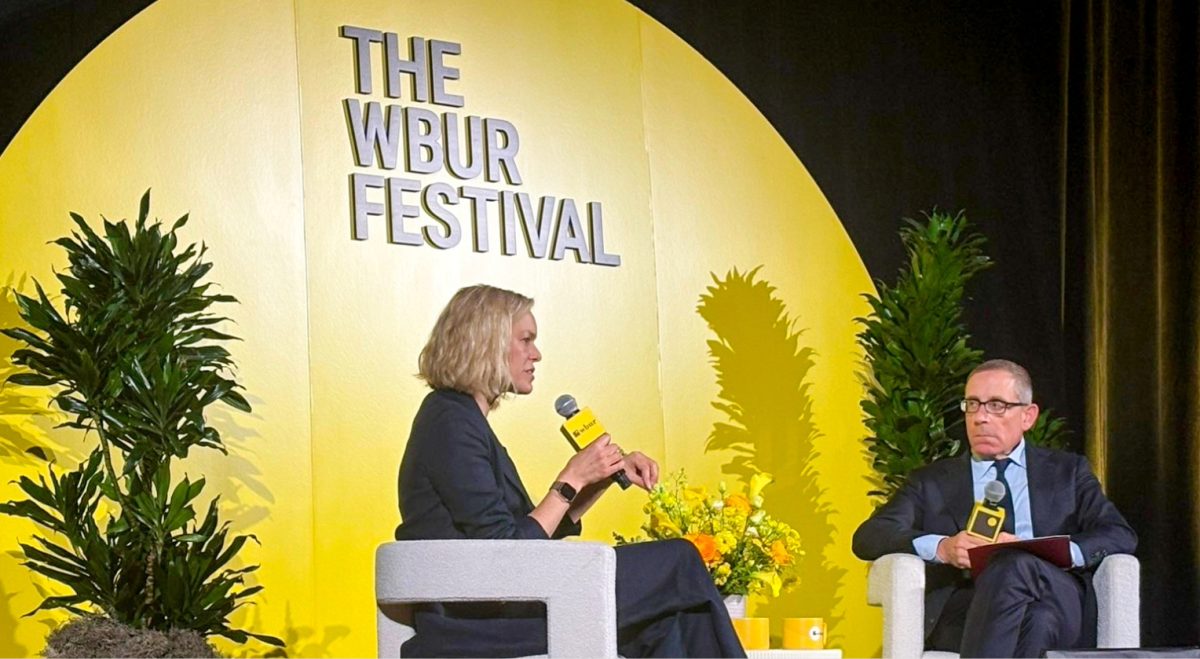

The West is facing a crisis of liberalism—driven by a combination of elite shortcomings, cultural failures, and a crisis of spiritualism—according to Ross Douthat, opinion columnist and podcaster for The New York Times.
“Over the last 25 years, we have passed from an era of intense and potent consensus to an era of fracture, fragmentation, and polarization,” Douthat said.
Douthat’s remarks were part of a broader conversation at the Clough Center for the Study of Constitutional Democracy’s Spring Symposium on Democratic Resilience, a two-day conference examining the historical and contemporary state of democracy and the values that support democratic rule.
A series of perceived failures by governing elites, such as policy setbacks and the COVID-19 pandemic, has eroded public trust in institutions, Douthat argued.
“There is a sense that the leadership class of the Western world has not succeeded in anything like the way they were perceived to have succeeded in managing the end of the Cold War and the transition from the 1980s into the digital age,” Douthat said.
Douthat also highlighted how cultural shifts—the rise of artificial intelligence and the weakening of traditional community pillars, namely religion, family, and civic structures—have compounded the sense of elite failure.
“You have a kind of personal, sociological, and spiritual crisis that has taken hold pretty strongly in the Western world,” Douthat said. “Everything is connected to the sense of elite failure. It is connected to political and economic failures. And some of the old critiques of what liberalism gets wrong have taken on a new force and found new vindication.”
Douthat argued that this dynamic has sparked a renewed focus on spiritual and traditional values.
“People are looking for something higher, looking for a sense of identity, looking for someone to blame, looking for something that the larger institutions of society are not providing, looking for something that digital culture itself seems to be profoundly dissolving,” Douthat said.
The convergence of these shortcomings has fueled a crisis of liberalism, he explained, leading many to seek strong, decisive leadership.
“The rise of populism is essentially a kind of personalist illiberalism, a vision of the current crisis that looks for incredibly strong figures who can act in politics, cut through the failures of bureaucracy, and the sclerosis of legislatures, and get things done,” Douthat said. “There is always a desire for a strong leader who can solve the insolvable problems and put history back on track.”
At the same time, Douthat argued, many defenders of the liberal order have, ironically, adopted illiberal methods to manage public discourse.
“I see [this] as the illiberal temptation of the center-left, the desire to remove certain issues from political debate and to use managerial systems, not charismatic personalities to keep a lid on the extremes of political debate and speech,” Douthat said.
Douthat, however, remained faithful in democratic institutions, emphasizing that a crisis of liberalism is not a crisis of democracy itself. He suggested that restoring public confidence hinges less on ideological debates and much more on the effectiveness of governance.
“Spending more time governing the country in service to the shrunken constituency of conflicted swing voters would go a long way towards restoring broad public confidence in the capacity of elites in governing society,” Douthat said. “To save liberalism, serve democracy a little better than you have been as of late.”