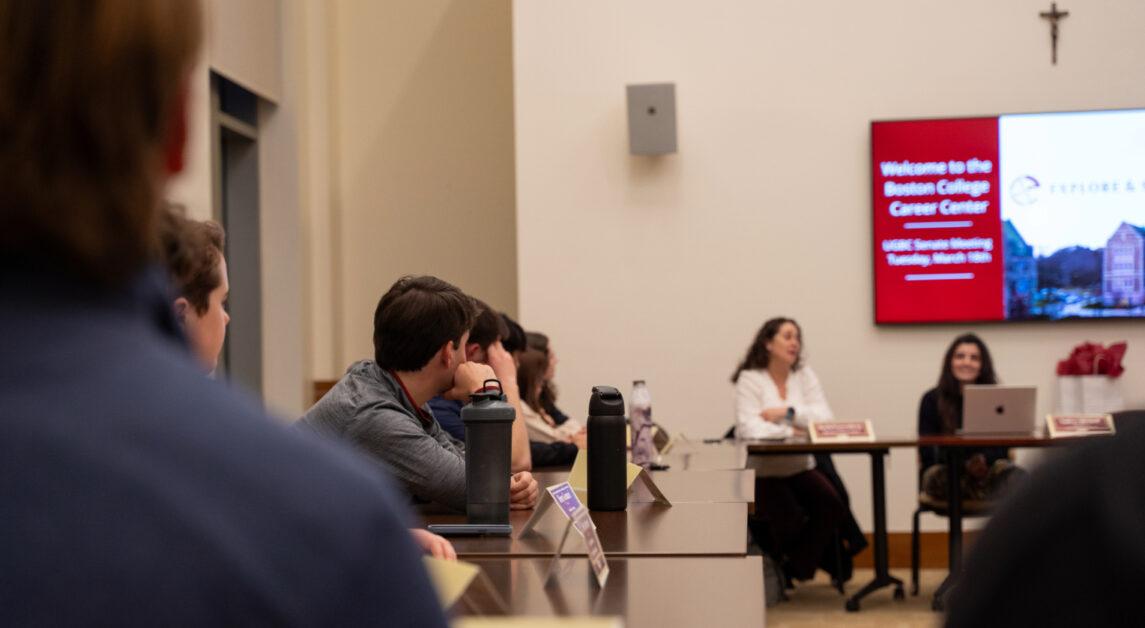

The UGBC Senate voted to approve a $371,500 budget for the 2026–2027 academic year—a $7,225 increase from last year—at its meeting Tuesday night.
Cami Kulbieda, outgoing president and LSEHD ’26, presented the budget along with Kelly Wu, director of financial affairs and CSOM ’26.
The budget is divided among UGBC’s eight divisions—Communications, Queer Leadership Council (QLC), AHANA+ Leadership Council (ALC), Student Initiatives, Environmental Sustainability (E&S), Council for Students with Disabilities (CSD), Senate, and Executive Council.
Allocations for ALC, QLC, E&S, and the Executive Council were reduced, while Communications, CSD, Student Initiatives, and Senate received increased appropriations.
Executive Council: $58,000 ($6,550 decrease)
UGBC voted to cut the Executive Council budget by $6,550—the largest nominal decrease among its eight divisions.
The Senate, however, left UGBC’s controversial $15,000 annual retreat intact, with funds allocated for housing, food, and transportation.
“In consultation with the incoming leadership team and all of their one-on-one meetings with Kelly to make this presentation come together, as well as the incoming, newly-elected UGBC executive team for next year, we decided that, as a consensus, there’s a lot of value to having a retreat as a student organization,” said Kulbieda.
Kulbieda said the retreat smooths the onboarding process for new members, improves collaboration, and facilitates initiative planning.
She also noted that UGBC’s incoming executive team—headed by UGBC President-Elect Jonah Renz, CSOM ’27, and Vice President-Elect Addie Weiss, MCAS ’27—is dedicated to improving the retreat.
“I’m really excited for the incoming executive team, because they’ve really considered how they can recreate that space and use the time spent on the retreat to maximize the impact on students, and I think that not only maximizes everybody’s time, it maximizes the impact, but it makes the most of that budget spent,” said Kulbieda.
Renz said the retreat builds community within UGBC.
“Part of the retreat we’re hoping to do in these conversations, to think about ways where we can be intentional with our time, to make sure everyone at UGBC knows what’s going on, the organization has a purpose for what they’re trying to do, and feels a sense of belonging within the organization,” said Renz.
In addition, UGBC will not change the $18,000 allocated for leadership stipends. Kulbieda said that stipends for senior leadership members are a “tradition” within UGBC.
Currently, the UGBC president and vice president receive $4,000 and $3,500 per year, respectively. Additional stipends are disbursed to other members of UGBC senior leadership, including the chief of staff, committee chairs, and division directors.
The stipend total has gone unchanged for half a decade.
Kulbieda said the stipends are intended to compensate student leaders for the time they dedicate to the organization.
“It allows for the leadership space to be accessible to students from all financial backgrounds, because of the time commitment and responsibility that comes with being a member of UGBC leadership, we ensure that all students are able to be a part of leadership if they desire, by compensating for that time,” said Kulbieda.
Some of the funding allocated for UGBC’s General Body meetings—which include all divisions and are held monthly—went unspent during the 2025–2026 academic year, prompting a reduction in the new budget.
“This is currently, or previously, more than $4,000, but we didn’t meet all of it this year, and so we’re hoping to be a little more sustainable,” said Kulbieda.
Communications: $15,000 ($5,475 increase)
The Communications division budget will see a more than 50 percent increase next academic year, even as it remains among UGBC’s least-funded branches.
UGBC’s Marathon Monday merch—which Kulbieda noted had been distributed in minutes this year—will now have its own budget line item under the Communications budget.
Additionally, Kulbieda emphasized that UGBC has recently been able to increase its communications with the student body.
“We’ve just really been able to build our communications, programming, and outreach efforts in the last year or two, and we’re really proud of that,” said Kulbieda.
Kulbieda also noted that part of the Communications budget’s growth is due to increased subscription fees for software such as Canva Pro and CapCut Pro.
Senate: $15,000 ($6,500 increase)
The Senate budget will see the largest nominal increase among the divisions, rising 76 percent after a $2,900 increase last year.
For the second year in a row, the Senate budget increased by the largest percentage across UGBC’s eight divisions, nearly tripling in that period.
The increase in funding is a result of several policy and initiative line items being relocated from other divisions to under the Senate’s purview.
Kulbieda justified this choice by stating that most UGBC policy initiatives are led by policy coordinators, who serve as liaisons between their specific division and the Senate.
“In the past, ALC, QLC, CSD, and E&S have all had a line item that has been called initiatives and policy, and we decided to remove that for consistency purposes, because a lot of the time that’s not fully used by all the divisions, because most of the initiatives are coming from the policy coordinator, and those individuals also belong to the Senate,” said Kulbieda.
Queer Leadership Council: $51,000 ($2,900 decrease)
UGBC will cut QLC’s budget by 5 percent, marking a second consecutive year of reduction after a 2 percent decrease last year.
The budget decrease is a result of the discontinuation of funding for QLC’s speaker events. According to Wu, QLC has not held a speaker event since 2016.
“We’ve completely taken out their speaker event allocation, especially because QLC has not had a speaker event since 2016, and we don’t anticipate them having more in the future,” said Wu.
Additionally, UGBC’s free menstrual product program will now be listed under the QLC rather than the Student Initiatives division due to expressed interest from Maeve Yurcisin, QLC director and MCAS ’27, in leading the initiative.
Student Initiatives: $61,000 ($6,000 increase)
The Student Initiatives division’s budget increased to focus on freshmen programming—specifically through increased spending on the Fresh Fest and Newton Block Party events.
Wu noted that UGBC is also considering coordinating similar events in the future with a focus on Messina and transfer students.
“We’re also anticipating potentially creating similar events on the Messina campus and also for transfer students,” said Wu. “That will all be pulled from this line item, which is why it’s such a drastic increase.”
UGBC will also no longer contribute to BC Summit—a conference aiming to deepen students’ understanding of intersectionality.
In past years, according to Wu, Student Initiatives allocated nearly $3,500 to the Summit conference and the free menstrual product program.
Environmental Sustainability: $14,000 ($800 decrease)
Of the four divisions facing budget decreases, E&S had the lowest nominal decrease.
According to Kulbieda and Wu, UGBC’s decision to decrease E&S overall budget “aligns with [its] mission of sustainability.”
E&S plans to reallocate funds from signature events to regular programming. Wu praised E&S numerous programming events this year—including “apple picking, river cleanup, tree planting, etc.”
“We really want to grow the programming part of ES, so that’s why we increase that allocation,” said Wu.
AHANA+ Leadership Council: $125,500 ($5,500 decrease)
The ALC budget decreased slightly this year, after remaining unchanged last year.
This decrease is primarily due to the discontinuation of the ALC Ball, which was hosted in the fall. The ball accounted for $30,000—about 24 percent—of ALC’s yearly budget.
ALC will reallocate the money to its other signature events: ALC Showdown and ALC’s annual speaker event.
“With showdown, production costs are increasing every single year, and it’s really important for us to try to maintain the ticket price as steady as possible, so that we don’t have to increase the cost of showdown to match the increase in production costs,” said Wu.
Wu added that the success of ALC’s last speaker event—which hosted Tarana Burke, founder of the #MeToo movement—calls for an increase in the council’s speaker event budget.
“In addition, we are also increasing the speaker allocation fund, mainly because it will give the directors more flexibility of choosing another speaker, especially because the speaker event this year, Tarana Burke, was super successful,” said Wu.
UGBC also considered using the funds to establish an AHANA+ scholarship, which would be awarded to one AHANA+ student of high financial need per year. Renz and Weiss had proposed redirecting ALC funds toward two AHANA+ scholarships as part of their campaign.
Wu, however, noted that the organization decided to pivot from this initiative.
“After deeply thinking about it, we thought that it wouldn’t make the most sense for us, like our student activity fee, to be contributing towards a tuition-based scholarship,” said Wu.
Wu noted that the new plans for the funds will act as “more of a resource-based support experience for the overall student body.”
ALC now plans to divert these funds toward a Montserrat Student Support Fund, which will seek to support the Montserrat office’s textbook program.
Additionally, ALC plans to increase Culture Collaborations—programming between BC’s numerous culture clubs and UGBC—next academic year.
“In talking to the current ALC leadership, as well as the incoming one, they voiced it’s really important that they wanted to increase this fund, especially because they want to directly try to improve the student experience, especially through collaborations with these culture clubs,” said Wu.
Council for Students with Disabilities: $32,000 ($5,000 increase)
CSD’s budget had the lowest nominal increase for the 2026–2027 academic year at 18 percent.
UGBC will allocate more funding to CSD’s signature events, including Dinner in the Dark and other speaker events.
Wu expressed her hope that the increased funding will improve student attendance at these events.
“We are increasing their allocation, especially because Dinner in the Dark is one of CSD’s most popular events, and just putting more money towards that potentially could get more people in the door and, like, participate in that,” said Wu.