Knowing your professors are married feels like a forbidden glimpse into their private lives.
The person who stands at the chalkboard proctoring tests with a menacing gaze couldn’t possibly be the same person who returns to their spouse and family at the end of each day—or could they?
The Heights spoke to five married couples who work at Boston College. Here’s what they had to say.
Meet-Cutes in Chestnut Hill…
On a summer day in 1990, Roderick Williams entered the BC Bookstore on the first floor of McElroy Commons, perhaps looking to buy a textbook for his classes as a political science Ph.D. student.
But Roderick left the bookstore that day with something much more valuable than an overpriced textbook: he had met his future wife.
“We met in the bookstore and were introduced by a mutual acquaintance,” said Lopa Williams, Roderick’s now wife.
Lopa and Roderick began dating soon after their first meeting and have been together ever since. This October, they’ll celebrate their 32nd marriage anniversary.
Over the years, both have worked as employees of BC Libraries—Lopa as a senior reference & tech support specialist and Roderick as a member of the scholarly platforms & discovery services department—until their respective retirements in July 2025 and January 2026.
… And Beyond
Although Roderick and Lopa met on campus, other BC faculty couples’ stories began a bit further away from Chestnut Hill.
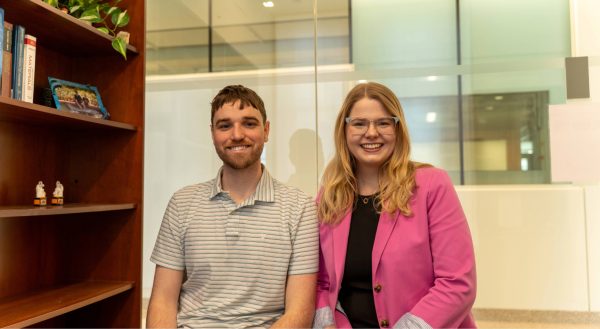
Ashley and Matthew Herkins, both faculty members in the engineering department—Ashley as an assistant professor of the practice and Matthew as a part-time faculty member—met as freshmen at The Ohio State University.
“In our Intro to Engineering class, we were assigned the same project team, and we kind of knew each other all throughout undergrad, and we were partnered up in a lot of different classes,” Ashley said.
Matthew said he made a move their sophomore year, when the two were lab partners—but when he asked Ashley if she wanted to grab food, he got no response.
“I honestly did not hear him,” Ashley said, laughing. “And I would have absolutely said yes if I did hear him.”
Fortunately, Matthew didn’t lose hope. Their senior year, he asked Ashley to go to Chipotle, and Ashley (who heard his question this time around) said yes. The two got married during graduate school in 2022, Ashley said.
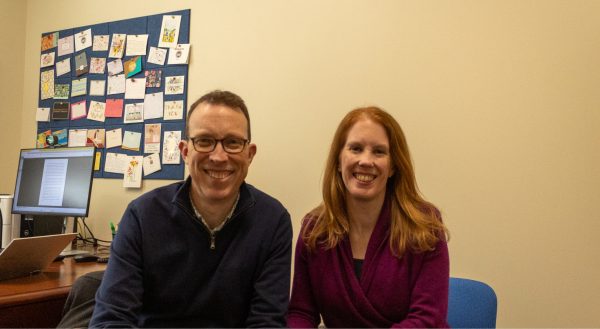
Stephen Mendelsohn and Christine Rojcewicz, both assistant professors of the practice in the Portico program, also met as undergraduate students.
“We met at Providence College,” Stephen said. “Chrissy was a freshman. I was a junior there, way back in 2010.”
Stephen was a double major in philosophy and political science. Christine, a freshman, was a philosophy major but was debating a double major in political science, she said.
“Steve was working as a research assistant for this professor, and I had her as a professor too, and she was like, ‘Oh, you should meet my assistant. He’s also double majoring,’” Christine said. “And the rest is history.”
The pair’s similar trajectories continued up north in Chestnut Hill, where they attained their master’s degrees and Ph.D.s from BC. They married in St. Ignatius in 2019, in a ceremony presided over by one of their professors.
For Megan and Paul Ulishney, assistant professor and visiting professor in the theology department, shared academic interests as graduate students kept them in the same environment.
As Megan prepared to cede her leadership of the Graduate Theological Society at the University of Oxford, she met frequently with the incoming president: a student named Paul.
“We started meeting to kind of talk about handing over the reins of leading the society. And yeah, we just realized that we really enjoyed meeting each other for that, and kept meeting,” Megan said.
Megan and Paul began dating while in school, and the pair married shortly before the pandemic. They have been working together in the Theology Department since 2024, they said.
Sean and Julie MacEvoy, senior lecturer in the psychology department and associate professor in the Lynch school, met for the first time through Julie’s roommate while attending Brown University. Soon after, they began dating, and they married in 2002.
When it came time to hunt for jobs after graduation, they considered offers that might have stretched them as far as Dartmouth College and BC, but the impracticalities sent them back to the drawing board.
“We just knew we also didn’t want to live apart the way that some couples who are in academia know that they’re willing to live apart for the sake of their jobs,” Julie said.
They were able to coordinate opportunities across their respective departments. Since their hiring in 2009, Sean and Julie have made BC a family affair: their eldest daughter is a freshman this coming fall.
Shared Experiences, Shared Goals
On paper, it isn’t surprising that many professors end up together. With an extensive background of shared knowledge and similar professional goals, the connection is all but fate.
“It’s very common that academics want to marry each other, because you often meet in graduate school, and the reason you fall in love is you have similar interests and similar goals that kind of come together,” said Megan.
In fact, nearly 36 percent of employees in academia are married to a fellow academic, according to a 2008 study published by Stanford University. As Christine put it: “Academics kind of find each other.”
The couples emphasized the support that comes with having a partner who understands the stress associated with graduate programs—and the anxiety that comes with transitioning into a career in professional academia.
“It’s not like either of us were going through it alone, and so I think that that helped us to, you know, keep at it and work hard and stay positive throughout all the stress, all the various stressful periods that there have been,” Stephen said.
But couples connect over more than just the stresses of academia (or as Matthew jokingly referred to it, their “shared traumas”). Working in academia, and particularly within the same academic field, creates a language of understanding.
“It’s good to be able to talk about stuff I’m passionate about and have [Ashley] understand,” Matthew said.
But according to the couples, working together is more than just solidarity in a shared experience. Attaining your goals while simultaneously watching your partner accomplish theirs creates an energy of linked success.
Paul said that he and Megan often discuss how “life-giving and generative” it is for each to get to work with the other.
“I think that really does impact our work and our own research outputs and how productive we are, knowing that the other person is thriving in the career that you know they’ve dreamed about,” Paul said.
Workplace Dynamics
Not all relationships look alike, and married professors are no exception.
For some couples, such as Lopa and Roderick, ensuring that colleagues viewed them as individual coworkers—rather than as a single unit—was a priority.
“When we got married, you know, we were just, we were kind of mindful about appearances and things like that, you know, because it’s, it’s just something you have to be conscious of,” Lopa said.
This didn’t mean a full differentiation of their professional and personal lives, though. In fact, for Lopa and Roderick, working together at BC enabled them to develop more friendships as a couple.
“We got to know people together, and we sometimes would socialize with the people we got to know together,” Roderick said. “And I think that’s something that I enjoyed.”
Workplace interactions also differ depending on how often, if at all, couples see each other during the workday.
For Ashley and Matthew, neighboring offices in 245 Beacon—a total coincidence, according to Ashley—mean that they see a lot of each other while at work.
“I’m like, ‘Oh, I have a problem. I have to go see my wife. Okay, let me walk 5 feet. Hey, how’s it going?’” Matthew said.
Other couples take on a more tangible synergy and collaboration in the workplace. For instance, Stephen and Christine said that they’ve turned to each other for support in devising syllabi and developing courses.
“It made it so easy to be able to have somebody who had already devised a curriculum and knew it well, to be able to talk about it in that way, too,” Stephen said.
For couples with children, schedules take on increased complexity.
“I remember thinking, ‘Oh, we’re gonna drive to work together every day. We’re gonna have lunch together every day,’ and I think we’ve had lunch together one time in our, what, 16 years of being here?” Julie said, laughing at Sean as she spoke.
With pick-up times to coordinate and babies to tend to, working in the same place can look less like being joined at the hip and more like a complex collaboration of priorities.
Megan and Paul said they have opted for a split-week schedule to juggle supporting their young children while remaining dedicated to the classes they teach and the careers they have fostered.
“What helps is that we are both totally committed to the flourishing of the other person, so we try to support each other in every way possible,” Megan said. “And also, just to split responsibilities as much as possible, both with parenting and then also trying to give the other person time to get work done.”
Compromise is essential to these busy couples, who view taking on more tasks not as a burden, but as an act of dedication to their spouse and the careers they lead.
“I think every academic couple really needs support from a broader community beyond just themselves in order to make things work,” said Megan.
Julie and Sean, who work in different departments, make up for the distance by participating in BC events outside of the classroom that allow them to collaborate.
“We both, in the summertime, do orientation for the incoming freshman,” Sean said. “So we are always there together, and it’s fun to look across the room and see you helping a group of students get registered for classes. And both know that we’re in the same place, and it’s in the summertime, so it’s kind of a relaxed vibe.”
Taking on a new environment as a couple also alleviates some of the stress it generates, at least initially.
“It’s just easy to support each other in dealing with or learning how the institution works,” Julie said. “When we first got here, I think having two brains observing things makes it easier for both of us. And we were able to compare notes. As time has gone on, we’ve been here for so long that it doesn’t matter so much. But at the very beginning, I think that mattered a lot.”

Love is All Around
It seems the exclusive information about professor and academic employee relationships is that they are, after all, normal relationships.
And yet, it is endearing to know that the moments that define part of a couple’s experience together happen at a place we all frequent every day.
In the BC Bookstore, where students purchase their course textbooks, one couple bumped into each other and launched a decades-long love story.
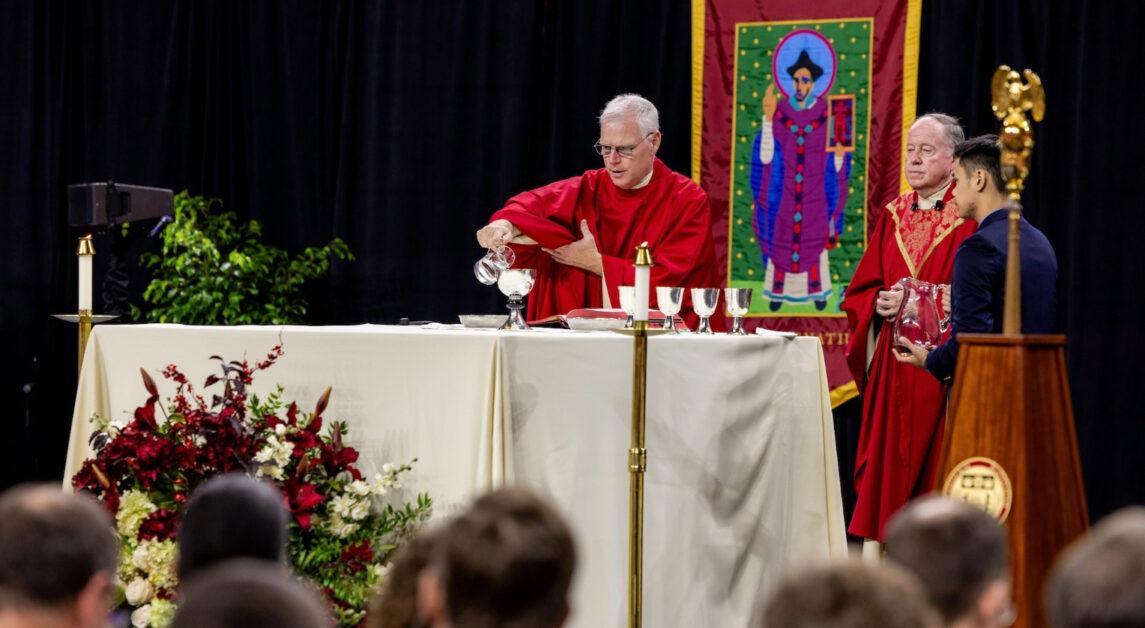
At St. Ignatius, where students attend weekly Masses, another couple tied the knot in a ceremony officiated by their graduate school professor.
Some love stories will echo through future classes, as Sean and Julie’s daughter enters her freshman year this coming fall.
For the five couples featured here—as for the many other couples employed at BC and at other colleges and universities around the world—working with one’s partner is a special experience.
“Working with your spouse is not for everyone, but I really enjoy it,” Christine said. “I’m really glad.”