
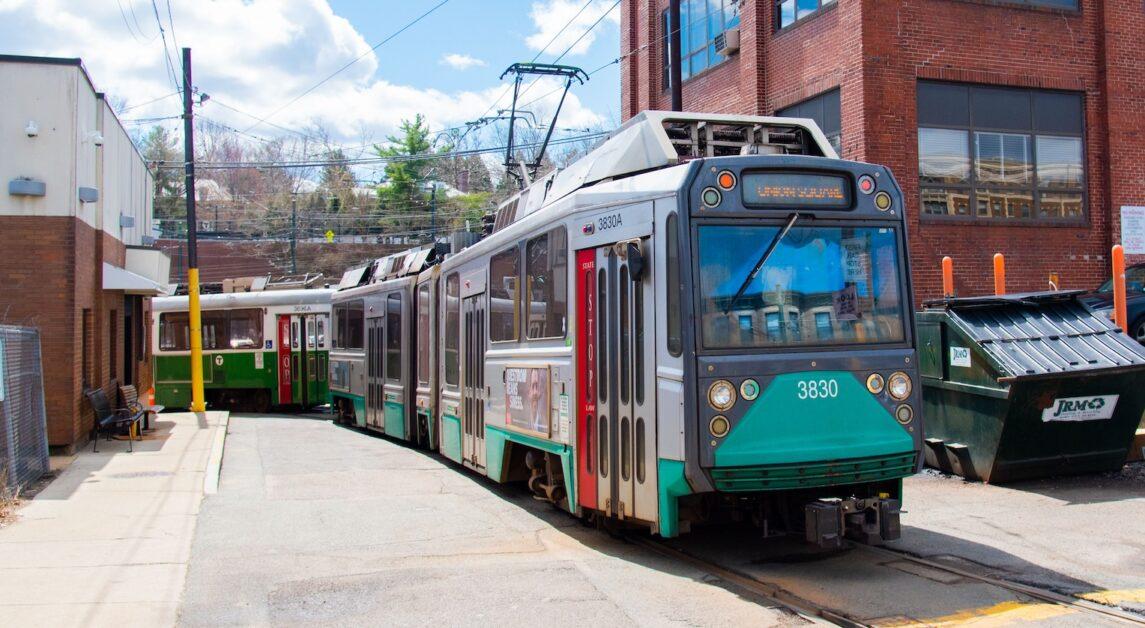
Noelle Lyden starts her Tuesdays at 5:30 a.m., long before the sun rises.
She takes a 6 a.m. bus through a quiet campus, down Commonwealth Avenue, and to the Reservoir T stop. From there, she spends nearly an hour on the D line, riding it to the Longwood Medical and Academic Area, where she arrives at Brigham and Women’s Hospital just in time for her 7 a.m. clinical experience.
“In the morning, it’s really tough,” Lyden, CSON ’28, said. “Getting up at like 5:30 … it’s the worst thing ever.”
Lyden is not alone.
Clinicals—weekly six- to eight-hour shifts at Boston-area hospitals—are a core component of Boston College’s nursing curriculum, supplementing classroom learning with hands-on experience. Students are often assigned to shifts starting as early as 7 a.m.
Early-morning assignments at faraway hospitals force nursing students into a dilemma—either sit through a tedious ride on the T or shell out the money for an Uber. Because students are responsible for their own transportation to clinicals, they must determine how much their time is really worth.
“We’re in charge of our own transportation, whether that’s T or Uber, and it’s up to us to meet up with the other members of our clinical group—which is usually groups of six—to get there,” said Amira Aitsaid, CSON ’27.
Aitsaid said her clinical sites—primarily in the Longwood Medical and Academic Area—are technically accessible by the MBTA, but not always practical.
“Most of us are left to Uber just because of how long the T takes in the morning,” Aitsaid said. “We have to be there anytime between 6:30 and 7 a.m.”
Uber rides typically cost between $20 and $40 total and are split between a group. Still, those costs accumulate over the course of a semester—especially for students with multiple clinicals per week.
“This semester, since I have two clinicals a week, I’m spending like $15 or $20 to get there and sometimes back,” Aitsaid said.
Even with shared rides, the financial burden can be significant. Zachary Elias, CSON ’27, said his transportation costs depend heavily on where his clinical placements are located. With his clinicals this semester at the Boston Medical Center in the South End and Arbour Hospital in Jamaica Plain, Elias has found himself spending more.
“Quite a few of them you can’t get to by the T, so you either have to Uber or rely on someone with a car,” Elias said. “This semester I have to Uber to both of them—it’s like $20 or $25 each day.”
While Elias splits rides with classmates, he estimates spending $30 to $35 per week on average.
“It can be kind of annoying, because I have to spend my own money to get to something that is required,” he said.
For students who choose public transportation, commutes can take up to an hour each way, depending on the route and time of day.
“I feel like it’s so much wasted time,” Aitsaid said. “The part that I don’t like the most is just getting there, especially so early in the morning.”
Driving is rarely an alternative. Even students with cars often cannot park due to limited availability at Longwood-area hospitals.
And 28 out of 31 surveyed by The Heights said they were unaware that they’d have to organize and pay for their own transportation to clinicals before coming to BC—something that may have factored into their decision had they known sooner.
“I didn’t realize how much we’d have to rely on Ubers,” Elias said. “I assumed most of them would be on the T.”
According to responses from 31 CSON students surveyed by The Heights, commuting via public transportation can take up to four hours per week—compared to just 30 minutes to an hour when using Uber.
Delays and traffic can further complicate already tight schedules. Aitsaid recalled instances when unreliable transportation made students late to clinicals—something that carries serious consequences.
“We’ve had horror stories with Ubers being late, and that causing us to be late, which is a huge no-no in the nursing world, because the day starts at 7 exactly,” she said. “Most of our preceptors expect us to get there even earlier.”
“Room for Improvement”
Recognizing these challenges, some student leaders have pushed for institutional support. Cami Kulbeida, UGBC president and LSEHD ’26, began advocating for transportation funding after encountering similar issues during her own field placement.
“As soon as I learned that BC does not provide monetary support for LSEHD and CSON student transportation to off-campus sites for required field placements, my passion project was born,” Kulbieda wrote in a statement to The Heights.
“On top of a hefty tuition cost, no student should be responsible for these costs when their practicums and clinicals are required,” she added.
UGBC, in collaboration with the Division of Student Affairs, helped establish a pilot program to provide CharlieCards to LSEHD and CSON students with high financial need for transportation to practicums and clinicals.
Eligible students receive an invitation to participate in the program, according to Associate Vice President of Career Services Joe Du Pont. The form includes basic information to confirm their placement details and transportation needs.
The program remains limited in scope. In late March, UGBC reopened conversations about providing all undergraduate nursing students with free, accessible transportation to clinicals. Senators who supported it hoped to emulate the PULSE program, which provides students with a $50 CharlieCard each semester.
But there were also signs the PULSE solution may not be a good fit.
“[PULSE] always chooses stops that are convenient for students to get to, right on the T lines,” said Emily Prucher, MCAS ’28. “But I know the nursing stops aren’t like that, like even mostly hospitals you can’t really get to.”
In the meeting, Prucher said that UGBC will continue to explore options and “reach out to some new contacts.”
Some students believe the University could go further, pointing to existing programs like 4Boston, which covers transportation costs for service placements, including Ubers.
“It would be awesome if BC paid for our transportation,” said Kathleen McGraw, CSON ’28, who volunteers with 4Boston. “With 4Boston, we have a business Uber account, and they totally cover the cost.”
Others suggested alternatives, such as a dedicated shuttle system to clinical sites.
“I’m honestly surprised they don’t have some sort of bus or shuttle,” Elias said. “That could make a big difference.”
Aitsaid echoed that sentiment, adding that despite the relatively small size of the nursing program, students’ needs should not be neglected.
“I understand that the nursing school is small,” she said. “But I feel like we’re just overlooked.”
Despite the challenges, many students say BC’s clinicals come with a lot of benefits, one being the wide selection of hospitals where students can work.
“Across my time, I’ll have gone to six different hospitals,” Lyden said. “We get to go to hospitals that are specialized in our area, which is really interesting.”
But Kiersten Rock-Torcivia, CSON ’27, emphasized that a stronger transportation system would make the program even better.
“I know that a lot of other schools … have a better system to work it out,” Rock-Torcivia said. “I think there is definitely room for improvement.”
















Christine Liona • Apr 3, 2026 at 2:15 pm
This is how it was when I was at BC 40 years ago. We all carpooled or we took public transportation wherever we needed to go. And if we carpooled with a friend we offered to pay for gas. Nursing is not a 9-to-5 job. You will run into crazy hours and crazy shifts no matter where you work. It is the reality of the profession you have chosen. Graduating from BC SON is a gift, enjoy the ride.
Julie Carpenter • Apr 3, 2026 at 3:45 am
I went to nursing school and clinicals. I had to pay my way there. What is your problem? This was 40 years ago, do you think it is going to get better? Be lucky you are there. You will be making big dollars when you get your license and experience. If you work the day shift you have to get up at 5:30 A.M.
SEO • Apr 1, 2026 at 11:29 am
Commuting to work by public transportation is pretty standard in the real world, especially if you work in Boston. Using the MBTA to get to clinicals—or student teaching positions—even first thing in the morning seems to be preparing students for what they might encounter when they graduate. Also, using public transportation is a great way to cut down on carbon emissions when possible.
Amy Paul, SON.87 • Apr 1, 2026 at 5:21 pm
Agree. With two exceptions- both employers that subsidized commuting costs in various ways- I’ve been paying for my own commute for 41 years, starting with BC SON clinicals in Boston and all around eastern MA in 1985. It’s called getting to work, people. I believe that when I was a BC nursing student, those who had cars were asked to disclose that during registration for clinicals, and the university made some effort to put at least one car owner into each group. I never had a car while I was an undergraduate. I was either able to get a ride, or I took public transportation. To get from Cleveland Circle to Brigham & Women’s- using a combination of walking, the C line and the D line- never took more than 45 minutes door to door. I would applaud the BC’s subsidization for those with a demonstrated fiscal need, but I think most people just need to grow up and deal with it.
Abigail • Apr 1, 2026 at 8:49 am
The ride on the T from Reservoir to Longwood is 10 minutes. The authors misrepresented the T ride for dramatic effect in this article. There are problems with the T sometimes but the D line is ALWAYS reliable and so speedy. To say that students are spending an hour on the D line to get to Longwood is just a lie. It’s probably inconvenient but so many people in Boston commute to work on the T anyways and the train runs faster in the morning because of that. Waking up at 5:30 for your job at 7am feels pretty standard. The commute from BC to Longwood is about 30 minutes. This article could have been much better researched. People complain about the T all the time but it’s a very affordable option for transportation and the D line at least runs smoothly. Please correct this article.
KL • Apr 1, 2026 at 9:59 am
My thoughts exactly. In the WORST case a student lives off-campus on the Chestnut Hill side and must leave before BC buses are available, in which case they’d have a 25-min walk to Reservoir followed by the 10-15 min T ride to Longwood, then the 10 min walk to Longwood Medical from the T – still a substantial commute, but much more realistic. I certainly do not deny the immense burden that clinicals place on nursing students, and it’s absolutely not something I could’ve handled while in college full-time. This author’s stretching of the truth undermines the strong case that CSON (and Lynch) students make for subsidized Charlie cards for all.
Emily Wollan • Apr 1, 2026 at 8:30 am
I’m disappointed to see that there is only one sentence addressing the cost for LSEHD students in the elementary & secondary education majors who have similar struggles. Arguably, the education majors actually have it worse because they spend an entire semester, 5 days a week, at a school, as opposed to the nursing students who only go in a couple of times a week. As an education major who was placed at a school in the South end where no other education students were, I was required to pay the entirety of the costs of my transportation. I would be sure to look more into this so that education majors don’t feel overlooked because it often feels that way.
K.C • Apr 5, 2026 at 11:13 am
As a nurse of 38 years I currently get up at 4:45 am for my commute to a Boston hospital. I feel blessed to be there. As a nursing student so many years ago, I commuted from a school in the middle of MA, to a Boston hospital, leaving the dorm at 4:30 am. But again so grateful to be there . It’s all about perspective. The opportunity to learn at a Boston hospital is gift, sometimes sacrifice comes with the greatest reward.
Emily Wollan • Apr 1, 2026 at 8:25 am
I’m disappointed to see that there is only one sentence addressing the cost for LSEHD students in the elementary & secondary education majors who have similar struggles. Arguably, the education majors actually have it worse because they spend an entire semester, 5 days a week, at a school, as opposed to the nursing students who only go in a couple of times a week. As an education major who was placed at a school in the South end where no other education students were, I was required to pay the entirety of the costs of my transportation. I would be sure to look more into this so that education majors don’t feel overlooked because it often feels that way.