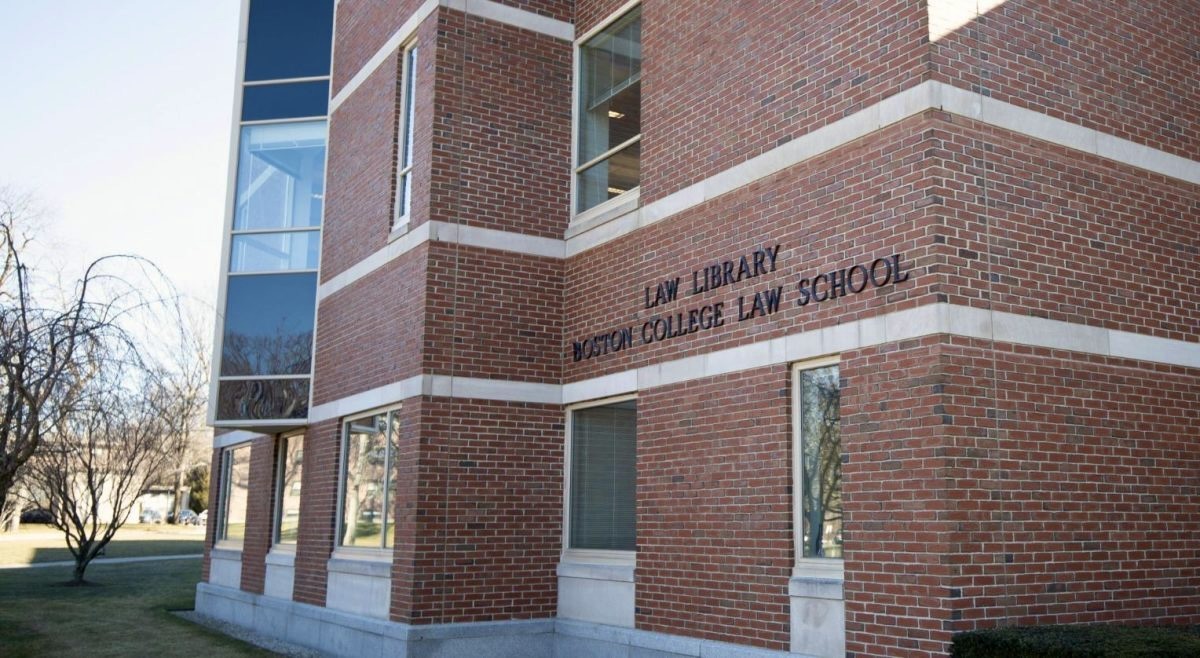

Boston College accepted 12.7 percent of a record-high 41,898 applicants for the Class of 2030, according to a University release.
This year’s total number of applications surpassed the previous record of 40,477 set by the Class of 2026 and marked a 5.6 percent increase over the Class of 2029.
“Prospective students and their families resonate with BC’s conviction that college is not simply a means to an end,” Dean of Undergraduate Admission and Financial Aid Grant Gosselin, BC ’97 and LGSOE ’02, said in the release.
While the press release also celebrated this year’s admissions cycle as the most competitive in the University’s history, the acceptance rate is actually 0.1 percent higher than last year’s 12.6 percent initial acceptance rate.
The University typically revises its initial acceptance rate in the fall after reviewing waitlist applicants and extending additional offers. The true acceptance rate for the Class of 2029 was 14 percent, according to the BC Fact Book—1.4 percentage points higher than the initial figure.
For Ben McMorrow, his acceptance day was unconventional. An international student from Berlin, Germany, McMorrow woke up at 4 a.m. to his early decision acceptance.
“The decision came at like midnight,” McMorrow, MCAS ’30, said. “I decided that I wasn’t gonna stay up for the decision, because I was like, ‘Oh, I want to sleep—if I open it at night, I’m never gonna sleep.’”
McMorrow was first struck by BC’s campus, but said that he fell in love with the University after touring and hearing about the balance between academics and extracurriculars.
“I just thought the campus was amazing,” McMorrow said. “One important part for me for university was to have a balanced life, and have a campus with a diverse campus with lots of different types of people, and that’s exactly what BC sounded like to me.”
McMorrow, who plans to study biochemistry and minor in Asian studies, looks forward to coming to the United States and immersing himself in a new academic and social setting.
“I’ve never really been to Boston outside of like, three days in the summer, so I’m super excited to experience basically a new culture,” McMorrow said.
Nine percent of accepted students are international, hailing from 89 countries, and the accepted class includes students from all 50 states, Washington, D.C., and two U.S. territories.
The admissions cycle marked the third year the University did not immediately release the percentage of admitted students who identified as AHANA+, following the Supreme Court’s 2023 decision to abolish affirmative action.
Since the Supreme Court’s decision, BC has reported two consecutive years of declining AHANA+ student enrollment. AHANA+ students comprise 35 percent of the Class of 2029, according to the University.
The most diverse freshman class remains the Class of 2027, with 38 percent of students identifying as AHANA+.
According to the University, 11 percent of this year’s accepted class is first-generation, down from 12 percent of the Class of 2029. In line with last year, BC did not immediately release the number of students who were accepted through the QuestBridge program or are Pell Grant recipients.
Unlike last year, BC did not publish the percentage of applicants who submitted test scores. The University has maintained a test-optional policy since the Class of 2025’s admission cycle.
Since then, 52 percent of enrolled students submitted scores for the Class of 2026, 44 percent for the Class of 2027, and 45 percent for the Class of 2028.
The University has not released the Common Data Set for the Class of 2029, which it typically publishes in the fall.
Among students admitted to the Class of 2030, 95 percent ranked in the top 10 percent of their high school class. The average SAT and ACT scores were 1500 and 34, respectively. The average SAT score dropped by 3 points while the average ACT score remained the same for the sixth year in a row.
Matt LaTour, a high school senior from Newtown Square, Pa., said seeing his acceptance was “a huge relief.”
“It was like a weight off my shoulders,” said LaTour, CSOM ’30. “I was very nervous. It came out on like a Monday, and I got home, and I did nothing until 6 o’clock when it came out—like I just sat in my room in silence for an hour, just waiting.”
LaTour said he was attracted to BC for its blend of challenging academics and sports culture. Visiting his brother for weekends, he said, cemented his decision to apply.
“I’ve always enjoyed my time when I went up there, and it did feel like a place where I could imagine myself, and I could see myself growing,” LaTour said.
Update (4/10/2026, 6:31 p.m.): An older version of this article stated that the University said this admission cycle was the “most selective” in the University’s history. That line has been updated to say “most competitive” to more precisely mirror the language in the release.