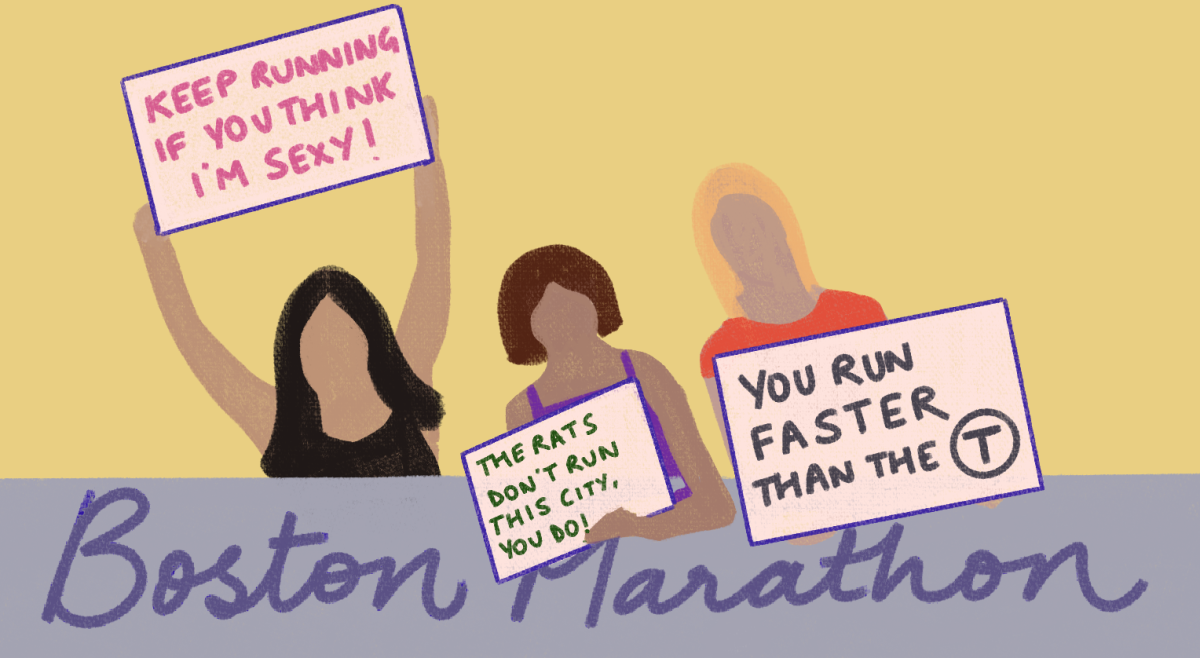
This year, on April 20, Boston residents and students alike will flock to the streets to watch nearly 30,000 athletes take on the Boston Marathon. The crowds will have many eccentric ways of showing their support—cheering, hitting cowbells, screaming as loud as possible—but perhaps the most timeless way of celebrating Marathon Monday is with a sign.
If you’ve ever been to the race, you’ll know just how seriously crowds take their signs. Family and friends write supportive words to their loved one in the race, and onlookers create witty jokes to try to motivate passing runners.
Some signs are plain, while others are meticulously decorated and colored to stand out in the crowd. But no matter what ends up on those pieces of cardboard, you can guarantee that Boston Marathon spectators are using the event to brandish some of their creativity. It’s always a good time to see a memorable message or creative gag that makes both the onlooker and passing runner laugh.

This year, Bostonians will surely be thinking up new ways of getting racers to smile. From fatheads of marathon participants, to funny quips, to satirical jabs at the MBTA, signs are a form of self-expression and a way for Bostonians to show their city pride.
The signs have become a staple of the Boston Marathon throughout the years as a show of creativity, passion, and perhaps, most importantly, humor. Many students and young adults also make signs referencing viral trends and media, such as signs referencing Severance or Charli XCX’s hit album Brat.

But marathon signs can be more than just pop culture references and complaining about the Green Line’s inefficiency. Many supporters’ signs, whether they know it or not, represent integral pieces of Boston Marathon history.
Many signs are based on lighthearted traditions. Wellesley College’s “kiss me” signs, for instance, are a playful part of the school’s history with the marathon. As runners fly by, Wellesley students wave signs asking for kisses. “Kiss me, I’m graduating!” and “Kiss me, I’m an econ major!” are just some of the messages students write in hopes of getting a quick peck from a passing marathoner.
But Wellesley’s “kiss me” signs aren’t just cute pick-up lines directed at unsuspecting runners—they’re a seemingly trivial aspect of a much more important and symbolic tradition. As a historically women’s college, many of Wellesley’s marathon traditions revolve around women’s history. They’re a celebration of the long-running history of women’s rights intertwined with the Boston Marathon.
Many of Wellesley’s marathon traditions began in 1972, the first year women were allowed to enter the race. That year, along with their signs, Wellesley students also originated the iconic “scream tunnel,” which runners can hear from a mile away.
These quirky and creative rituals are significant aspects of Boston’s culture. Not only can these signs offer motivation during a grueling race, but they also symbolize cultural resilience and pride.
Even Boston College is connected to a piece of Boston Marathon history. At Mile 21, BC comes right after the infamous Heartbreak Hill—a difficult, almost 100-foot, and approximately 3.3 percent incline between miles 20 and 21. Many supporters around Heartbreak Hill make encouraging signs for runners to push forward, and Mile 21 marks the joyous end of that arduous leg of the marathon.
These signs are often humorous, such as one that reads “Hill? More like speed bump.” But whether signmakers know it or not, their jokes surrounding the arduous climb are based on an inspiring tale from Boston Marathon history.
Heartbreak Hill gets its name from the victory of Ellison “Tarzan” Brown, a Narragansett Indian from Rhode Island, in the 1936 Boston Marathon.
Despite predictions that fan favorite and the previous year’s winner, John Kelley, would win, Brown overtook Kelley at Mile 20, ultimately winning the entire race. Mile 20 became “Heartbreak Hill” because it was the point in the race where Kelley lost his lead and his heart was “broken” by Brown.
The story of Heartbreak Hill being one of Native American resilience and excellence is inspiring, and it’s a source of empowerment for all marginalized groups, athletes or otherwise. Brown’s name is remembered in Boston Marathon history as a symbol of perseverance.
The best part is that Heartbreak Hill signs are intertwined with this story. By recognizing the incredible feat of a man whom nobody believed in, we keep his strength and determination alive. Even the silliest sign is entrenched in generations of history.
These signs give onlookers a voice and a way to use their creativity to share their beliefs. Whether celebrating the inspiring story of Heartbreak Hill, voicing complaints about U.S. politics, or even griping about public transportation, signs can be far more than just funny or flashy.

The Boston Marathon is a show of strength and endurance for runners, and for onlookers, it’s an event about creativity, originality, and pride. Marathon signs are not only a way of acknowledging the dedication of athletes and the admirable history of the race itself, but they’re also a form of self-expression—a way of using art and culture to make those around you smile.
So, when making your sign this year, think about what you want to say. The beauty of a sign is that it’s a representation of the person holding it.