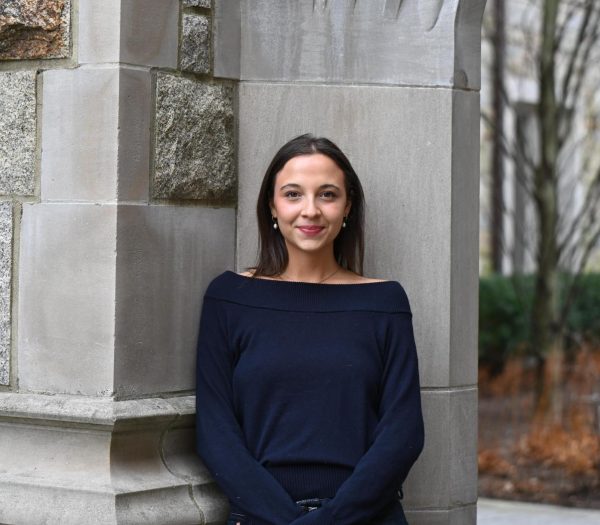
In January 2026, while Best New Artist Grammy winner Olivia Dean was basking in the glory of her recent nomination and debut album success, a new, young, neo-soul artist, Sienna Rose, emerged on the scene. Fans of Dean flocked to Rose’s discography, and Rose quickly amassed millions of monthly listeners on Spotify. Rose was even featured in an Instagram post of Selena Gomez.
Many of Rose’s listeners discovered her through Spotify’s Discover Weekly or Recommended for You features: rotating playlists curated by the algorithm that push new music to users based on their previous preferences and listening habits. What these listeners did not immediately discover, however, was that Rose’s low-profile media presence and rapid rise in popularity were not a result of her innate talent, but rather the exact opposite.
Rose was entirely AI-generated.
The question of AI’s place in music is just one moral dilemma out of the myriad that have surfaced since ChatGPT’s genesis in early 2023. Over the last three years, computer science college dropouts, following in the footsteps of OpenAI founder Sam Altman, have flooded the web with what’s estimated to be hundreds of thousands of large language models (LLMs).
With each new model, upgrade, and retraining initiative, AI startups are successfully dismantling the free market of ideas that humanity has long operated under—and while this transposal of human thought may be efficient in certain fields, it has no place in art.
The modern music industry is inseparable from the rapid technological advancements of the last few decades. Electric instruments, synthesizers, autotune, and a plethora of other recording tools and platforms have woven technology and artistry together to create incredible, moving pieces of work. The reality we face now, though, is one where tech and art aren’t supplementing one another—AI is hijacking creativity, replacing the artistic process with a computer shortcut in the interest of fast profit.
The total production cost for AI-generated artists—exempt from both the human labor behind it and the actual financial investments to pay for recording sessions and equipment—is essentially zero. But Rose’s 2 million monthly listeners, for instance, are generating approximately $2,302 in royalties per month, according to the BBC.
The costless venture is all too tempting for the independent labels and streaming services to resist pushing AI artists into the algorithm. The “Fans Also Like” page—a section on every artist’s Spotify page that recommends similar artists to listeners—under Rose’s Spotify profile lists multiple artists that also sound the AI alarm: Imani Dawn, Let Babylon Burn, and Aurora Lane, to name a few.
One clear indicator of AI is the sheer volume of work over an impressively short time span and the corresponding audience growth. Lane, for example, has amassed 224,590 monthly listeners since releasing an EP in 2025 and three singles in January 2026. Seems fishy, doesn’t it? Her artist biography, found in the “About” section of her profile, also points towards AI-involvement, reading “Aurora Lane makes music for golden hours and quiet hearts—where soul meets stillness.” A vague, mismatched mixture of adjectives and nouns, followed by an appositive clause attached by an em dash? Come on. We all know what wrote that.
Dawn’s and Let Babylon Burn’s profiles follow the same pattern: an essentially impossible discography complemented by a relatively high number of monthly listeners, AI-written biographies, and—the cherry on top—collaborations with Rose.
The link that connects these four AI artists is unclear. Rose is seemingly represented by Nostalgic Records, an independent record label established in 2024. The label’s other two listed artists, Toji and Dani Perez, are questionable: Toji has no Spotify profile, and Dani Perez’s profile exhibits the same red flags as Rose’s.
Aurora Lane, Imani Dawn, and Let Babylon Burn hide behind the guise of independent production and management. Dawn’s artist biography asserts that she was born and raised in Texas, and Let Babylon Burn is described on his YouTube profile as an independent artist from Norway.
And this is perhaps the most frustrating aspect of all: the deliberate attempt of AI artists, or their creators, to distance themselves from artificial intelligence and align with the human experience. They are, of course, tricking no one who takes an active role in their music consumption. It takes a few listens, a quick profile scan, and, at most, a brief Google search, to realize that these aren’t real musicians.
But is it fair that we, the listeners paying considerable money to streaming services, have to do this work ourselves? The burden of detection should not be ours to carry. The platforms we pay for, with thousands of employees and music experts, have a logistical and moral obligation to do it for us.
Spotify, the preeminent streaming site for AI artists, is not incapable of discerning AI from human-produced content. It’s choosing not to. Its AI rulebook, last updated on Sept. 25, 2025—before the Sienna Rose controversy—states that the platform is enforcing stronger impersonation rules and requiring AI disclosures to mitigate the rise of AI artists, but they are not banning them altogether.
“The industry needs a nuanced approach to AI transparency, not to be forced to classify every song as either ‘is AI’ or ‘not AI,’” reads Spotify’s website.
Sure, some artists are only using AI to manufacture drum kits or enhance vocals. It is, as Spotify duly notes, difficult to single those individuals out and tell them they can’t release their music on the platform because of a bit of AI usage.
But using the veneer of “nuance” with nonsensical liberality to allow completely AI-generated artists to exist on, and profit off, the platform does significantly more harm than good. It undermines the efforts of legitimate, human artists, many of whom are already struggling to get a foot in the door of the music industry. It also insults the commercial music itself, insinuating that despite the surplus of musicians who would do anything for a record deal, the industry has to resort to robots to turn a profit. And, it algorithmically tricks its inattentive users into generating that profit.
Perhaps the most frustrating aspect of AI-generated musicians is that they disrespect the centuries of honest, human creativity that have made music a transcendent art form, with an immeasurable impact on the lived experience and the cultural mythos. To erase this honesty—as algorithmically programmed learning models summarize and witlessly regurgitate incredible music and real experience—is an insult to years of miraculous human innovation.
Generations of people have found unity through a shared love of music. Hip-hop, jazz, the blues, and soul are all genres produced by African American communities as a response to social and political marginalization. Folk music acted as social commentary for millions of Americans, linking individuals across the country through universally meaningful lyricism.
Music has always been, and will continue to be, an integral part of the human experience. It reaches across time zones and border lines, and can give a musician in their bedroom with a guitar the chance to influence the life of someone thousands of miles away: in their car, doing their dishes, or maybe even creating art of their own.
The streaming services—who, at this point, have established a monopoly on music distribution—owe us a real attempt at protecting this art form. They have a moral responsibility to artists, listeners, and the industry, and they aren’t fulfilling it.