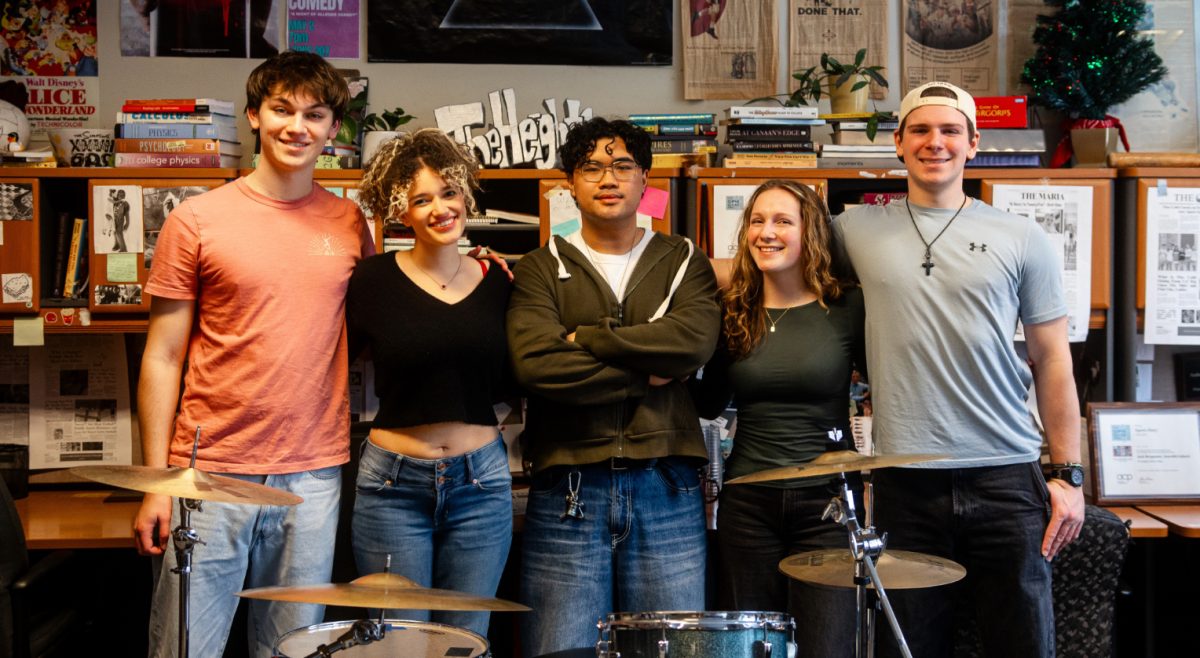

Maximum Utility is the latest band to appear on Live From The Newsroom, presented by Music Go Round Boston: a live performance show in which The Heights’ office is the backdrop for short sets from some of the most talented musicians on campus.
The band is rooted in the members’ high school experience in Lexington, Mass., where they began sporadically jamming together during lunch breaks. The name was even inspired by an economics class a couple of the bandmates took together as Lexington High School students.
Founding member Aidan Courduvelis encouraged the group to keep playing together, and, over time, a unified band began to take shape—one that now tackles the college music scene.
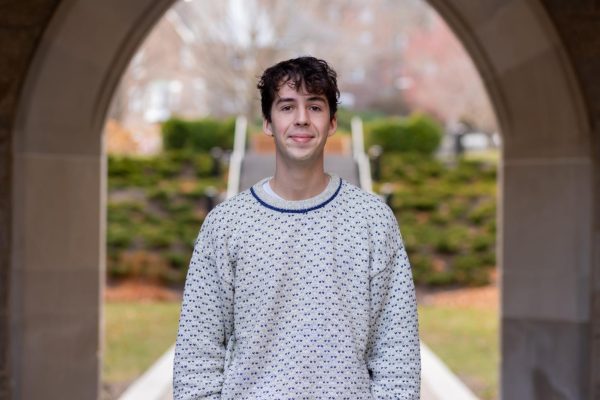
Maximum Utility is made up of hometown friends guitarist/vocalist Courduvelis, guitarist/vocalist Tobin Ting, MCAS ’27, and drummer Cuyler Kahan. Also playing with the band at the moment is bassist Jose Builes Lemus, Messina ’26.
Despite its current, compelling indie pop-rock sound, Maximum Utility was initially formed under a different name and with different musical intentions.
“We were originally a Beatles cover band,” said Ting. “That was our start.”
In a classic coming-of-age moment, the band—which was then called The Lexington—had its first gig at the high school talent show, performing The Beatles’ “Can’t Buy Me Love.”
When heading into college, however, Maximum Utility’s members were bound for different Massachusetts universities: Boston College, Boston University, and UMass Amherst. For a lot of bands, that might’ve been the end of things. But, spurred on by the desire to release some original songs they wrote in high school, Maximum Utility was able to maintain musical activity.
“The desire to finish up those projects and get the originals out kind of kept us cooking,” said Ting. “And then we started on an album. It was like one project followed another.”
Despite its members attending different schools, Maximum Utility has existed primarily as a BC band. It has been heavily involved with the University’s music community, playing gigs both on and off campus. Kahan, who is a junior at BU, noted the difference between the two schools’ music scenes.
“If you’re not a part of the College of Fine Arts community at BU, it can be hard to get in with a band, play music, and have a space to practice,” said Kahan. “I think BC has a better environment … no matter what your major is, what you’re studying, you can still express yourself through music.”
Maximum Utility emphasized how the University’s support of clubs like the Music Guild is invaluable in creating the musical infrastructure necessary for student bands to thrive.
“The fact that there are spaces on [BC’s] campus for people to practice, spaces for them to perform, and it’s all very well organized and thought out—I think it’s great,” said Kahan.
Perchance The Band, who featured on Live From The Newsroom in February, echoed this sentiment in its interview with The Heights.
Unsurprisingly, attending different universities and managing individual academic commitments make it exceedingly difficult for the band to get together regularly.
“It’s so difficult to maintain this level of activity as a band with these circumstances,” said Ting. “I think it really shows how dedicated we are. The stars have to align in a certain way to have us all together.”
But circumstance hasn’t stunted Maximum Utility’s musical output: the band’s 2025 album I Have To Admit has 12 songs and a 40-minute run time.
As a young band with a significant catalog of music, the setlists for the band’s live performances are almost exclusively original songs. Maximum Utility noted this as difficult at times—when people aren’t familiar with the music—but incredibly rewarding when they do know the songs.
“I think it’s the coolest thing, when people are singing along to the songs we wrote,” said Kahan.
The band’s 2024 single “Kill That Girl” has over 16,000 streams on Spotify, making it a frequent crowd favourite. It is just one example of the band’s songwriting successes, which are essentially a team effort, explained Kahan.
“One person will take the lead on a song, but everyone’s going to work with them to make sure that the song is as good as it can be,” said Kahan. “No song is going to be completely finished before all of us look at it.”
Maintaining friendships from high school through college is a difficult task in itself. And doing so while also being bandmates and managing the nightmarish logistics that come with each member attending a different university is something of a miracle.
“We’re still friends—we still make music the same way that we did when we were in high school together,” said Kahan. “There’s something really valuable about having a long-term friendship like that, and I think—from where we were five years ago to where we are now—being closer as a band really does help make better music.”