
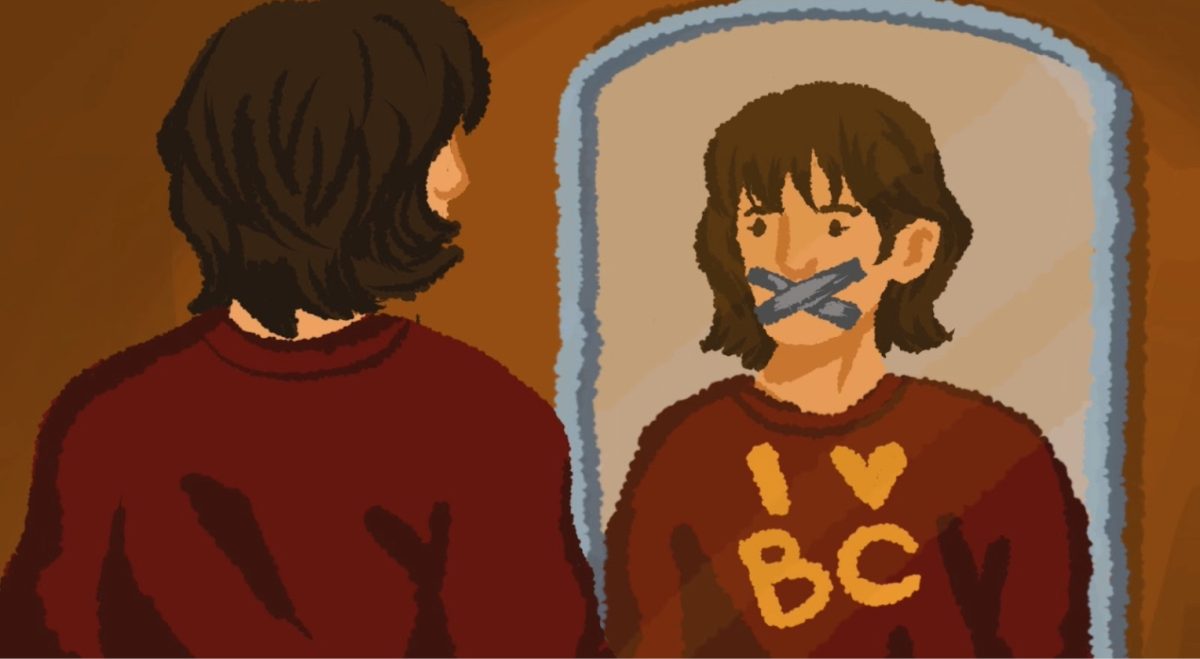
Caring is dying at Boston College, and nobody plans to attend the funeral.
When writing the First-Year Experience column, I have done my best to keep things positive. I’ve written quaintly about public transit and unexpected friendships. I have desperately tried to see the best in this institution, but the illusion has finally shattered.
The rose-tinted version of reality that BC feeds us is far from the truth: We have all been bait-and-switched out of the education we deserve.
I can’t help but be angry—aren’t you, too?
I thought college would be a beautiful mosaic of new experiences. Indeed, that’s what this institution promised us, and that’s why I chose to attend.
BC boasts about its “men and women for and with others.” President Leahy’s statement touts its promotion of “concern for all of the human family.” Thus, I expected my college experience to be a vibrant forum for debate, motivated by shared compassion for those around the globe. I thought students would be eager to discuss global, social, and political issues.
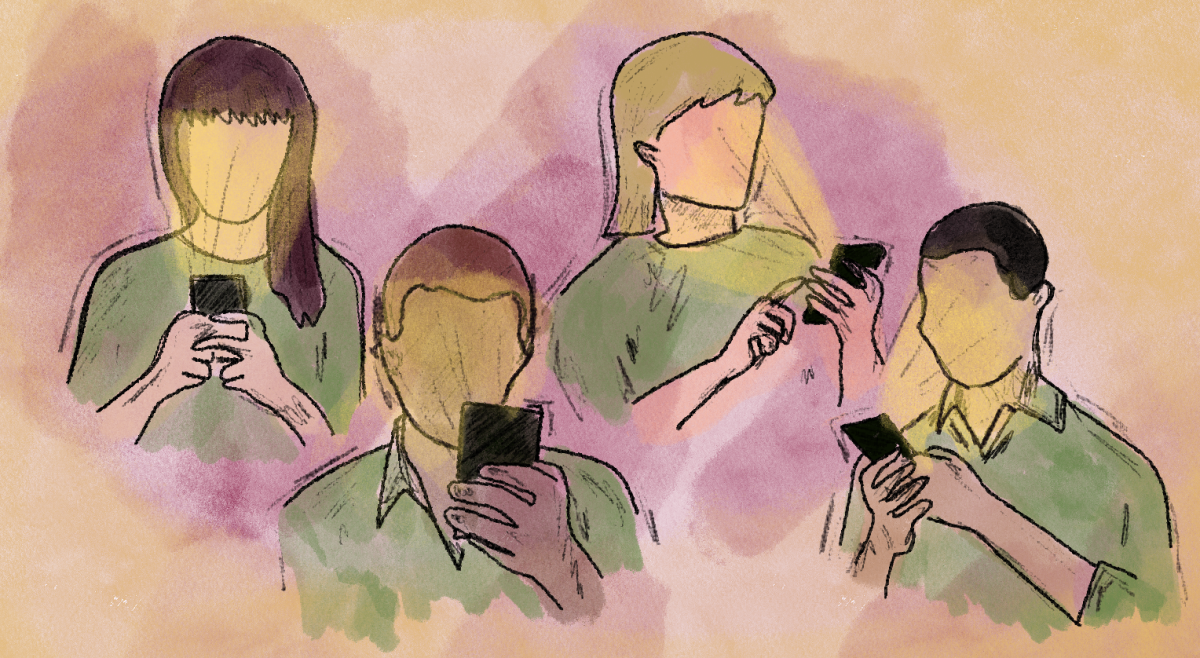
Instead, I discovered a culture of silence.
The “BC Bubble” seems to prevent most students from caring about anything that does not threaten them. After all, we are a primarily white, affluent campus. We are peacefully secluded from the bustling city, cushioned by picket fence suburbia. It often feels like comfortable topics—the next football game, an upcoming exam, your latest Aritzia purchase, the bland Mac dinner—overshadow real-world stakes.
The problem is that this silence doesn’t mean peace. Under the picturesque surface, something is wrong. Ignoring racism, abuse, extremism, and other global crises doesn’t make them go away. Instead, it creates empty spaces that violence is all too eager to colonize.
Trespassers violate our campus, threatening Black students with slurs and hate. ICE intimidates our classmates and friends. Our representatives refuse to condemn them. Student groups who purport to value dialogue are hosting speakers who forgo exactly that in favor of belligerence and inflammation. BC has been flagged as the seventh-worst university in the nation for free speech. Meanwhile, our administration stands idly by as our campus grows increasingly white and continues to skirt its underservice of queer students.
Hate and fear metastasize through campus, while business as usual continues. As a first-year student, this dichotomy has me disgusted and disillusioned.
When the damning report about our free-speech ranking came out, I was gutted. Disappointment and outrage burned in my throat as I sat in my chemistry lecture. Yet, when I brought it up to my peers, the few who actually knew shrugged it off with a joke. I felt like asking, “Am I the only one seeing this?”
No one warned me that it’s taboo to care about immigration, genocide, or queer rights at BC. No one warned me that conformism hangs thick in the air of these so-called sacred halls.
This isn’t just a burden to those directly targeted—it deprives every one of us. Even if you aren’t fearing deportation, hiding your LGBTQ+ identity in a theology paper, or getting called slurs outside of Saint Mary’s, BC’s culture of conformity hurts you, too.
When we graduate, we’ll likely live in a city, not a gated campus, where the realities of injustice will be harder to ignore. If that feels distant right now, it won’t for long.
We’ll work jobs where we can’t handpick social circles that agree with us, look like us, or live like us. Amid these new circumstances, we’ll be faced with a pressing question: What should I do with my life to make it worth living?
Answering this means planning a future in the “real world” with its social, political, and economic problems, which we can’t do if we never talk about these problems in the first place. It also means figuring out what matters to us, what issues and questions pull our attention. We can’t identify those issues if we hold them at arm’s length or look the other way.
Most of all, to build lives that feel true to who we are, we need a sense of what we stand for and value. Unless others test them, our viewpoints and convictions can never expand or sharpen. In short, when we can’t engage in dialogue about real-world issues and injustices, we can’t develop a sense of direction, motivation, or self-criticism.
If college isn’t pushing us to broaden our understanding of people and power, it’s not preparing us for meaningful lives, but insulating us from them.
If we’re only here to post charming sunset photos of Gasson Hall or be disappointed by football, maybe we’re in the right place. But I know we’re worth more than that. If we want to “set the world aflame,” we deserve real, open discourse.
Thus, regardless of your identity or political views, this university fails to meet its promise. BC’s atmosphere of apathy, conformity, and silence is hurting all of us. We deserve better, we need better, and we were promised better.
Those of us affected by these incidents are silent by force. Speaking up threatens our safety and well-being.
But for those unaffected, silence is a choice. It is a choice I empathize with—confronting touchy issues carries anxiety and shame. It’s all too easy to say, “Yeah, it sucks, but it is what it is,” and move on. At the same time, I know you can do better. Your friends and classmates are scared. Now isn’t the time for staying in your comfort zone.
So what can we do? We can talk. We can talk to teammates, friends, roommates, and classmates. We can talk even when it’s sensitive or scary or tiring or unfamiliar. The places we should be filling with lively discussion—dinner tables, dorm lounges—remain silent. Let’s fix that. The administration might take 80 days to approve a protest, but they don’t have to approve a conversation with a classmate, or you sending this article to a friend and asking for their thoughts.
We can also listen. When a classmate describes an unfamiliar experience in a class discussion or voices an opinion you dislike, you don’t have to tune it out. Instead, you can ask questions and reflect. When a marginalized student dares to speak up, you can give them your attention and ask honest questions. Just because someone else’s words don’t resonate with you directly doesn’t mean you should toss them aside.
You can be angry. For your own sake. For the fact that you’re being denied the chance to grow and discover yourself. For your undocumented or international classmates who walk on eggshells daily. For your classmates of color who bear the weight of constant alienation. For your queer classmates, whose university continues to treat their existence as sinful. I don’t mean the hot, stinging anger that shuts down conversation. I mean the quiet, deeper kind of anger that makes you resolve to act, to care, to speak, to listen.
When I put on my BC sweatshirt, it’s not because I’m proud to represent this institution. It’s because now that I’m here, I want to make it better. Next time you reach for your BC merchandise, ask yourself if our school’s silence makes you proud. If not, let’s demand better.
Through speaking, listening, and caring, we can fight for the BC we deserve. Caring isn’t dead yet—not if we refuse to bury it.



Abdul Ashir-Ibn • Feb 9, 2026 at 8:45 pm
What student is fearing deportation at BC???
Head down Comm Ave to bu, they’d be more into your leftwing rubbish
Lex (Author) • Feb 12, 2026 at 12:02 am
Some of my peers here at The Heights have excellent coverage on the uncertainty for international students caused by visa revocations and other policy issues. I recommend the articles entitled “BC Reaffirms Support for International Community Amid Trump Visa Revocations” and “Housing, Immigration Concerns Complicate Breaks for International Students”. More broadly, BC has also acknowledged the possibility of its students being undocumented. Many students also may have family members or loved ones at risk. Hope that helps!
Gianna • Jan 15, 2026 at 1:44 pm
Beautifully written
Jack • Jan 15, 2026 at 1:12 pm
I think this argument bites off more than it can chew… this is insanely anecdotal, is there any concrete indicator like event attendance or surveys to actually support your claim? My experience is that I know many students and faculty directly involved in not just activism but real, progressive research initiatives. You say “students don’t talk” but jump to stating “hate metastasizes” here without walking through any mechanisms as to how?? You’ve got a big casual claim without a matching casual argument here. My advice for BC students searching for more is to simply reach out to the groups that are already doing the work.
Lex (Author) • Jan 15, 2026 at 5:47 pm
Hey Jack,
Thanks for engaging thoughtfully. I take feedback like this seriously, and I’m glad you raised these questions. This is the kind of open dialogue I advocate for.
Regarding my work’s focus on anecdotal evidence: As a columnist for first-year experience, I’m making a cultural argument, not a statistical one, with an emphasis on relatable storytelling. This phenomenon *is* very well-documented in other student’s writing; cultural claims often emerge first narratively before they’re captured statistically. As you referenced in your own comment, sometimes “my experience” is all we have.
That said, my key claim about silence and poor freedom of speech at BC is far from anecdotal. Outlining all of this evidence would be impossible to do with the requisite brevity, so let me offer a few highlights.
As per the latest FIRE rankings, which I briefly reference, we’re ranked 253/257 for comfort expressing ideas, 234/257 for self-censorship, and 229/257 for openness. 59% of students feel very/somewhat uncomfortable expressing views on touchy subjects among other students in common areas–even more online or in class. 67% of students self-censor among other students occasionally or more, with similar portions self-censoring in class. Majorities or significant (40-50%) pluralities of students feel unable to express opinions on controversial subjects on at *least* an occasional basis for fears of others’ responses. That climate has tangible consequences, some of which I describe in the article itself (see ninth paragraph).
I don’t doubt that there are students and faculty doing meaningful work. Many of them are friends of mine. But the existence of engaged sub-communities doesn’t negate a broader campus climate where many students feel unable or unwilling to speak. My argument isn’t that activism doesn’t exist, but that it’s siloed rather than normalized.
The mechanism that leads from silence to hate is well-documented. I attempted to summarize it briefly via the statement that “Ignoring racism, abuse, extremism, and other global crises doesn’t make them go away. Instead, it creates empty spaces that violence is all too eager to colonize.” The link between suppressed discourse and polarization is well-documented. Suppression of free speech disengages moderate voices, allowing extremes to dominate. Collapse of discussion erodes empathy. When grievances lack nonviolent outlets, social trust breaks down. I gestured at this mechanism briefly due to space constraints, not because it lacks grounding. If any of this isn’t clear, I’m happy to discuss further.
Regarding your advice to “reach out to the groups that are already doing the work” – I couldn’t agree more. Downstream of talking about political issues is acting on them, as I call students to do at the end of my piece. This is the exact form of political involvement I’m advocating for, so I’m pleased to see we share some common ground.
Thanks for your comment, Jack. I hope I was able to clear some things up.
Conor • Jan 15, 2026 at 12:50 pm
Great Column
Sarah • Jan 15, 2026 at 10:13 am
well said👏
Lex (Author) • Jan 15, 2026 at 11:44 am
thank you!